May 05, 2017

Trump’s Indonesian Allies in Bed With ISIS-Backed FPI Militia Seek to Oust Elected President Jokowi


With an introduction by Peter Dale Scott

April 27, 2017
Volume 15 | Issue 9 | Number6
Introduction
The following important essay, by the respected and reliable journalist Allan Nairn, reports what Indonesian generals and others have told him of an army-backed movement to overthrow Indonesia’s civilian-led moderate constitutional government. Its thesis is alarming: that “Associates of Donald Trump in Indonesia have joined army officers and a vigilante street movement linked to ISIS in a campaign that ultimately aims to oust the country’s president… Joko Widodo (known more commonly as Jokowi).”
More recently a New York Times editorial, pointing to the electoral defeat on April 19 of Jakarta’s incumbent Christian governor, Basuki Tjahaja Purnama (or Ahok), has also expressed concern about the fate of Indonesia’s fragile democracy.1 But the threat perceived by the Times is that from “hard line Islamic groups” (many of them Saudi-funded), not that from the leaders (often U.S.-trained and financed) of the Indonesian army. The editorial reflects the fear of many scholars that traditional Indonesian Islam, relatively tolerant but unable to compete with Saudi wealth, may lose out to well-funded Salafi extremism. (Last October Margaret Scott warned in the New York Review of Books that it was “far-fetched” to think that Indonesia’s Islamic moderates “can stop Salafi recruitment, much less ISIS recruitment.”2)
Important in both narratives are the massive recent protests in Jakarta by Islamist thugs (preman) of the Islamic Defenders Front or FPI (Front Pembela Islam) that led to Ahok’s defeat.
The FPI was founded in 1998 with military and police backing, and at first served as the army’s proxy to beat up left-wing protesters at a time of transition in Indonesian politics.3 1998 was a key year: with the retirement of Suharto, the end of over three decades of “New Order” army dictatorship, and reforms (reformasi) that led to the army’s surrender of its domestic security function to a newly created civilian police force.
To others, the army’s connection to the FPI is less clear now than it was in 1998. At that time the connection was reminiscent of the army’s use, in its 1965 suppression of the Communist PKI, of paramilitary preman or thugs from its creation, the Pemuda Pancasila (Pancasila Youth). Eventually the FPI, initially financed by Police General Sutanto, began to be supported by funds from Saudi Arabia.4 As the FPI expanded, its makeup and policies became more diverse.
According to Nairn, the army still prevails:
In repeated, detailed conversations with me, the key protest figures and officials who track them have dismissed the movement against Ahok and the charges against him as a mere pretext for a larger objective: sidelining the country’s president, Jokowi, and helping the army avoid consequences for its mass killings of civilians — such as the 1965 massacres that were endorsed by the U.S. government, which armed and backed the Indonesian military.
Allan Nairn has been following and exposing the brutalities of the Indonesian Army (TNI) for decades. He has also been remarkably successful in gaining access to key figures, notably former General Prabowo Subianto, “a US trainee and protege … implicated in torture, kidnap and mass murder.”5 Prabowo in particular is a poster boy for America’s duplicitous policies in Indonesia. Congress cut off funds for training his Kopassus shock troops in 1991, after they murdered up to 270 protesters, including schoolchildren, at a peaceful demonstration in East Timor. But the Pentagon, undeterred, secretly continued the training under a Pentagon project called JCET (Joint Combined Education and Training).6
As Commander of the Army Strategic Reserve Command, KOSTRAD, Prabowo repressed the bloody 1998 Jakarta riots that led to the resignation of his then father-in-law Suharto. Prabowo was subsequently discharged from the TNI, after he acknowledged responsibility for the kidnapping of thirteen activists who “disappeared.”7 He then became a multibillionaire businessman, but also sought a political career. With the support of two pro-military parties he contested the 2014 election, losing narrowly in a runoff to the civilian populist Jokowi.
Underlying Nairn’s latest story is the desire of Prabowo, the TNI generals and their parties, to preserve what they can of their former privileges, in a new age of Reformasi as civilians like Jokowi nudge Indonesia slowly towards a more egalitarian future. Nairn’s chief source, Gen. Kivlan Zen, is a Prabowo ally and associate from KOSTRAD. Kivlan in turn points to the central role in the alleged “coup” plan of Prabowo’s 2014 campaign manager Fadli Zon, who as Nairn reports “is known for publicly praising Donald Trump and appeared with the candidate at a press conference at Trump Tower during the opening days of the [Trump] presidential campaign.”8
Given Nairn’s sterling press record, we can be confident that he has accurately reported what Kivlan and Admiral Ponto and others told him. What we can ask is the reason for their apparent candor: is it simply to reveal truth, or is it rather to restore the threatening image that the generals long used to maintain their influence? (As someone who has never been to Indonesia, I cannot say, but my main Indonesian source advises me not to trust Kivlan Zein “when he says anything.”)
It does seem clear that the Prabowo faction have reached out to Trump and taken heart from Trump’s election. Prabowo himself has boasted to Nairn about his excellent connections with the DIA, the Defense Intelligence Agency that was once headed by Trump’s now disgraced former National Security Adviser Michael Flynn.9 And it is indeed telling that Fadli Zon, Prabowo’s contact with Trump, has been an active defender of the FPI and appeared with their leader in the FPI-led anti-Ahok demonstrations.
Americans should also be concerned that the Freeport-McMoRan Mining Company has engaged as attorney Munarman, an FPI spokesperson and former Commander of the FPI’s paramilitary group Laskar Islam. Historically Freeport has not been friendly to democracy in Indonesia. A declassified U.S. State Department cable reveals that by April 1965 (when Sukarno was still in power) Freeport Sulphur had reached a preliminary “arrangement” with unnamed Indonesian officials for what would become a multi-billion dollar investment in West Papua.10 Today Freeport is currently in a dispute with the Jokowi government, and reportedly may be “on the verge of losing what is arguably its most important asset, as Indonesia prepares to strip ownership from it of the massive Grasberg copper and gold mine.”11
Indonesia’s democracy is fragile, and its constitution will continue to be challenged by both generals and Islamists with foreign backing. But the complexity of Indonesia’s pluralist society, which makes it difficult for democracy to function smoothly, also makes it difficult to overthrow it. So many conflicting forces are at work. As Nairn points out, Jokowi’s military defender, Gen. A.M. Hendropriyono, (former BIN chief and CIA asset), has also been implicated in major crimes.
We should not forget that in 2014 Allen Nairn posted a warning similar to his present one, that Indonesia's army special forces (Kopassus) and the state intelligence agency (BIN) are involved in a covert operation … designed to ensure that the July 9 [2014] vote count will be won by General Prabowo Subianto, the former Kopassus commander who was a longtime protege of the Pentagon and US intelligence.12
Nairn’s warning then was well documented. But Jokowi won.
We in America should pursue what Nairn’s current essay has to tell us about Trump’s global alliance in Indonesia. Elsewhere he has reminded us that after the 9/11 attacks in 2001 there were actually presented, at the White House and at Camp David, proposals for a US Special Forces attack on Indonesia. The idea was for a dramatic strike to send a message to the Muslim world. It would involve simultaneous moves against Indonesia and other countries.13
No such attack was launched. But if such ideas could be discussed in the presence of George W. Bush, what may not be contemplated in Donald Trump’s call to fight “Islamic terrorism all over the world”?
Peter Dale Scott

In Indonesia, a Trump-Army-pro-Isis Alliance?

Allan Nairn
Associates of Donald Trump in Indonesia have joined army officers and a vigilante street movement linked to ISIS in a campaign that ultimately aims to oust the country’s president. According to Indonesian military and intelligence officials and senior figures involved in what they call “the coup,” the move against President Joko Widodo (known more commonly as Jokowi), a popular elected civilian, is being impelled from behind the scenes by active and retired generals.
Prominent supporters of the coup movement include Fadli Zon, vice speaker of the Indonesian House of Representatives and Donald Trump’s main political booster in the country; and Hary Tanoe, Trump’s primary Indonesian business partner, who is building two Trump resorts, one in Bali and one outside Jakarta.
This account of the movement to overthrow President Jokowi is based on dozens of interviews and is supplemented by internal army, police, and intelligence documents I obtained or viewed in Indonesia, as well as by NSA intercepts obtained by NSA whistleblower Edward Snowden. Many sources on both sides of the coup spoke on condition of anonymity. Two of them expressed apparently well-founded concerns about their safety.

The Coup Movement

On the surface, the massive street protests surrounding the April 19 gubernatorial election have arisen from opposition to Jakarta’s ethnic Chinese incumbent governor, Basuki Tjahaja Purnama, known as Ahok. As a result of pressure from the well-funded, well-organized demonstrations that have drawn hundreds of thousands — perhaps millions — to Jakarta’s streets, Gov. Ahok is currently standing trial for religious blasphemy because of an offhand comment about a verse in the Quran. On Thursday, the day after he hears the results of the very close governor’s election, he is due back in court for his blasphemy trial.
Indonesian President Joko Widodo at the Merdeka Palace in Jakarta on March 27, 2017.

Yet in repeated, detailed conversations with me, key protest figures and officials who track them have dismissed the movement against Ahok and the charges against him as a mere pretext for a larger objective: sidelining the country’s president, Jokowi, and helping the army avoid consequences for its mass killings of civilians — such as the 1965 massacres that were endorsed by the U.S. government, which armed and backed the Indonesian military.
Serving as the main face and public voice of the generals’ political thrust has been a group of what Indonesians call preman — officially sponsored street thugs — in this case, the Islamic Defenders Front, or FPI (Front Pembela Islam). Originally established by the security forces — the aparat — in 1998 as an Islamist front group to assault dissidents, the FPI has been implicated in violent extortion, especially of bars and sex clubs, as well as murders and attacks on mosques and churches. During the mass protests against the governor, FPI leader Habib Rizieq Shihab has openly called for Ahok to be “hanged” and “butchered.”
FPI leader Habib Rizieq Shihab openly called for Ahok to be “hanged” and “butchered.”

Joining Rizieq at the protests atop a mobile command platform have been the FPI’s spokesman and militia chief, Munarman, as well as Fadli Zon, who is known for publicly praising Donald Trump and appeared with the candidate at a press conference at Trump Tower during the opening days of the presidential campaign. Fadli Zon serves as the right-hand man of the country’s most notorious mass-murdering general, Prabowo Subianto, who was defeated by Jokowi in the 2014 election.
Munarman, who has been videotaped at a ceremony in which a roomful of young men swear allegiance to ISIS and its leader, Abu Bakr al-Baghdadi, is also a corporate lawyer working for the Indonesian branch of the mining colossus Freeport McMoRan, now controlled by Carl Icahn, President Trump’s friend and deregulation adviser. Although the Trump connections appear to be very important for the coup plotters, it is unknown whether Trump or Icahn have any direct knowledge of the Indonesian coup movement.
FPI spokesman and corporate lawyer Munarman, indicated with an arrow far left, at a ceremony in which young men swear allegiance to ISIS

Munarman did not respond to requests to comment for this article.
The FPI demonstrations in Jakarta, officially shunned by the country’s top mainstream Muslim groups, have been endorsed in messages from Indonesian ISIS personnel in Syria. The FPI, for its part, has waved black ISIS flags at Prabowo rallies and has officially endorsed the call of Al Qaeda chief Ayman al-Zawahri for Al Qaeda and ISIS to pursue their common fight in Iraq, Syria, and elsewhere.
The Snowden archive contains numerous documents related to the Islamic Defenders Front, including an Australian intelligence document describing FPI as a “violent extremist group.” The documents include Indonesian-language intercepts of reports by police officials complaining that the Indonesian public distrusts the police because it uses violent groups like FPI. The intercepted Indonesian police reports also note that although FPI is largely a creation of the state security apparatus, it at times escapes the state’s control, particularly when fomenting mob violence, such as in a well-known case in which a man was beaten to death on videotape because he attended a mosque targeted for extermination by the FPI. In one case of murder carried out by an FPI mob, a memo states, police were unable to arrest and detain the FPI suspects because they were afraid the mob would attack and burn the police station.
Another intercept links FPI figures to an offshoot of Jemaah Islamiyah, the jihadist network implicated in the 2002 Bali bombings, and details weapons training delivered by officers of the Indonesian national police special forces to FPI Aceh members.
The NSA had no comment on the content of the intercepts. The White House did not respond to requests for comment.
Islamic Defense Front headquarters in Jakarta, where a portrait of Osama bin Laden hangs on the wall in 2007. 

As the FPI’s mass protest movement has proceeded over the last six months, I received detailed information from five Indonesian internal intelligence reports. The reports were assembled by three different Indonesian agencies. Each one was confirmed by at least two current army, intelligence, or palace officials.
One intelligence report asserted that the FPI-led protest movement was being funded in part by Tommy Suharto — son of the former dictator Suharto — who once served time for having a judge who displeased him shot in the head. Tommy’s financial contributions were also affirmed to me by retired Gen. Kivlan Zein. Kivlan, who helped the FPI lead a massive November protest in Jakarta, is currently facing the charge of treason (makar) for allegedly trying to overthrow the government during the recent protest drive. He is also the former campaign chair for Gen. Prabowo, who was defeated by President Jokowi in the 2014 presidential election.
Another report asserted that some funds came from Donald Trump’s billionaire business partner Hary Tanoe, who was repeatedly described to me by key movement figures as being among their most important supporters. Last Friday night, when I sat down with a roomful of such figures — none of whom requested anonymity — they expressed excitement about their closeness to Hary and his personal and financial relationship with President Trump, who along with his son Eric welcomed Hary to Trump Tower and the inauguration. They said they hoped Hary, who is building two Trump resorts in Indonesia, would serve as a bridge between Trump and Gen. Prabowo. Manimbang Kahariady, an executive of Prabowo’s political party, said he had met with Hary three days before. He and others at the meeting were convinced that Hary is telling Trump about the need to back the movement and remove their adversaries, beginning with Ahok.
Tommy Suharto could not be reached for comment. Hary Tanoe declined repeated requests for comment.
A third report asserted that some FPI movement funds came from former president and retired general Susilo Bambang Yudhoyono (SBY) — information that apparently angered President Jokowi, was leaked to the public, and was in turn denied publicly by an angry SBY who asserted at once that the facts were false and that the government had tapped his phone to get them. Nonetheless, seven current or former army or intelligence officials I spoke to said that SBY had indeed given funds but had channeled them indirectly. One official, retired Adm. Soleman Ponto, who is not a supporter of the coup movement, is the former chief of military intelligence (BAIS) and currently advises the state intelligence agency (BIN). Though he declined to comment directly when I asked him about specific intelligence reports, Soleman said that it was “very clear” that SBY, whom he called a friend, helped fund the movement, “giving through a mosque, giving through a school, SBY is the source.”
More broadly, Ponto said, “almost all the retired military” and “some current military back SBY” in supporting the FPI-led protests and the coup movement. He said he knows this because — in addition to his being an intelligence man — the pro-coup generals are his colleagues and friends, many of whom correspond on the WhatsApp group known as The Old Soldier. The admiral said that for the movement’s military sponsors, the Ahok issue is a mere entry point, a religious hook to draw in the masses, but “Jokowi is their final destination.”
As for the tactic of a straight army assault on the palace in a coup d’etat, Ponto said that would not happen. This one would be “a coup d’etat by law,” resembling in one sense the uprising that toppled Suharto in 1998, except that in this case the public would not be on the revolt’s side — and the army, rather than defending the president, would be working to bring him down. The FPI-led protestors, he said, would enter the palace and congress grounds, then try to get inside and set up camp until someone made them leave.
Thousands of members of the hard-line Islamic Defenders Front take part in a protest in Jakarta, Indonesia, on Oct. 14, 2016, to show their disapproval of Gov. Basuki Tjahaja Purnama, better known as Ahok, who has been charged with anti-Islamic blasphemy.

“It would look like People Power” — the people gathered by FPI and their allies, but in this case, “with everything paid. The military would just do nothing. They only have to go to sleep” and let the president fall.
The admiral’s description of the movement’s strategy matched that of a dozen top officials I spoke to, some of them still active in the aparat — some for the coup, some against it.
Another possible scenario was described by another large group of officials: that the FPI-led rallies would get out of hand, with Jakarta and other cities tumbling into chaos, and the army stepping in and assuming control to save the state. This second, more violent option was discussed in detail when I met in late February, on the record, with FPI movement leaders Ustad Muhammad Khattath and Haji Usamah Hisyam.
Ustad Khattath had been referred to me by the Freeport lawyer and FPI militia chief Munarman, who had declined to see me. Haji Usamah accompanied Ustad Khattath and they gave a joint interview.
(The material in this section is attributed to “they” and presented without quotation marks, because since our interview, Ustad Khattath has been arrested and charged with makar (treason), a legal concept that I view as being unjust and repressive and have denounced when it has been used before.)
Barely mentioning religious questions, they said Indonesia’s problem was New-Style Communism, and the army must be able to step in and guide the situation because Indonesia is not mature, not ready for democracy. Jokowi, they charged, was providing a space for communism, and the only strong organization that can face up to that is the army.
As to their street protest movement, they said, we civilians must be backed by the military, something they said was indeed happening secretly because now under reformasi the military can’t engage in politics. According to Haji Usamah, “It’s an intelligence operation by military personnel, but the army can’t be out front. They give the strategic view and direction. The army doesn’t like the communists.”
They said there are communists in the legislature and the executive branch. They must be targeted. For the street movement, the key strategic and tactical guidance was given to them by an anti-communist general who works with them. The army can only step in if there is chaos. If there is peace, they can’t do anything.
Ustad Khattath and Pak Usamah told me that they don’t want blood, they want peaceful revolution, but also insisted that not long from now there will be a revolution by the umaat, several weeks in the future. The palace is afraid, they said, they are afraid Jokowi will fall. They said the upcoming street actions would all be with revolutionary steps because peace has not yet brought down Ahok.
Ustad Khattath and Pak Usamah told me that if the president does not accede to their demands, there will be more massive action, using a stronger style of pressure, and added that their direct destination will be the president.
They saw the revolution beginning with days-long occupations of the congress and the palace and noted that if the people are hurt by being rebuffed, they will take the shortcut outside the law. Anything could happen. There could be millions that take the law into their own hands. Their position was, remind the president not to break the law by failing to jail Ahok or the people will get mad and out of control. It’s a disorderly situation, one that they felt would resolve itself by the army stepping in.
After Ustad Khattath was arrested by police and charged with treason, Usamah texted me to say he had now taken command of the street actions, just as Ustad Khattath had done after FPI leader Rizieq was brought up on pornography and other charges.

An alleged dissident questioned under gunpoint by Indonesian soldiers in 1965.

1965 Again

Soon after our interview, I received an army document from an officer inside the aparat that could be seen as providing the template for Khattath’s and Usamah’s remarks about the street actions.
Titled “Analyzing the Threats Posed by the New-Style Communism in Indonesia,” it is a series of PowerPoint slides used for ideological training at army bases nationwide.
New-Style Communism, or Komunisme Gaya Baru, abbreviated “KGB,” is a concept whose menace is framed with sketches of Stalin, Pol Pot, and Hitler — and appears to be broadly enough defined to include any critic of the army anywhere.
Referring to such purportedly communist policies as “free health care and education programs,” the document denounces “idealizing pluralism and diversity in the social system” as a specific “KGB” threat now rising in Indonesia. Using threat assessment techniques drawn from Western intelligence doctrine and texts — excerpts from which are used, sometimes in English — the document warns of the communist enemy “separating the army from people” and “using human rights and democracy issues while positioning oneself as victim to gain sympathy.”
See all slides here.
The statement about human rights victims is an apparent reference to figures such as the brilliant social justice advocate Munir Said Thalib, my friend, who was assassinated in 2004 with a massive dose of arsenic that caused him to vomit to death on a flight to Amsterdam, or the victims of the 1965 slaughter of perhaps a million civilians, carried out by the army with U.S. backing in order to consolidate power after an attempted coup.Analyzing the Threats Posed by New Style Communism in Indonesia30 pages
The 1965 massacre came up when I sat down with retired Gen. Kivlan Zein, who said that if Jokowi refused to accede to the army’s wishes, similar tactics could be deployed again.
Like many officials I spoke with, Kivlan said that the current army-backed street movement and crisis began as a result of the Symposium, a 2016 forum organized by the Jokowi government that allowed survivors and descendants of ’65 to publicly describe what had happened to them and to discuss how their loved ones died. For much of the army, the Symposium was an intolerable outrage and in itself justified the coup movement. One general told me that what most outraged his colleagues was that “it made the victims feel good.” The Symposium, of course, had nothing to do with Gov. Ahok or with religious questions of any kind. It was about the army and its crimes.
“If not for the Symposium, there wouldn’t be a movement now,” Kivlan told me. “Now the communists are on the rise again,” Kivlan complained. “They want to establish a new communist party. The victims of ’65, they all blame us. … Maybe we’ll fight them again, like ’65.”
I was taken aback by that and wanted to make sure I had heard correctly.
“It could happen,’65 could be repeated all over again,” he repeated.
And the reason?
“They are seeking redress.”
A visitor walks past a picture of Suharto at the Suharto museum on May 6, 2016, in Yogyakarta, Indonesia.

In other words, Kivlan was raising the specter of new mass slaughter if the old victims did not learn to forget. Kivlan then went on to detail why the ’65 coup was justified. He said that the ousted president, Sukarno, who was by then the army’s virtual captive, had given an order for the army to take over. The army “was handed power” by the congress.
Could that happen again now, I asked?
“It could,” the general said. “The army could move again now, like Suharto in that era.”
The general told me that last July, Jokowi had visited armed forces headquarters in the aftermath of the Symposium and had told the assembled generals that “he was not going to apologize to the PKI [communist party].”
“If Jokowi sticks with that” — the no-apology stance — “he won’t be overthrown. He will save himself. But if he apologizes, [he is] finished, over,” Kivlan said.
I again wanted to be sure he was really saying the army would take action, like ’65 again.
“Yes, it will secure the situation, including like in ’65.”
“No say surrender,” he concluded in English.
Though Kivlan is regarded as being among the more ideological of the generals, it’s worth noting that many of his colleagues have been toying with ousting Jokowi even if he doesn’t apologize. In that sense, Kivlan belongs to the movement’s moderate wing. Remarkably, the idea of a mere apology to the army’s victims is enough to motivate generals to move to overthrow the president.
Kivlan is often credited with helping to create the FPI, after Suharto’s fall. In our conversation he denied to me that he was responsible for setting up the FPI but went on to discuss in detail how the group was just one example of the broader army and police strategy of creating civilian front groups, sometimes Islamist, sometimes not, that could be used to attack dissidents while keeping the aparat’s own hands clean.
He said that days before the massive Jakarta demonstration of November 4 last year, he received a text message from retired Major Gen. Budi Sugiana asking him “to join and take over the 411 [November 4] movement.”
The mission, he said, was “to save Indonesia,” by joining FPI leader Habib Rizieq on the mobile stage at the demonstration, because “they need someone if [Rizieq] is shot and dead to take over the mass” outside the palace.
In December, Kivlan was arrested by the police for trying to overthrow Jokowi, but as we spoke in late February he remained free and had been traveling outside the country. Indeed, he told me he had been carrying out missions for Gen. Gatot Nurmantyo, the current armed forces commander, attempting to release Indonesian hostages held in the Philippines.
On the question of who privately backs the movement and who precisely the “communists” are, Kivlan spoke both on and off the record, and both precisely and generally. His characterization of his fellow generals’ stances meshes closely with what the other aparat people said, but, unlike most of them, he said it on the record.
“So many retired military — and in the military — are with the FPI. … Because the goal of the FPI is also against the communists.”
After his discourse to me about ousting Jokowi and taking actions like ’65, I asked him: Does Gen. Gatot — the current armed forces commander — agree?
“He agrees!”
But he noted that as a younger, still-active officer, Gatot has to “be very careful” in his public stances.
Kivlan’s on-the-record remarks about Gatot’s role are consistent with those of other generals and coup people, as well as with the purported remarks of President Jokowi himself. When I asked an official with regular access to the president about a claim that Jokowi had said that “Gatot is the main factor in the coup,” the official replied, yes, the president said it, privately. Gatot did not respond to requests for comment.
As for his old boss Gen. Prabowo, Kivlan also echoed what others said: “Prabowo doesn’t want to be close, but he does it through Fadli Zon.” If he were openly close to the movement, it would be difficult for him, so Fadli Zon is the front. Regarding Gen. Ryamizard, the current minister of defense, Kivlan claimed that “his heart agrees. He agrees with our goal,” but he can’t “speak candidly.”
Kivlan praised the stance of Gen. Wiranto, saying “Wiranto is good.” Kivlan said Wiranto “wants to build harmony” with the movement, often pressing its case from his current post as coordinating minister for politics, law, and security. It was under Wiranto’s command that the FPI was first created. When Wiranto received the FPI’s Rizieq during the demonstrations, he described him as “an old friend.”
Kivlan added that Wiranto, who is himself under indictment for East Timor war crimes, has a “good plan” on the army’s pivotal issue. He is pressing Jokowi for “no human rights trials.”
The strategic elegance of the army push for a coup is that the army wins even if it loses. Even if Jokowi stays in office, the generals will be safer than ever — they think — from human rights trials, since in order to stave off one group of killers, the president has embraced another group of equally murderous generals who have exacted a price.
Foremost among them is Gen. A.M. Hendropriyono, the former BIN chief and CIA asset, who has been implicated in the Munir assassination and a series of other major crimes. Throughout the coup crisis, it has been Hendro’s men — army, intel, police, civilian — who have been leading the anti-coup defense of Jokowi against their colleagues. It is mainly Hendro’s people who have organized the treason arrests and hobbled Habib Rizieq Shihab with pornography charges, as well as charging movement financiers with ISIS money laundering.
In exchange, Hendro and his allies have received what they view as guarantees of immunity from prosecution. And under prevailing aparatrules, if they’re safe, everyone else is as well, since there’s a tacit agreement to reject prosecution of colleagues, even if they’re bitter enemies.
In February, under palace pressure, a Jakarta administrative court declared that the Jokowi administration could duck its legal obligation to officially release a government fact-finding report that openly addressed Hendro’s responsibility for the Munir assassination. Munir’s widow Suciwati and Haris Azhar of Munir’s human rights group, Kontras, denounced that verdict as “legalizing criminality.”
In similar fashion, the coup movement has also been helpful for Freeport. Since last year, the Jokowi government, after decades of state quiescence, has been trying to rewrite the state contract with Freeport and has been dialing back their export rights. At the same time, the government has been shaken by the movement led in part by a lawyer associated with the company.
In early April, after the movement launched the first of what the police claimed were four planned attempts to seize congress and the palace, the Jokowi administration shocked Indonesia’s political world by unexpectedly giving in to Freeport and green lighting new copper exports. The sudden retreat didn’t end the dispute — deep, long-term contract issues remain — but it suggested, as Jokowi officials later told me, that the government now felt its position had been weakened.
In a story with the droll headline “Freeport gets red-carpet treatment, again,” the pro-U.S. and pro-business English-language Jakarta Post observed: “The government has defended its decision, even though there is no legal basis that backs [it]. … Freeport is seen as having dodged the bullet again.”
On April 20, Vice President Mike Pence is due in Indonesia. Jokowi administration officials have been saying privately that they expect Freeport’s demands to be at the top of his wish list. At the meeting of movement figures last Friday, one of them looked at me and exclaimed: “Pence will threaten Jokowi on Freeport!”
Freeport Indonesia did not respond to requests for comment.
Jakarta’s Gov. Ahok speaks to his lawyers inside the courtroom during his blasphemy trial at the auditorium of the Agriculture Ministry in Jakarta on April 11, 2017.

Blasphemy as Pretext

Although privately movement leaders and their sponsors spoke incessantly of the army, evading justice, and seizing power, on the streets outside the theme was decidedly religious. Walking among the huge crowd at one action at the Istliqlal mosque near the palace, it was clear to me that although the protest movement was fronted by the FPI, it had drawn a wide swath of people, many of whom were demonstrating simply because they were conservative or felt aggrieved.
The proximate cause of that grievance was Ahok and his alleged blasphemy in suggesting that non-Muslims could lead Muslims. (Ahok is also justly criticized for his evictions of the poor.) It was therefore quite illuminating to hear the leaders of the coup movement privately minimize those themes.
Kivlan surprised me when he remarked offhandedly that Ahok had given the movement a “gift” with his “slip of the tongue” regarding the Quran.
The required public stance of movement leaders was to claim to be forever wounded by Ahok’s remark asking people not to be deceived by rivals trying to use a Quranic verse against him. But here was one of them — with a small smile — acknowledging that strategically Ahok’s statement was welcome, because it had enabled the FPI and its sponsors to shift the balance of power inside the state, elevate themselves from street killers to theologians, and alter the cultural climate to boot. And here he was, accepting that the fateful remark was a “slip of the tongue.”
With that, he not only appeared to be conceding that the blasphemy criminal case against Ahok was bogus — as we spoke, Ahok’s lawyers were arguing in court precisely that he had just spoken loosely, intending no offense — but also that the coup movement’s sole big public issue was something that, in private, they did not take seriously.
Beyond that, when I sat with Usamah and the movement leaders whom he half-joking called his politbureau, they casually contradicted their position that non-Muslims cannot lead Muslims. They did so while discussing Hary Tanoe, who they all effusively praised as their movement’s top supporter — through direct aid and by means of his TV stations, which were admonished by Indonesia’s broadcast commission for unseemly pro-movement political bias and inaccuracy — and their perceived lifeline to President Donald Trump.
Those in the room all agreed they wanted a Prabowo-Hary Tanoe government, perhaps with Hary as president and Prabowo as vice president, or the reverse, depending on the polling.
The catch, which didn’t seem to bother them, is that Hary, like Ahok, is an ethnic Chinese Christian, which if they believed in their own standards should disqualify him from leading Jakarta, let alone Indonesia.
Allan Nairn's article was published at The Intercept on April 18th, 2017.

Notes

1Election Tests Indonesian Democracy,” New York Times, April 27, 2017.
2Margaret Scott, “Indonesia: The Saudis Are Coming,” New York Review of Books,” October 27, 2016.
3Peter Chalk, Angel Rabasa, William Rosenau, The Evolving Terrorist Threat to Southeast Asia: A Net Assessment (Santa Monica, CA: RAND, 2009).
4Robert Hefner, “Disintegration or Democratization? Muslim Christian Violence and the Future of Indonesia.” In Olle Tornquist, ed., Political Violence: Indonesia and India in Comparative Perspective (Oslo: Center for Development and the Environment, University of Oslo.) 
6Ed Vulliamy and Antony Barnett, “How US trained butchers of Timor,” Guardian, September 19, 1999.
7The Joint Fact Finding Team set up by the government (comprising military, government and civil society reps) in its October 1998 report on the May riots--including the mass rapes of ethnic Chinese women--recommended that Prabowo's role in the entire process (including a meeting at Kostrad headquarters) that led to the May riots be investigated. 
9Allan Nairn, “Prabowo, Part 2: ‘I was the Americans' fair-haired boy.’ The Nationalist General and the United States,” Allan Nairn Website, July 1, 2014: “Prabowo told me [in 2001] he was ‘Very good friends with DIA (the US Defense Intelligence Agency) back to George Benson.’ Benson spent decades going in and out of Indonesia for US intelligence. Benson worked with elements of ABRI in the CIA-backed covert operation to oust Sukarno, providing US intelligence for the 1958 attack on Padang, West Sumatra. Benson later effectively ran US-ABRI covert operations against Sukarno leading up to Sukarno's toppling amid the mid-1960s US-backed massacres that killed hundreds of thousands of Indonesian civilians.”
10Declassified Documents Quarterly Catalogue, 1982, 002507 (Cable of April 15, 1965, from U.S. Delegation to U.N.). This gives the lie to the public claim that Freeport Sulphur did not initiate negotiations with Indonesians until February 1966 under Suharto (Forbes Wilson, The Conquest of Copper Mountain [New York: Atheneum, 1981], pp. 153-5).
11Rich Duprey, “Indonesia Still Looking to Strip Freeport-McMoRan of World's Largest Gold Mine,” The Motley Fool, April 20. 2017. Cf. Jon Emont, “Foreigners Have Long Mined Indonesia, but Now There’s an Outcry,” New York Times, March 31, 2017, “The government has in recent years passed regulations intended to exert greater control over mine operators. Freeport says those requirements violate the company’s 1991 contract, which lasts until 2021 and which it wants to renew.”
13Allan Nairn, “Prabowo, Part 2: 'I was the Americans' fair-haired boy.' The Nationalist General and the United States,” citing Bob Woodward, Bush at War, (Simon & Schuster, 2002), [90, 217].

Newly released UN “Nazi Holocaust archives” show US & UK colluded with Third Reich to destroy Soviet Union


Washington and London have been reluctant to make the UN war crimes files publicly available


As Victory Day (May 9) approaches in Russia to commemorate the defeat of Hitler’s Nazi army, new United Nations archives from the Second World War-era war crimes commission investigating the Nazi Holocaust have finally been released, amid protests from the US and UK. Why?

The archives “damningly” show state collusion between the US, UK, and the Third Reich. The end goal between their collusion was not to end the Nazi Holocaust, but to defeat Soviet Union.
The parallels between WW2 history, as evidenced in the archive release, and how the US/EU and NATO are working with ISIS and neo-nazi Ukraine in order to destroy Russia, is proof to the point that the more things change, the more they stay the same.
Russia has been, and always will be, the eternal enemy of the western globalist elite.
The perpetuous war against Russia against the backdrop of the historic UN Nazi Holocaust archives, are discussed in a post entitled, “The Deep History of US, Britain’s Never-Ending Cold War On Russia” from the Strategic Culture on-line journal (www.strategic-culture.org).

After decades of delaying, the United Nations finally released archives from the Second World War-era war crimes commission investigating the Nazi Holocaust. The source of those archives on Nazi war crimes were Western governments, including those in exile at the time of the war, such as the Belgian, Polish and Czechoslovakian. The time period covered is 1943-1949. Washington and London had long sought to halt the release. Why?
Notably, the landmark publication of the files last month was given scant Western media coverage. Surprisingly, perhaps, because the story that can be gleaned from the documents tells of a hidden history of the Second World War, namely the systematic collusion between the American and British governments and the Nazi Third Reich.
As a report in Deutsche Welle remarked on the released archives: «The files make clear that [Western] Allied forces knew more about the Nazi concentration camp system before the end of the war than has generally been thought».
This revelation points to more than just «knowledge» among the Western allies of Nazi-era crimes; it points more damningly to state collusion. This would also explain why Washington and London have been reluctant to make the UN war crimes files publicly available.
There has long been a controversial debate among Western nations about why the US and Britain in particular did not do more to bomb the Nazi infrastructure of death camps and railroads. Washington and London have often made the claim that they did know the full extent of the horror being perpetrated by the Nazis until the very end of the war when extermination centers such as at Auschwitz and Treblinka were liberated – by the Soviet Red Army, it should be noted too.


However, what the latest release of UN Holocaust files shows is that Washington and London were indeed well aware of the Nazi Final Solution in which millions of European Jews and Slavic people were being systematically worked to death or exterminated in gas chambers. So the question again is: why did the US and Britain not direct more of their aerial bombing campaign to destroy the Nazi infrastructure?

One possible answer is that these Western allies had a callous disregard for the Nazi victims. Washington and London establishments were themselves accused of harboring antisemitic prejudices, as can be seen from the scandals when both these governments spurned thousands of European Jewish refugees during the Second World War, in effect sending many of them to their deaths under the Nazi regime.
Not excluding the above factor of Western racist insouciance, there is a second more disturbing factor. That the Western governments, or at least powerful sections, were loath to hamper the Nazi war effort against the Soviet Union. Notwithstanding that the Soviet Union was a nominal «ally» of the West for the defeat of Nazi Germany.
This perspective harks to a radically different conception of the Second World War in contrast to that narrated in official Western versions. In this alternative historical account, the rise of the Nazi Third Reich was deliberately fomented by American and British rulers as a bulwark in Europe against the spread of communism. Adolf Hitler’s rabid anti-Semitism was matched only by his detest of Marxism and the Slavic people of the Soviet Union. In the Nazi ideology, they were all «Untermenschen» (subhumans) to be exterminated in a «Final Solution».

So, when Nazi Germany was attacking the Soviet Union and carrying out its Final Solution from June 1941 until late 1944, little wonder then that the US and Britain showed a curious reluctance to commit their military forces fully to open up a Western Front. The Western allies were evidently content to see the Nazi war machine doing what it was originally intended to do: to destroy the primary enemy to Western capitalism as represented by the Soviet Union. This is not to say that all American and British political leaders shared or were even aware of this tacit strategic vision. Leaders like President Franklin Roosevelt and Prime Minister Winston Churchill appeared to be genuinely committed to defeating Nazi Germany. Nevertheless, their individual views must be set against a background of systematic collusion between powerful Western corporate interests and Nazi Germany.
As American author David Talbot documented in his book, The Devil’s Chessboard: Allen Dulles, the CIA and the Rise of America’s Secret Government (2015), there were massive financial links between Wall Street and the Third Reich, going back several years before the outbreak of the Second World War.
Allen Dulles, who worked for the Wall Street law firm Sullivan and Cromwell and who later headed up the American Central Intelligence Agency, was a key player in the linkage between US capital and German industry. American industrial giants, such as Ford, GM, ITT and Du Pont were invested heavily in German industrial counterparts like IG Farben (manufacturer of Zyklon B, the poisonous gas used in the Holocaust), Krupp Steel and Daimler. American capital, as well as British, was thus integrated into the Nazi war machine and the latter’s dependence on the system of slave labor as provided by the Final Solution.


This would explain why the Western allies did so little to disrupt the Nazi infrastructure with their undoubted formidable aerial bombing capacity. Far more damning than mere inertia or indifference owing to racist prejudice towards the Nazi victims, what emerges is that the Americans and British capitalist elite were invested in the Third Reich. Mainly for the purpose of eliminating the Soviet Union and any kind of genuinely socialist global movement. Bombing Nazi infrastructure would have been tantamount to deleting Western assets.
To this end, as the war was drawing to a close and the Soviet Union looked poised to roll up the Third Reich singlehandedly, the Americans and British belatedly stepped up their war efforts from western and southern Europe. The goal was one of salvaging Western assets remaining in the Nazi regime. Allen Dulles, the director of the-soon-to-be-formed American Central Intelligence Agency, extricated top Nazis and their gold looted from Europe in secret surrender deals known as Operation Sunrise. Britain’s military intelligence MI6 was also involved in the clandestine American effort to salvage Nazi assets via ratlines. The bad faith on display to the Soviet «allies» heralded the chill of the ensuing Cold War that immediately followed the Second World War.
Significant and damning testimony of what was going down was given recently in a BBC interview by Ben Ferencz, the most senior surviving US prosecutor from the Nuremberg trials. At age 98, Ferencz was still able to lucidly recall how scores of Nazi war criminals were let off the hook by the American and British authorities. Ferencz cited US General George Patton who remarked just before the final surrender of the Third Reich in early May 1945, as saying: «We’re fighting the wrong enemy». Patton’s candid expression of deeper animosity towards the Soviet Union than towards Nazi Germany was consistent with how the US and British ruling class had been colluding with Hitler’s Third Reich in a geo-strategic war against the Soviet Union and worker-led socialist movements arising across Europe and America.
In other words, the Cold War which the US and Britain embarked on after 1945 was but a continuation of hostile policy towards Moscow that was already underway well before the Second World War erupted in 1939 in the form of a build up of Nazi Germany. For various reasons, it became expedient for the Western powers to liquidate the Nazi war machine, along with the Soviet Union. But as can be seen, the Western assets residing in the Nazi machine were recycled into American and British Cold War posture against the Soviet Union. It is a truly damning legacy that American and British military intelligence agencies were consolidated and financed by Nazi crimes.
The recent release of UN Holocaust files – in spite of American and British prevarication over many years – add more evidence to the historical analysis that these Western powers were deeply complicit in the monumental crimes of the Nazi Third Reich. They knew about these crimes because they had helped facilitate them. And the complicity stemmed from Western hostility towards Russia as a perceived geopolitical rival.


This is not a mere historical academic exercise. Western complicity with Nazi Germany also finds a corollary in the present-day ongoing hostility from Washington, Britain and their NATO allies towards Moscow. The relentless build up of NATO offensive forces around Russia’s borders, the endless Russophobia in Western propagandistic news media, the economic blockade in the form of sanctions based on tenuous claims, are all deeply rooted in history.
The West’s Cold War towards Moscow preceded the Second World War, continued after the defeat of Nazi Germany and persists to this day regardless of the fact that the Soviet Union no longer exists. Why? Because Russia is a perceived rival to Anglo-American capitalist hegemony, as is China or any other emerging power that undermines that desired unipolar hegemony.

American-British collusion with Nazi Germany finds its modern-day manifestation in NATO collusion with the neo-Nazi regime in Ukraine and jihadist terror groups dispatched in proxy wars against Russian interests in Syria and elsewhere. The players may change over time, but the root pathology is American-British capitalism and its hegemonic addiction.

The never-ending Cold War will only end when Anglo-American capitalism is finally defeated and replaced by a genuinely more democratic system.

“Capital in the Twenty-First Century,” Three Years Later By Brad Delong May 4 2017

“Capital in the Twenty-First Century,” Three Years Later


Marshall Steinbaum and Heather Boushey  May 4, 2017
The following is an excerpt from After Piketty: The Agenda for Economics and Inequality, edited by J. Bradford DeLong, Heather Boushey, and Marshall Steinbaum and published by Harvard University Press:

Thomas Piketty’s Capital in the Twenty-First Century, which we will abbreviate to C21, is a surprise best seller of astonishing dimensions.
Its enormous mass audience speaks to the urgency with which so many wish to hear about and participate in the political-economic conversation regarding this Second Gilded Age in which we in the Global North now find ourselves enmeshed.1 C21’s English-language translator, Art Goldhammer, reports in Chapter 1 that there are now 2.2 million copies of the book scattered around the globe in thirty different languages. Those 2.2 million copies will surely have an impact. They ought to shift the spirit of the age into another, different channel: post-Piketty, the public-intellectual debate over inequality, economic policy, and equitable growth ought to focus differently.

Yet there are counterbalancing sociopolitical forces at work. One way to look at Piketty’s project is to note that, for him, the typical low-inequality industrialized economy looks, in many respects, like post–World War II Gaullist France during its Thirty Glorious Years of economic growth, while the typical high-inequality industrialized economy looks, in many respects, like the 1870–1914 Belle Époque version of France’s Third Republic. The dominant current in the Third Republic was radically egalitarian (among the male native born) in its politics, radically opposed to ascribed authority—especially religious authority—in its ideology, and yet also radically tolerant of and extremely eager to protect and reinforce wealth. All those who had or who sought to acquire property—whether a shop to own, a vineyard, rentes, a factory, or broad estates—were brothers whose wealth needed to be protected from the envious and the alien of the socialist-leaning laboring classes.
Underlying Piketty’s book is a belief that this same cultural-ideological-economic-political complex—that all those with any property at all—need to band together to protect any threats to the possession or the profitability of such property—will come to dominate the twenty-first century political economy, in the North Atlantic at least. It will thus set in motion forces to keep the rate of profit high enough to drive the rise of the plutocracy Piketty sees in our future.

Two years ago we editors would have said, “Maybe, but also maybe not.” In the wake of the 2016 presidential election in the United States, however, Piketty’s underlying belief looks stronger. While we will not repeat the cultural dominance of property of the 1870–1914 Belle Époque French Third Republic, we do look to be engaged in the process of echoing many of its main characteristics.

It is important to note that Donald Trump won the 2016 presidential election thanks to the electoral college and not because he got more votes. But he got a lot of votes, and he got them in some places that have historically voted Democratic but faced extreme economic dislocation in the recent past. Moreover, Hillary Clinton failed to achieve the margins among young voters and racial minorities that Barack Obama did, plagued as they are with historically low employment rates, despite the record-high student debt they were promised would lead to security in the labor market. And so Piketty’s analytical political-economic case looks to us to have been greatly strengthened by Trump’s presidential election victory.
Thus we believe our book is even more important now. And so we have assembled our authors and edited their papers to highlight what we, at least, believe economists should study After Piketty as they use the book to trigger a focus on what is relevant and important.

Extracted from After Piketty edited by Heather Boushey, J. Bradford DeLong & Marshall Steinbaum published by Harvard University Press, $35. Copyright @ 2017 by the President and Fellows of Harvard College. All rights reserved.


  1. Thomas Piketty, Capital in the Twenty-First Century,  trans. Arthur Goldhammer (Cambridge, MA: Belknap Press of Harvard University Press, 2014).

May 02, 2017

“The Rent Eats First”: Fighting Gentrification in California, By Justin Gomer, May 2, 2017

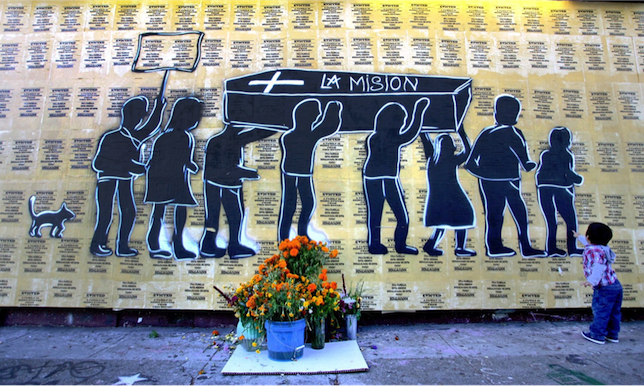
An anti-gentrification mural in San Francisco’s Mission District. Photo: S.F. Examiner.
A recent report found that the city I call home—Long Beach, California, located on the Pacific Ocean along the southern border of Los Angeles County, the second most populous city in the Los Angeles metropolitan area—ranked fifth among US cities with the fastest growing rent prices in the country. Given that the two-bedroom median rent of the four cities ahead of Long Beach on the list average roughly half that of Long Beach, the city may very well be California’s new epicenter of gentrification, which has already had devastating impacts on other cities like San Francisco, Oakland, and Los Angeles. As economic geographer Richard Walker notes, the scourge of gentrification is a “many-sided phenomenon” that combines the organic nature of cities themselves with urban growth, booming metropolitan economies, and increasing racial and economic inequality that create immense amounts of wealth for very few at the top while displacing large populations of folks, disproportionately black and brown, at the bottom.
Walker also highlights that chief among the drivers of gentrification is the role of government in supporting policies that prioritize the interests of corporations over those of lower-income residents of a given city. The alignment of corporations and governments is a hallmark of gentrification and neoliberalism more broadly. In California, the alliance of politicians with corporate interests—corporations, real estate developers, and landlords—reveals a state that has at best offered a half-hearted willingness to protect its most vulnerable residents and at worst encouraged the extraction of maximum economic profit through the displacement and gentrification of poor communities of color.
Causa Justa, “a multi-racial, grassroots organization building community leadership to achieve justice for low-income San Francisco and Oakland residents,” defines gentrification “as a profit-driven racial and class reconfiguration of urban, working-class and communities of color that have suffered from a history of disinvestment and abandonment. The process is characterized by declines in the number of low-income, people of color in neighborhoods that begin to cater to higher-income workers willing to pay higher rents.” Gentrification, therefore, brings together issues of housing, capitalism, and racial justice. With that in mind, it is important that we situate the more recent reality of gentrification within the larger history of producing wealth and poverty through housing policy. Which side of that divide one falls on has a whole lot to do with race.
A recent reportThe Asset Value of Whiteness: Understanding the Racial Wealth Gap, found that the median white household has thirteen times the wealth of the median black household and more than ten times that of the median Latino family. While there are certainly a multitude of factors that contribute to this disparity, housing is a primary contributor. Gentrification is not only a matter of who has rightful claim to certain neighborhoods and city spaces, but it is also part of the much larger historical process of reinforcing white supremacy through housing policy.

America’s racial wealth gap: median net worth of households (in 2012 dollars). Source: Pew Research Center.
Redlining, for example, excluded communities of color and black communities, in particular, from the largest federal housing project in our nation’s history. That, combined with the restrictive housing covenants that white homeowners enacted to protect their investments via maintaining segregated neighborhoods, racialized the geography of the American city in new ways, creating what historian Eric Avila refers to as “vanilla suburbs” and “chocolate cities.” Housing projects like Cabrini Green in Chicago, Marcy in Brooklyn, and Jordan Downs in Watts (Los Angeles), built to deal with the subsequent overcrowding of those black and brown communities trapped by redlining, along with later developments like newly built freeways paid for by federal dollars that carved up neighborhoods like Boyle Heights in Los Angeles, produced even more blight. In other words, in the middle decades of the twentieth century, housing policy created a cycle that manufactured immense amounts of wealth and povertyWhites got subsidized mortgages out in the suburbs and newly built freeways to better connect them to the downtown core; black and brown folks got redlining, housing projects, and federal interstates through their backyards. This history reveals the absurdity of contemporary partisan debates about “re-distribution” through tax policy. Contrary to the insistence of conservatives, the re-distribution of wealth occurs long before the levying of tax-bills.

“HOLC Residential Security Map,” Los Angeles, 1939.
Redlining was outlawed in 1968, but that did not eliminate the impoverishment of communities of color through housing policy. The sub-prime mortgage crisis, for example, catalyzed the 2008 housing collapse. While people of all races were victimized by the sub-prime mortgage collapse, blacks and Latinos were nearly two-and-a-half times more likely than whites to receive sub-prime loans. Much of the “why” in that case had little to do with economic inequality. In 2012, Wells Fargo paid $175 million to black lenders as part of a settlement with the Justice Department after the bank admitted that its brokers deliberately steered black and Latino borrowers into sub-prime loans in order to maximize lender fees, even though those customers qualified for prime loans.
So, whether it’s government policy or private banks, a (relatively) regulated Keynesian economy or a deregulated neoliberal one, blacks and Latinos have not only repeatedly been denied access to wealth accumulation through homeownership, but housing policy has continually impoverished the communities in which they live. In this context, gentrification offers a more recent episode in our nation’s much longer narrative of manufacturing wealth and poverty through housing policy. Gentrification, moreover, embodies the relationship between government and the market in the age of neoliberalism. Neoliberalism, in theory, posits maximizing economic efficiency by implementing, wherever possible, markets and market-logic in order to reduce the wasteful inefficiency of the public sector. However, it is not, as some argue, anti-statist. Neoliberalism, according to political economist Jamie Peck, “has always been about the capture and reuse of the state in the interests of shaping a pro-corporate, freer trading ‘market order’.” Gentrification provides an illuminating case study in the ways in which neoliberalism has not sought to eliminate, but instead to capture and re-task the state to serve pro-corporate interests.
San Francisco, perhaps the nation’s most gentrified city, offers a case in point. In 2012, the city passed Proposition E, a massive tax cut for any corporation that moved into office buildings in San Francisco’s mid-Market district, at the encouragement of Mayor Ed Lee. Dubbed the “Twitter Tax Break,” in 2014 alone Prop E. equated to a $34 million tax cut for tech companies. The recruitment of tech companies through government handouts has led to a massive influx of high-earning tech workers into San Francisco neighborhoods like the Mission. This influx has pushed the average rent for a one-bedroom apartment in the city over $3100 per month, which is displacing the Mission’s longstanding working-class Latino population. While one might hope “techies” and the corporations that employ them cared more about the populations they are forcing out, it is ultimately the responsibility of City Hall to protect the city’s residents. Yet, the routine prioritization by the San Francisco government of corporate interests over those of lower-income residents illuminates the political displacement of people by corporations in the neoliberal era.
Long Beach appears headed down a similar path, but the lack of tenants’ rights here makes poor and working-class communities of color more vulnerable to the draconian displacement that has already devastated San Francisco’s Mission District. Long Beach is the largest community of renters on the West Coast without any form of rent control or just cause eviction rights for tenants. A landlord can increase a tenant’s rent by any amount or send an eviction notice at any point with little notice and without cause. As Josh Butler, Executive Director of Housing Long Beach, a non-profit organization founded in 2011 that advocates for more affordable housing and tenants’ rights in our city, explained, “The lack of tenants’ rights, combined with the city’s old downtown core, its high population of renters, high-poverty rate, and low-vacancy rate make it a perfect target for gentrification.”

Gentrification reveals a deeper, more historically rooted discourse of race, home ownership, and citizenship. Government policy has, for the last 80 or so years, proved incredibly effective at creating wealth and poverty through housing policy. Race has fundamentally determined on which side of that divide one falls. The gentrification of cities like San Francisco and Long Beach reveals the ways local governments often prioritize the interests of corporations over those of their low-income black and brown residents. Resisting gentrification therefore demands a two-pronged approach. On the one hand, cities need strong tenants’ rights and an adequate affordable housing stock to protect their renters from displacement. On the other hand, we need a more critical engagement not simply with the racial politics of who profits and who is victimized by gentrification, but how those racial dynamics have inhibited our collective willingness to ease the burden of gentrification and displacement. As Butler told me about his organization’s efforts, “Until recently whites haven’t been impacted at the same rate as people of color, so we’ll see what happens, but I suspect if Housing Long Beach was organizing all white renters this problem would’ve already been solved.”

May 01, 2017

From the Archives June 2005: Reflection: Lessons for America from German History, By Fritz Stern


Reflection: Lessons for America from German History


This article is adapted from the author's remarks at the tenth annual dinner of the Leo Baeck Institute in New York, at which he was honoured for distinguished scholarship in German history and for contributions to good relations between the United States and Germany. 
Note that Fritz Stern's concern as a liberal proponent of the Social Welfare state regarding the possibility of a turn to fascism in the United States was an expression of trends he saw developing within the tenure of the G.W. Bush presidency.


To have witnessed even as a child the descent in Germany from decency to Nazi barbarism gave the question, how was it possible? an existential immediacy. Along with others of my generation, I wrestled with that question, trying to reconstruct some parts of the past and perhaps intuit some lessons.
Today, I worry about the immediate future of the United States, the country that gave haven to German-speaking refugees in the 1930s. (In 1938, at the age of 12, I came with my family to New York.) We refugees are grateful to the United States for saving us and for giving us a chance for a new start, if often under harsh circumstances. We loved and admired this country that, when we arrived, was still digging itself out from an unprecedented depression, under a leader whose motto was "the only thing we have to fear is fear itself," while his German contemporary preached fear in order to exploit it.
The United States was the best functioning democracy of the 1930s -- that "low, dishonest decade" -- and under President Franklin Roosevelt it was committed to pragmatic reform and maintained inimitable high spirits. I have not forgotten the unpleasant elements of those days -- the injustices, the right-wing radicals, the anti-Semites -- but the dominant note of Roosevelt's era was ebullient affirmation.

LASTING MEMORIAL

The Leo Baeck Institute is a monument that German Jewish refugees built as a memorial to their collective past, a troubled, anguished, glorious past to which many of them remained loyal even after National Socialism sought to deny and destroy it. It is impossible to generalize about German Jews in the modern era, but common to most of them was an earlier deep affection for their country, its language, and its culture. Perhaps they loved not wisely but too well. Even Albert Einstein, with his abiding antipathy for things German, remembered his unique, never duplicated companionship during his great years in Berlin with his German colleagues Max Planck and Max von Laue.
I remember from my childhood the decent Germans, so-called Aryans who, being opponents of the Nazi regime, disappeared into concentration camps in and after 1933. The ties between us had been close, and when they were broken, when so many Germans decided they did not want to know what was happening to their Jewish or "non-Aryan" neighbors, when they denied their common past, the pain was deep. But something of what had once been remained in the minds of many refugees, and they founded the Leo Baeck Institute to be a repository of this legacy. Its archives are a treasure for historians, and scholars from everywhere -- in recent decades especially from Germany itself -- have visited its unique library. The institute has contributed to greater understanding and reconciliation between Americans and Germans, between Christians and Jews.

The founders probably seized quickly upon the name Leo Baeck to recall the last liberal rabbi of Germany -- a student of the German philosopher Wilhelm Dilthey, someone who deepened theological learning by taking a fuller account of the irrational, mysterious elements in human existence. However much Baeck and Paul Tillich had understood the power of the demonic when they studied it in the 1920s, Baeck could not have imagined that he would live to see the triumph of hate-filled unreason. In the end, he had to endure living under that triumph, in a unique position as the last head of Germany's Jewish community, its representative to the Nazi authorities.
Eventually, in 1943, the regime sent him to Theresienstadt, that Nazi mockery of a "model" concentration camp, where for a time specially selected victims, spared as yet from extermination, were allowed to retain some form of a community before most of them died of hunger and disease. Baeck survived his years there; perhaps he met my father's sister and her husband there before they were deported to Auschwitz, where they were murdered.

Former German President Richard von Weizsaecker, in his extraordinary address on the fortieth anniversary of Germany's unconditional surrender, warned that sparing German feelings would be of no avail. The wounds remain and need to be acknowledged. In that same spirit of candor, let me say that the work of the institute is all the more important in light of what an early head of the Jewish Theological Seminary, Gerson Cohen, wrote in the 1975 Leo Baeck Institute Year Book. He mentioned that German Jewry had received a "bad press" in recent literature, being depicted occasionally as epitomizing submissiveness and self-hatred. The history of German Jews is complex, and hence the importance of the diverse testimony collected at the institute; but it is also appropriate to recall the poet Heinrich Heine's thought -- that Jews are like the people they live among, only more so. Hence German Jews, who came in great variety -- orthodox, liberal, secular, converted -- were like Germans, only more so: ambitious, talented, disciplined, and full of ambivalence.
After their civic emancipation in the nineteenth century, German Jews made an unprecedented leap to achievement, prominence, and wealth within only three generations, but some special insecurity and vulnerability clung to them, as it did to many Germans. I remember finding in an obscure book British Prime Minister Benjamin Disraeli's confession in the early 1870s to young Leonard Montefiore, English author and philanthropist, "You and I belong to a race that can do everything but fail." What a poignant remark, I thought, and mentioned it to my son, who instantly responded, "How hard on the others."

It probably was hard on the others, but now many Germans regret the absence of that creative complicated element in German Jewry. They recall the inestimable contributions that Jews made to German life and culture in their century of partial emancipation. But their forbears had more complicated feelings on the subject, and even the most successful Jews felt, as the industrialist and statesman Walther Rathenau once said, that "there comes a moment in every Jew's life when he realizes he is a second-class citizen."
Perhaps that strange mixture of German hospitality and hostility to Jews evoked the ambivalent response of some of the greatest of German Jews. They were the brilliant diagnosticians of German and European hypocrisy, the memorable breakers of taboos: think of Heine's mockery of German sentimental pretense, of Karl Marx's insistence that the cash nexus trumps virtue, or of Sigmund Freud's exposure of sexual hypocrisy and falsehood. Disturbers of a false peace are indispensable but rarely welcomed. So anti-Semitism, which comes in many guises and degrees, existed in pre-1914 Germany, as it did more ferociously in other countries. In Germany, it became an all-consuming political weapon only after the Great War.
It is now conventional wisdom that World War I and its senseless, unimaginable slaughter was the ur-catastrophe of the last century. It brutalized a Europe that before 1914, although deeply flawed by injustice and arrogance, also contained the promise of great emancipation movements championing the demands for social justice, for equality, for women's rights -- for human rights, more generally. World War I radicalized Europe; without it, there would have been no Bolshevism and no fascism. In the postwar climate and in the defeated and self-deceived Germany, National Socialism flourished and ultimately made it possible for Hitler to establish the most popular, the most murderous, the most seductive, and the most repressive regime of the last century.

MORALS OF THE STORY

The rise of National Socialism was neither inevitable nor accidental. It did have deep roots, but it could have been stopped. This is but one of the many lessons contained in modern German history, lessons that should not be squandered in cheap and ignorant analogies. A key lesson is that civic passivity and willed blindness were the preconditions for the triumph of National Socialism, which many clear-headed Germans recognized at the time as a monstrous danger. We who were born at the end of the Weimar Republic and who witnessed the rise of National Socialism should remember that even in the darkest period there were individuals who showed active decency, who, defying intimidation and repression, opposed evil and tried to ease suffering. I wish these people would be given a proper European memorial, not to appease our conscience but to summon the courage of future generations.
After World War I and Germany's defeat, conditions were harsh, and Germans were deeply divided between moderates and democrats on the one hand and fanatic extremists of the right and the left on the other. National Socialists portrayed Germany as a nation that had been stabbed in the back by socialists and Jews; they portrayed Weimar Germany as a moral and political swamp; they seized on the Bolshevik danger, painted it in lurid colors, and stoked people's fear in order to pose as saviors of the nation.

In the late 1920s, a group of intellectuals known as conservative revolutionaries demanded new volkish authoritarianism, a third Reich. Richly financed by corporate interests, they denounced liberalism as the greatest, most invidious threat and attacked it for its tolerance, rationality, and cosmopolitan culture. These conservative revolutionaries were proud of being prophets of the Third Reich -- at least until some of them were exiled or murdered by the Nazis when the latter came to power. Throughout, the Nazis vilified liberalism as a Marxist-Jewish conspiracy, and, with Germany in the midst of unprecedented depression and impoverishment, they promised a national rebirth.
Twenty years ago, I wrote an essay called "National Socialism as Temptation," about what it was that induced so many Germans to embrace the terrifying specter. There were many reasons, but at the top ranked Adolf Hitler himself, a brilliant populist manipulator who insisted and probably believed that Providence had chosen him as Germany's savior, a leader charged with executing a divine mission. God had been drafted into national politics before, but Hitler's success in fusing racial dogma with Germanic Christianity was an immensely powerful element in his electoral campaigns. Some people recognized the moral perils of mixing religion and politics, but many more were seduced by it. It was the pseudoreligious transfiguration of politics that largely ensured his success, notably in Protestant areas.

German moderates and German elites underestimated Hitler, assuming that most people would not succumb to his Manichean unreason; they did not think that his hatred and mendacity could be taken seriously. They were proved wrong. People were enthralled by the Nazis' cunning transposition of politics into carefully staged pageantry, into a flag-waving martial Mass. At solemn moments, the National Socialists would shift from the pseudoreligious invocation of Providence to traditional Christian forms: In his first radio address to the German people, 24 hours after coming to power, Hitler declared, "The national government will preserve and defend those basic principles on which our nation has been built up. They regard Christianity as the foundation of our national morality and the family as the basis of national life." German elites proved susceptible to this mystical brew of pseudoreligion and disguised interest. Churchmen, especially Protestant clergy, shared his hostility toward the liberal-secular state and its defenders; they were also filled with anti-Semitic beliefs, although with some heroic exceptions.

Let me cite one example of the acknowledged appeal of unreason. Carl Friedrich von Weizsaecker, a Nobel laureate in physics and a philosopher, wrote to me in the mid-1980s saying that he had never believed in Nazi ideology but that he had been tempted by the movement, which seemed to him then like "the outpouring of the Holy Spirit." On reflection, he thought that National Socialism had been part of a process that the National Socialists themselves had not understood. He may well have been right. The Nazis did not realize that they were part of a historic process in which resentment against a disenchanted secular world found deliverance in the ecstatic escape of unreason.
Although modern German history offers lessons in both disaster and recovery, German has remained the language of politics in crisis. And the principal lesson speaks of the fragility of democracy and the fatality of civic passivity or indifference; German history teaches us that malice and simplicity have their own appeal, that force impresses, and that nothing in the public realm is inevitable.


Reconstruction is another lesson, for the history of the Federal Republic since World War II, a republic that is now 55 years old, exemplifies success despite its serious flaws and shortcomings. In postwar Germany, democracy grew on what was initially uncongenial ground, when Germans were still steeped in resentment and denial. American friendship supported that reconstruction, especially in its first decade. I fear that an estrangement is now taking place; at the least, we must all try to preserve in the private realm what may be in jeopardy in public life.
German democracy and German acceptance of Western traditions have been the preconditions for Germany's gradual reconciliation with neighbors and former enemies, with Poles and Slavs; for efforts at reconciliation with Jews; for a general acceptance of the burden of the past and a collective commitment to the future. This German achievement is remarkable -- but it too needs constant protection.


My hope is for a renewal on still firmer ground of a transatlantic community of liberal democracies. Every democracy needs a liberal fundament, a bill of rights enshrined in law and spirit, for this alone gives democracy the chance for self-correction and reform. Without it, the survival of democracy is at risk. Every genuine conservative knows this.

US has regressed to developing nation status, MIT economist warns

US has regressed to developing nation status, MIT economist warns

Peter Temin says 80 per cent of the population is burdened with debt and anxious about security 
Peter Temin says the world's’ largest economy has roads and bridges that look more like those in Thailand and Venezuela than those in parts of Europe. 
In his new book, “The Vanishing Middle Class", reviewed by the Institute for New Economic Thinking, Mr Temin says the fracture of US society is leading the middle class to disappear. 
american-feeding.jpg
Volunteers from the Midnight Mission help feed the homeless and poor during its annual Easter/Passover celebration at Skid Row in Los Angeles, California (Getty Images)
The economist describes a two-track economy with on the one hand 20 per cent of the population that is educated and enjoys good jobs and supportive social networks. 
On the other hand, the remaining 80 per cent, he said, are part of the US’ low-wage sector, where the world of possibility has shrunk and people are burdened with debts and anxious about job security. 
Mr Temin used a model, which was created by Nobel Prize winner Arthur Lewis and designed to understand developing nations, to describe how far inequalities have progressed in the US. 
When applied to the US, Mr Temin said that “the Lewis model actually works”
american-homeless.jpg
Homeless men try to stay warm in a Manhattan church on an unseasonably cold day in New York City (Getty Images)
He found that much of the low-wage sector had little influence over public policy, the high-income sector was keeping wages down to provide cheap labour, social control was used to prevent subsistence workers from challenging existing policies and social mobility was low. 
american-inmates.jpg
Female jail inmates are chained together as they bury cadavers at Maricopa County's pauper's graveyard in Phoenix, Arizona (Joe Raedle/Liaison)
Mr Temin says that education is the solution to offer everyone in society better opportunities and calls for investments in public schools and public universities. 
He says: “Knowing how to think, how to get on with people, how to cooperate. All the social skills and social capital … [are] going to be critically important for kids in this environment."

Featured Story

Dejemos que la izquierda de Estados Unidos tenga cuidado! por Andrew Taylor 23.06.2021

La Administración Biden ha habilitado una nueva "Iniciativa contra el terrorismo doméstico" para defender "The Homeland"...