October 12, 2019

"We're in a permanent coup", Matt Taibbi, October 11, 2019

We're in a permanent coup

Americans might soon wish they just waited to vote their way out of the Trump era


I’ve lived through a few coups. They’re insane, random, and terrifying, like watching sports, except your political future depends on the score.
The kickoff begins when a key official decides to buck the executive. From that moment, government becomes a high-speed head-counting exercise. Who’s got the power plant, the airport, the police in the capital? How many department chiefs are answering their phones? Who’s writing tonight’s newscast?
When the KGB in 1991 tried to reassume control of the crumbling Soviet Union by placing Mikhail Gorbachev under arrest and attempting to seize Moscow, logistics ruled. Boris Yeltsin’s crew drove to the Russian White House in ordinary cars, beating KGB coup plotters who were trying to reach the seat of Russian government in armored vehicles. A key moment came when one of Yeltsin’s men, Alexander Rutskoi – who two years later would himself lead a coup against Yeltsin – prevailed upon a Major in a tank unit to defy KGB orders and turn on the “criminals.”
We have long been spared this madness in America. Our head-counting ceremony was Election Day. We did it once every four years.
That’s all over, in the Trump era.
On Thursday, news broke that two businessmen said to have “peddled supposedly explosive information about corruption involving Hillary Clinton and Joe Biden” were arrested at Dulles airport on “campaign finance violations.” The two figures are alleged to be bagmen bearing “dirt” on Democrats, solicited by Trump and his personal lawyer, Rudy Giuliani.
Lev Parnas and Igor Fruman will be asked to give depositions to impeachment investigators. They’re reportedly going to refuse. Their lawyer John Dowd also says they will “refuse to appear before House Committees investigating President Donald Trump.” Fruman and Parnas meanwhile claim they had real derogatory information about Biden and other politicians, but “the U.S. government had shown little interest in receiving it through official channels.”
For Americans not familiar with the language of the Third World, that’s two contrasting denials of political legitimacy.
The men who are the proxies for Donald Trump and Rudy Giuliani in this story are asserting that “official channels” have been corrupted. The forces backing impeachment, meanwhile, are telling us those same defendants are obstructing a lawful impeachment inquiry.
This latest incident, set against the impeachment mania and the reportedly “expanding” Russiagate investigation of U.S. Attorney John Durham, accelerates our timeline to chaos. We are speeding toward a situation when someone in one of these camps refuses to obey a major decree, arrest order, or court decision, at which point Americans will get to experience the joys of their political futures being decided by phone calls to generals and police chiefs.
My discomfort in the last few years, first with Russiagate and now with Ukrainegate and impeachment, stems from the belief that the people pushing hardest for Trump’s early removal are more dangerous than Trump. Many Americans don’t see this because they’re not used to waking up in a country where you’re not sure who the president will be by nightfall. They don’t understand that this predicament is worse than having a bad president.

The Trump presidency is the first to reveal a full-blown schism between the intelligence community and the White House. Senior figures in the CIA, NSA, FBI and other agencies made an open break from their would-be boss before Trump’s inauguration, commencing a public war of leaks that has not stopped.
The first big shot was fired in early January, 2017, via a CNN.com headline, “Intel chiefs presented Trump with claims of Russian efforts to compromise him.” This tale, about the January 7th presentation of former British spy Christopher Steele’s report to then-President-elect Trump, began as follows:
Classified documents presented last week to President Obama and President-elect Trump included allegations that Russian operatives claim to have compromising personal and financial information about Mr. Trump, multiple US officials with direct knowledge of the briefings tell CNN.
Four intelligence chiefs in the FBI’s James Comey, the CIA’s John Brennan, the NSA’s Mike Rogers, and Director of National Intelligence James Clapper, presented an incoming president with a politically disastrous piece of information, in this case a piece of a private opposition research report.
Among other things because the news dropped at the same time Buzzfeed decided to publish the entire “bombshell” Steele dossier, reporters spent that week obsessing not about the mode of the story’s release, but about the “claims.” In particular, audiences were rapt by allegations that Russians were trying to blackmail Trump with evidence of a golden shower party commissioned on a bed once slept upon by Barack Obama himself.
Twitter exploded. No other news story mattered. For the next two years, the “claims” of compromise and a “continuing” Trump-Russian “exchange” hung over the White House like a sword of Damocles. 
Few were interested in the motives for making this story public. As it turned out, there were two explanations, one that was made public, and one that only came out later. The public justification as outlined in the CNN piece, was to “make the President-elect aware that such allegations involving him [were] circulating among intelligence agencies.”
However, we know from Comey’s January 7, 2017 memo to deputy Andrew McCabe and FBI General Counsel James Baker there was another explanation. Comey wrote:
I said I wasn’t saying this was true, only that I wanted [Trump] to know both that it had been reported and that the reports were in many hands. I said media like CNN had them and were looking for a news hook. I said it was important that we not give them the excuse to write that the FBI has the material or [redacted] and that we were keeping it very close-hold.
Imagine if a similar situation had taken place in January of 2009, involving president-elect Barack Obama. Picture a meeting between Obama and the heads of the CIA, NSA, and FBI, along with the DIA, in which the newly-elected president is presented with a report complied by, say, Judicial Watch, accusing him of links to al-Qaeda. Imagine further that they tell Obama they are presenting him with this information to make him aware of a blackmail threat, and to reassure him they won’t give news agencies a “hook” to publish the news.
Now imagine if that news came out on Fox days later. Imagine further that within a year, one of the four officials became a paid Fox contributor. Democrats would lose their minds in this set of circumstances.
The country mostly did not lose its mind, however, because the episode did not involve a traditionally presidential figure like Obama, nor was it understood to have been directed at the institution of “the White House” in the abstract.
Instead, it was a story about an infamously corrupt individual, Donald Trump, a pussy-grabbing scammer who bragged about using bankruptcy to escape debt and publicly praised Vladimir Putin. Audiences believed the allegations against this person and saw the intelligence/counterintelligence community as acting patriotically, doing their best to keep us informed about a still-breaking investigation of a rogue president.
But a parallel story was ignored. Leaks from the intelligence community most often pertain to foreign policy. The leak of the January, 2017 “meeting” between the four chiefs and Trump – which without question damaged both the presidency and America’s standing abroad – was an unprecedented act of insubordination.
It was also a bold new foray into domestic politics by intelligence agencies that in recent decades began asserting all sorts of frightening new authority. They were kidnapping foreigners, assassinating by drone, conducting paramilitary operations without congressional notice, building an international archipelago of secret prisons, and engaging in mass warrantless surveillance of Americans. We found out in a court case just last week how extensive the illegal domestic surveillance has been, with the FBI engaging in tens of thousands of warrantless searches involving American emails and phone numbers under the guise of combating foreign subversion.
The agencies’ new trick is inserting themselves into domestic politics using leaks and media pressure. The “intel chiefs” meeting was just the first in a series of similar stories, many following the pattern in which a document was created, passed from department from department, and leaked. A sample:
  • February 14, 2017: “four current and former officials” tell the New York Times the Trump campaign had “repeated contacts” with Russian intelligence.
  • March 1, 2017: “Justice Department officials” tell the Washington Post Attorney General Jeff Sessions “spoke twice with Russia’s ambassador” and did not disclose the contacts ahead of his confirmation hearing. 
  • March 18, 2017: “people familiar with the matter” tell the Wall Street Journal that former Trump National Security Adviser Michael Flynn failed to disclose a “contact” with a Russian at Cambridge University, an episode that “came to the notice of U.S. intelligence.”
  • April 8, 2017, 2017: “law enforcement and other U.S. officials” tell the Washington Post the secret Foreign Intelligence Surveillance Court judge had ruled there was “probable cause” to believe former Trump aide Carter Page was an “agent of a foreign power.” 
  • April 13, 2017: a “source close to UK intelligence” tells Luke Harding at The Guardian that the British analog to the NSA, the GCHQ, passed knowledge of “suspicious interactions” between “figures connected to Trump and “known or suspected Russian agents” to Americans as part of a “routine exchange of information.”
  • December 17, 2017: “four current and former American and foreign officials” tell the New York Times that during the 2016 campaign, an Australian diplomat named Alexander Downer told “American counterparts” that former Trump aide George Papadopoulos revealed “Russia had political dirt on Hillary Clinton.
  • April 13, 2018: “two sources familiar with the matter” tell McClatchy that Special Counsel Robert Mueller’s office has evidence Trump lawyer Michael Cohen was in Prague in 2016, “confirming part of [Steele] dossier.”
  • November 27, 2018: a “well-placed source” tells Harding at The Guardian that former Trump campaign manager Paul Manafort met with Julian Assange at the Ecuadorian embassy in London.
  • January 19, 2019: “former law enforcement officials and others familiar with the investigation” tell the New York Times the FBI opened an inquiry into the “explosive implications” of whether or not Donald Trump was working on behalf of the Russians.
To be sure, “people familiar with the matter” leaked a lot of true stories in the last few years, but many were clearly problematic even at the time of release. Moreover, all took place in the context of constant, hounding pressure from media figures, congressional allies like Democrats Adam Schiff and Eric Swalwell, as well as ex-officials who could make use of their own personal public platforms in addition to being unnamed sources in straight news reports. They used commercial news platforms to argue that Trump had committed treason, needed to be removed from office, and preferably also indicted as soon as possible.
A shocking number of these voices were former intelligence officers who joined Clapper in becoming paid news contributors. Op-ed pages and news networks are packed now with ex-spooks editorializing about stories in which they had personal involvement: Michael MorellMichael HaydenAsha Rangappa, and Andrew McCabe among many others, including especially all four of the original “intel chiefs”: Clapper, RogersComey, and MSNBC headliner John Brennan.
Russiagate birthed a whole brand of politics, a government-in-exile, which prosecuted its case against Trump via a constant stream of “approved” leaks, partisans in congress, and an increasingly unified and thematically consistent set of commercial news outlets.
These mechanisms have been transplanted now onto the Ukrainegate drama. It’s the same people beating the public drums, with the messaging run out of the same congressional committees, through the same Nadlers, Schiffs, and Swalwells. The same news outlets are on full alert.
The sidelined “intel chiefs” are once again playing central roles in making the public case. Comey says “we may now be at a point” where impeachment is necessary. Brennan, with unintentional irony, says the United States is “no longer a democracy.” Clapper says the Ukraine whistleblower complaint is “one of the most credible” he’s seen.
As a reporter covering the 2015–2016 presidential race, I thought Trump’s campaign was disturbing on many levels, but logical as a news story. He succeeded for class reasons, because of flaws in the media business that gifted him mass amounts of coverage, and because he took cunning advantage of long-simmering frustrations in the electorate. He also clearly catered to racist fears, and to the collapse in trust in institutions like the news media, the Fed, corporations, NATO, and, yes, the intelligence services. In enormous numbers, voters rejected everything they had ever been told about who was and was not qualified for higher office.
Trump’s campaign antagonism toward the military and intelligence world was at best a millimeter thick. Like almost everything else he said as a candidate, it was a gimmick, designed to get votes. That he was insincere and full of it and irresponsible, at first at least, when he attacked the “deep state” and the “fake news media,” doesn’t change the reality of what’s happened since. Even paranoiacs have enemies, and even Donald “Deep State” Trump is a legitimately elected president whose ouster is being actively sought by the intelligence community.
Trump stands accused of using the office of the presidency to advance political aims, in particular pressuring Ukraine to investigate potential campaign rival Joe Biden. He’s guilty, but the issue is how guilty, in comparison to his accusers.
Trump, at least insofar as we know, has not used section 702 of the Foreign Intelligence Surveillance Act to monitor political rivals. He hasn’t deployed human counterintelligence “informants” to follow the likes of Hunter Biden. He hasn’t maneuvered to secure Special Counsel probes of Democrats.
And while Donald Trump conducting foreign policy based on what he sees on Fox and Friends is troubling, it’s not in the same ballpark as CNN, MSNBC, the Washington Post and the New York Times engaging in de facto coverage partnerships with the FBI and CIA to push highly politicized, phony narratives like Russiagate.
Trump’s tinpot Twitter threats and cancellation of White House privileges for dolts like Jim Acosta also don’t begin to compare to the danger posed by Facebook, Google, and Twitter – under pressure from the Senate – organizing with groups like the Atlantic Council to fight “fake news” in the name of preventing the “foment of discord.”
I don’t believe most Americans have thought through what a successful campaign to oust Donald Trump would look like. Most casual news consumers can only think of it in terms of Mike Pence becoming president. The real problem would be the precedent of a de facto intelligence community veto over elections, using the lunatic spookworld brand of politics that has dominated the last three years of anti-Trump agitation.
CIA/FBI-backed impeachment could also be a self-fulfilling prophecy. If Donald Trump thinks he’s going to be jailed upon leaving office, he’ll sooner or later figure out that his only real move is to start acting like the “dictator” MSNBC and CNN keep insisting he is. Why give up the White House and wait to be arrested, when he still has theoretical authority to send Special Forces troops rappelling through the windows of every last Russiagate/Ukrainegate leaker? That would be the endgame in a third world country, and it’s where we’re headed, unless someone calls off this craziness. Welcome to the Permanent Power Struggle.
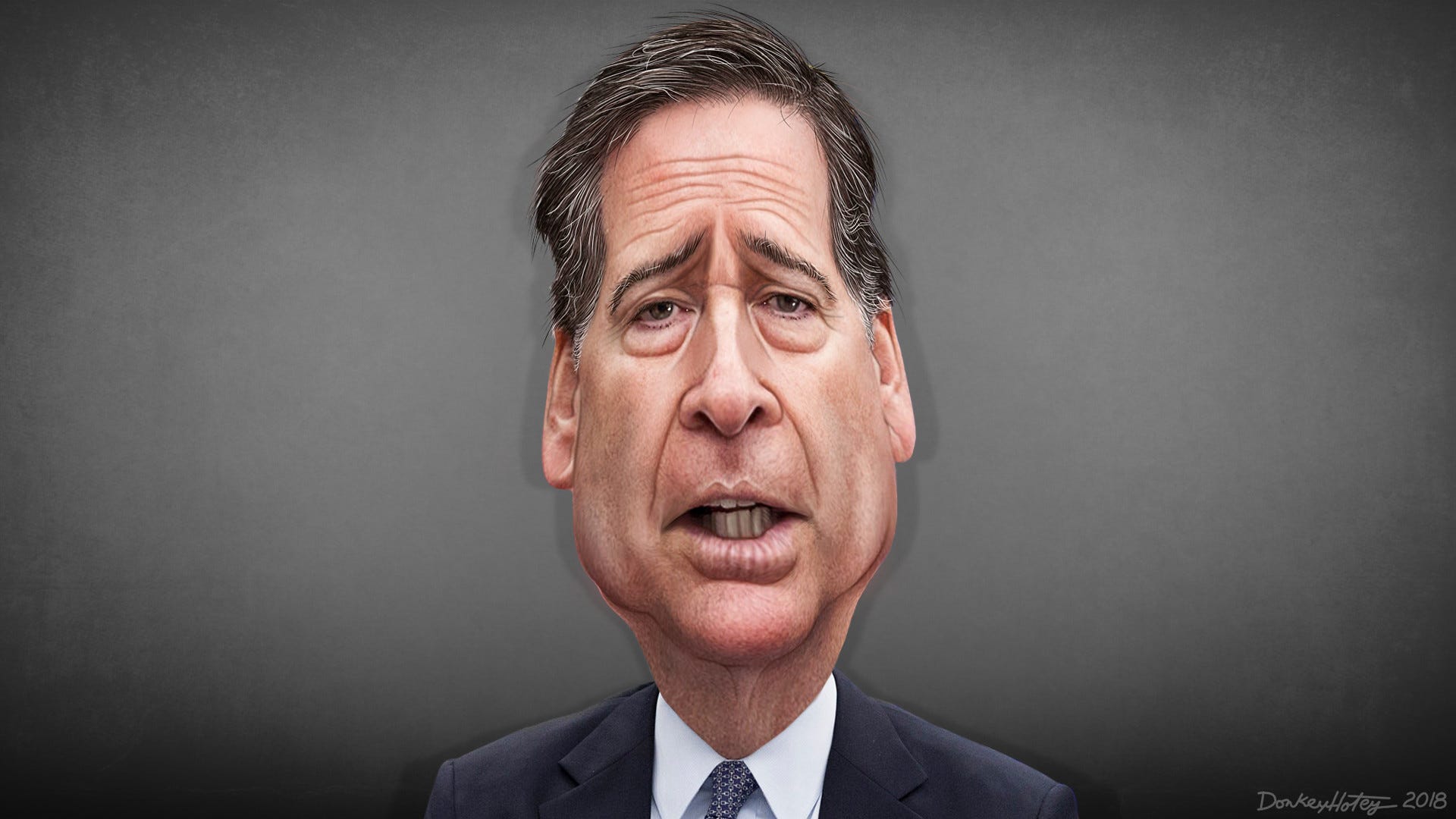
Image by Donkey Hotey

October 06, 2019

Saving Scotland's world-class industry, Morning Star, October 4, 2009

Saving our world-class industry

Scotland's rail construction complex, once employing 30,000 skilled engineers and exporting trains across the globe, is slated for closure - but not without a fight, writes JOHN FOSTER as he previews this weekend's Scottish Morning Star autumn conference in Glasgow

“WE must shift the balance between capital and labour to safeguard our industry, employment and our communities. We need legal and institutional change as well as a strengthening of trade union organisation on the ground.”
This was the conclusion of Paul Sweeney MP at a meeting held earlier this week in Springburn to draw lessons from the current battle to save “the Caley,” Scotland’s last remaining rail workshop in his constituency of Glasgow North East.
Paul Sweeney was quoting the title of Scottish Morning Star conference to be held this Sunday — with Richard Leonard, Scottish Labour leader, as the opening speaker — which will focus on how to win collective bargaining rights for all workers and learn the lessons of other recent struggles such as the Equal Pay strike in Glasgow.
Over 40 workers from “the Caley” attended the meeting organised in the Star’s “Our Class Our Culture” series and addressed by convener Les Ashton, Paul Sweeney, Pat McIlvogue of Unite and Mick Hogg of the RMT.
The meeting rehearsed the history of the workshops, once the centre of a rail construction complex employing 30,000 skilled engineers and exporting trains across the globe, and then heard the sorry tale of the slow run-down of a world-class facility following Tory rail privatisation.
Sold from one firm of corporate asset-strippers to another, the workers were finally told last Christmas that what remained of the workshops would be closed this July.
But it was not closed without a fight — and a fight that will continue. Mick Hogg of the RMT detailed the fight, the solidarity of workers across Scotland and the crazy economics of the decision taken with the complicity of the Scottish government.
“Today there is nowhere in Scotland to repair Scottish rail stock. Broken-down trains are having to be transported by road for repair in England while Abelio-Scottish Rail is failing to meet virtually every target as a result of a lack of adequate rail stock.”
Pat McIlvogue of Unite described how the Scottish government had refused an offer from the previous owners to hand over the entire facility together with £1m to the Scottish government if it could maintain employment.
“The Scottish government and the relevant ministers have rejected every proposal put by the workers. They have hidden behind competition rules and refused to consider any form of public or co-operative ownership.”
He paid tribute to the workers who had unanimously refused to take redundancy money last Christmas in order to continue the fight. “Britain’s current employment laws are truly shocking. You just have to look at the fate of the Thomas Cook workers to realise that.”
All present were unanimous that the fight must continue and workers should be ready for any attempt to use the facilities on the site by fly-by-night operators using non-unionised agency workers.
Paul Sweeney MP said the struggle at the Caley was an object lesson in the need to resist the destructive role of internationalised capitalism and for workers, and their communities, to realise that they had all the skills needed to themselves run vital pubic facilities like rail repair.
Sunday’s Scottish Morning Star conference “Shifting the Balance between Capital and Labour” will take place at the Scottish Trades Union Building, 333 Woodlands Road, Glasgow G3 on Sunday October 6 starting at 12 noon (register at the door).

October 03, 2019

Canadian Labour Congress should reinstate VP Donald Lafleur, Sept 30, 2019

Sep302019

The news that the Canadian Labour Congress has stripped Vice-President Donald Lafleur of his duties and put him on administrative leave raises many troubling questions. This action runs counter to the urgent need for labour to adopt a more militant fightback strategy, to strengthen the role of trade unions in the struggles for peace and international solidarity, and to promote a more democratic and inclusive leadership style, from the top levels of the CLC down to the provincial federations, labour councils, and union locals.
The Central Executive Committee of the Communist Party of Canada joins with other progressive activists calling for the reinstatement of Brother Donald Lafleur to his elected position in the CLC leadership. Despite the vicious media attacks and lies in recent days, Lafleur attended the Third International Trade Union Forum in Solidarity with Syrian Workers at his own expense, during his vacation time, and he did not address this forum or claim to be representing the CLC.
To his credit, Brother Lafleur took the courageous step of attending this conference in Damascus, “to listen and learn.” Convened to build opposition to imperialist intervention and economic sanctions, the event was organized by Syria’s General Federation of Trade Unions (GFTU), in cooperation with the International Confederation of Arab Trade Unions (ICATU) and World Federation of Trade Unions (WFTU). Other participating bodies included the Arab Labor Organization (ALO), the Organization of African Trade Union Unity (OATUU), and several national labour organizations from various countries.
We note that since 2011, the war and sanctions have caused over $90 billion USD in damages and losses to Syria. More than 9000 Syrian workers have been killed by terrorist attacks, with another 14000 wounded and 3000 kidnapped. The Trade Union Forum agreed to develop a worldwide solidarity campaign to confront those governments and organizations that support terrorism and sanctions against Syria and the Syrian people.
The McCarthyist attacks against Donald Lafleur in Canada’s mainstream media began almost immediately. CBC News and Postmedia’s bitterly reactionary Terry Glavin falsely claimed that the forum was “organized by the Assad regime,” and both condemned the forum’s call for an end to the deadly sanctions against Syria.
By throwing Donald Lafleur under the bus and repeating the media attacks against the elected government of Syria, the CLC leadership has indicated its clear support for the imperialist aggression aimed at forcing “regime change.” As we have seen in other countries in the region, this would not lead to democracy and social justice – it only opens the door for terrorist organizations to seize control. We urge labour activists to reject the CLC’s statements which closely reflect the US-NATO storyline, and to call on the Congress to change course – reinstate Brother Donald Lafleur, and begin building true solidarity with the trade unions and working class of Syria.
Central Executive Committee, Communist Party of Canada

October 02, 2019

Before October: The Unbearable Romanticism of Western Marxism Oct 08, 2011 MR Online, by Roland Boer

Before October: The Unbearable Romanticism of Western Marxism

The resentment of Western Marxists against the successful Eastern revolutions manifests itself in a complex mix of dismissal and unbearable romanticism.  As for the latter, it appears in the position that the perfect revolution is yet to come, that it will happen at an undefinable utopian moment in the future.  The criteria for what constitutes such a romantic moment constantly shift, depending on which position one takes, but they all remain in the future, have not yet been realised, offer as yet unimaginable qualitative change and certainly don’t need an army.  Needless to say, all of the successful Eastern revolutions fail the test, for they inevitably came to grief, were betrayed, fell from grace, turned away from romantic revolutionary ideals.  In short, they ‘failed’.  And the code word for such ‘failure’ is Stalin.  As soon as a revolution becomes ‘Stalinist’ — as they all did according to Western Marxists — then it was not a true revolution after all.  The seeds of that failure were already embodied in the moment of revolution itself.
I would like to address this revolutionary romanticism at three levels, one concerning a recent incident in relation to China, another dealing with a curious argument concerning Norway and a third by considering what may be termed ‘fall’ narratives in relation to the first successful communist revolution, namely, the Russian Revolution.
Chinese Communism
Through increasing visits to China, to teach, travel and engage in endless discussions with Marxists, I have found most of my preconceptions thoroughly dismissed and utterly complexified.  Slowly, I began to share the sense of my Chinese interlocutors that Western Marxist engagements with China were wanting in sophistication.  So I contacted the organisers of an energetic annual conference, a vibrant journal and book series — Historical Materialism.  The idea was to arrange for a panel or two on ‘Communism in China Today’ at a couple of conferences.  We would gather some Chinese experts who would engage in detailed debate concerning Marxism in China.
The response was disappointing and predictable: ‘Is China really communist anymore?’  ‘Are there any Marxists left in China?’  ‘If so, they do not know what they are talking about’.  ‘What about freedom, democracy, workers?’  To the suggestion of a conference panel I received a flat ‘no’, dismissing Marxism in China as at least unsophisticated, if not having betrayed some impossible ideal.  I had thought the Historical Materialism people would be more open to a vigorous debate, one that explored issues in a manner that would move past such preconceptions.  Yet, this response was also predictable, for I have encountered similar responses from one Western Marxist after another: China is not really communist, so it is not worth considering.  Sometimes my interlocutor will suggest that China is ‘evil’, that it is out for world domination, that we need to fear the Chinese Empire.  If I press further, my interlocutor will refer to an article in the Washington Post, the New York Times or another Western newspaper as ‘evidence’.  And if I refer to a Chinese source, it is dismissed as tainted or unreliable.  On such matters, these Western Marxists are no different from bourgeois critics of China.
Norway’s Bourgeois Socialism
The second example is even more astonishing.1  According to some sources in Norway, the country has achieved socialism without a revolution.  Forget those messy and ‘failed’ revolutions in the East; in Norway socialism has arrived by peaceful means.  The argument may best be described in terms of the following propositions:
The bourgeoisie is absolutely dominant.
It is firmly on the left.
It supports the Norwegian welfare state.
The working class has largely been dismantled, since all its wishes have been met.
The remnant of the working class is firmly right-wing.
The conclusion: Norway is a socialist country.
How might we make sense of these contradictory statements?  Let us grant this argument for a moment.  That would mean Norway has managed to achieve socialism via a non-revolutionary path.  That is, the country is a manifestation of the argument of Bernstein (among the German Social-Democrats at the end of the nineteenth) in which all one needs to do is persuade the bourgeoisie of the benefits of socialism and that class will see the light.  At the time, Bernstein soon found himself outside the socialist movement, but perhaps his moment has come — if we are to believe this argument.
Now, I can affirm that Norway is probably one of the most bourgeois places you may visit, an example of the pervasive success of the bourgeois project.  The problem is that what passes for ‘socialism’ in the minds of some of its inhabitants is actually good old liberalism in its authentic expression (which leads one to advocate feminism, gays, immigrants etc).  So I am left with the question: is Norway really a case of the Bernsteinian exception, so much so that it is an exception to the rest of the world, achieving what can only be a ‘chardonnay socialist’ state?  Of course not, for it is another manifestation of the resentment against the successful revolutions of the East, arguing now that the perfect, Western revolution has really happened, paradoxically without a communist revolution.
The Russian Revolution: A ‘Fall’ Narrative
The third instance of unbearable romanticism is manifested in what I call ‘fall’ narratives.  By a fall narrative I refer to the story in Genesis 2-3, in which Eve and then Adam eat of the fruit of the forbidden tree (of the knowledge of good and evil) and are thereby banished by God from paradise.  This narrative is unwittingly deployed by Western (not even necessarily Marxist) analysts of Eastern revolutions.  I take as my example the first successful communism revolution in Russia.
According to these Western analysts, when did the betrayal or fall take place?  The least generous suggest that it happened even before the revolution, especially through Lenin’s supposedly devious machinations and his refusal to cooperate with other socialist groups such as the Mensheviks and Socialist-Revolutionaries (both Left and Right wings).  An example of this approach may be found in Bruce Lincoln’s two massive works, Passage through Armageddon and Red Victory.2  The second book ends with a section called ‘the revolution consumes its makers’, where the rise of Stalin constitutes the final ‘travesty’ of the revolution.  Yet the conditions for that fall were also established in what Lincoln insists calling a ‘civil’ war (despite 160,000 troops from the USA, UK, Greece, Italy, Japan, Germany, Austria, France and Turkey, along with endless equipment, money and logistics support for the White Armies), if not beforehand in the very nature of communism.  For Lincoln, communism by its very nature leads to such betrayal.  He shows his true colours in his sympathies for the last stand of the White Army in Crimea under Wrangel.  This aristocrat was, argues Lincoln, a good tactician and organiser, supposedly trying to ensure a just regime.  After his defeat, the departure of about 150,000 whites from Crimea is recounted with a sense of loss.
More often, for Western Marxists at least, the moment of the fall is the October Revolution itself, if not immediately afterwards.  From that moment — to give a few of the many formulations — the party and even the working class disintegrate; the Bolsheviks become ‘renegades’; Lenin’s thought loses it coherence; his ‘heroic narrative’ of a victorious working-class socialist revolution begins to come apart; bureaucracy becomes pervasive; a transformation takes place from a flexible, democratic and open party to one of the most centralised and ‘authoritarian’ political organisations in modern history; the dictatorship of the proletariat becomes the dictatorship of the secretariat; the revolution shifts from being a revolution from below to one from above; the democratic soviets crumble before a centralised and dictatorial party.3  The problem with such fall narratives is that they tend to be theological (a fall from paradise) and fail to deal with the complex messiness of history.4  They also assume, as Tamara Prosic has pointed out,5 that communists are perfect human beings who should not ‘sin’.  And they neglect Lenin’s repeated point that the revolution itself is easy; far more complex is the construction of communism itself.  The result is that even the most sympathetic Marxists prefer the time before October, before the moment of the revolution itself when the Bolsheviks, with massive support, seized power.
Some lament the lost opportunities, suggesting that a broad, cross-party socialist government, such as the one established in the February Revolution, was the ideal.6  Others may actually allow that the brief time after the revolution was valid, but that the ‘civil’ war corroded all the gains, for it was a period of centralised control, tough measures, the Cheka and ‘war communism’, all of which betrayed the revolution.7  A solution for some is to side with Trotsky, arguing that if he had won out over Stalin, the situation would have been far different.  This is a classic example of a futile ‘what if’ narrative.
All of them are fall narratives, accounts of betrayal of the communist revolution.  Far better, then, to focus on the period before October, since that is where Western Marxists perpetually find themselves.  As for me, I prefer the time after October.  Why?  It is a story of the astonishing survival and success of the revolution against crushing odds.  In Russia, the widespread sense was that the new Soviet government would collapse within a matter of days.  At the moment of the revolution, the situation was desperate after three years of war with Germany and Austria — in terms of food, fuel for heat, transport, industrial production, along with the spontaneous demobilisation of the army.  It became worse after the revolution, with an economic blockade from the rest of the world and another four years of ‘civil’ war in the north, east and south: Denikin, Kolchak, Iudenich, Wrangel led various White Armies, even declaring new states in the territories they conquered.  The Poles added a front in the west, rendering the new Soviet state a mere rump of what it was to become.  All of them were enthusiastically supported by capitalist powers hostile to the Soviets, in terms of troops, money, equipment and advice.  As the contemporary account of Ransome shows so well, the Russians knew they had to overcome this devastation without assistance from outside.8  Yet, through sheer guts, determination and resourcefulness, the communists were successful.
One does not need to refer to the new archival material9 to gain a sense of both how desperate the situation was and how stunning was the victory of the Red Army and thereby the communist revolution against overwhelming forces.  One merely needs to read Lenin’s voluminous writings at the time — his texts, talks, telegrams and telephone conversations make it quite clear that it was touch and go for a quite a while.10  But all this is of no interest for romantic Western Marxists, for it merely shows how the revolution fell from grace.

1  The following section comes from a conversation with a Norwegian intellectual.
2  W. Bruce Lincoln, Passage through Armageddon: The Russians in War and Revolution 1914-1918 (New York: Simon and Schuster, 1986), W. Bruce Lincoln, Red Victory: A History of the Russian Civil War (New York: Simon and Schuster, 1989).
3  Moira Donald, Marxism and Revolution: Karl Kautsky and the Russian Marxists, 1900-1924 (New Haven: Yale University Press, 1993), pp. 221-46, Neil Harding, Lenin’s Political Thought (Chicago: Haymarket, 2009), vol. 2, pp. 283-328, Lars T. Lih, Lenin (London: Reaktion Books, 2011), Tony Cliff, Lenin 1917-1923: The Revolution Besieged (London: Bookmarks, 1987), Theodore H. von Laue, Why Lenin? Why Stalin? A Reappraisal of the Russian Revolution, 1900-1930 (London: Weidenfeld and Nicolson, 1964), Oskar Anweiler, The Soviets: The Russian Worker, Peasants, and Soldiers Councils, 1905-1921 (New York: Pantheon, 1974 [1958]).
4  Roland Boer, In the Vale of Tears: On Marxism and Theology V, Historical Materialism Book Series (Leiden: Brill, 2012).
5  Personal communication.
6  Alexander Rabinowitch, The Bolsheviks in Power: The First Year of Soviet Rule in Petrograd (Bloomington: Indiana University Press, 2007).
7  Cliff, Lenin 1917-1923: The Revolution Besieged.
8  Arthur Ransome, The Crisis in Russia (New York: Dodo, 2011 [1921]).
9  Rabinowitch, The Bolsheviks in Power: The First Year of Soviet Rule in Petrograd.
10  V.I. Lenin, Collected Works, 47 vols. (Moscow: Progress Publishers, 1960), vols. 23, 26-33, 36, 42.

References
Anweiler, Oskar.  The Soviets: The Russian Workers, Peasants, and Soldiers Councils, 1905-1921.  New York: Pantheon, 1974 [1958].
Boer, Roland.  In the Vale of Tears: On Marxism and Theology V, Historical Materialism Book Series.  Leiden: Brill, 2012.
Cliff, Tony.  The Revolution Besieged: Lenin 1917-1923.  London: Bookmarks, 1987.
Donald, Moira.  Marxism and Revolution: Karl Kautsky and the Russian Marxists, 1900-1924.  New Haven: Yale University Press, 1993.
Harding, Neil.  Lenin’s Political Thought.  Chicago: Haymarket, 2009.
Laue, Theodore H. von.  Why Lenin? Why Stalin? A Reappraisal of the Russian Revolution, 1900-1930.  London: Weidenfeld and Nicolson, 1964.
Lenin, V.I.  Collected Works.  47 vols.  Moscow: Progress Publishers, 1960.
Lih, Lars T.  Lenin.  London: Reaktion Books, 2011.
Lincoln, W. Bruce.  Passage through Armageddon: The Russians in War and Revolution 1914-1918.  New York: Simon & Schuster, 1986.
———.  Red Victory: A History of the Russian Civil War.  New York: Simon and Schuster, 1989.
Rabinowitch, Alexander.  The Bolsheviks in Power: The First Year of Soviet Rule in Petrograd.  Bloomington: Indiana University Press, 2007.
Ransome, Arthur.  The Crisis in Russia.  New York: Dodo, 2011 [1921].

Roland Boer is Research Professor in Theology at the University of Newcastle, Australia.  Visit his blog Stalin’s Moustache: <stalinsmoustache.wordpress.com>.


Featured Story

Dejemos que la izquierda de Estados Unidos tenga cuidado! por Andrew Taylor 23.06.2021

La Administración Biden ha habilitado una nueva "Iniciativa contra el terrorismo doméstico" para defender "The Homeland"...