November 24, 2020

International Defence Lawyer Christopher Black: Expectations for a U.S. Biden admin on International Relations


In the following interview for Strategic Culture Foundation, author and international lawyer Christopher Black assesses that the world will see more intensified U.S. militarism and aggression under a Joe Biden presidency than under the outgoing Trump administration. Black points to Biden’s long record in the Senate and as a former vice president attesting to his loyal support for illegal U.S. wars. Another ominous indicator is Biden’s picks for his new cabinet which features reactionary figures from the Obama administration who were keen advocates of military interventionism in Libya and Syria. Thirdly, as Black cogently concludes, war and aggression are an indispensable function of the U.S.’ capitalist economy. With mounting domestic social problems, the imperatives for militarism have become stronger for the American ruling class as a means of diverting from internal collapse. In Biden, the warmongers will find a willing instrument. During presidential debates, Biden expressed unhinged hostility towards China and Russia demonstrating a thoroughly propagandized mind.
 
Christopher Black is a renowned international defense lawyer based in Canada, specializing in war crimes. He served as a legal advisor to Serbian President Slobodan Milosevic before his death in 2006 in a prison cell in The Hague while on trial. Black also served as the lead defense counsel in a Rwanda war crimes trial where he succeeded in winning acquittal by exposing the prosecution case as a frame-up. He has been a trenchant critic of the criminalization of justice by NATO powers who use indictments of foreign leaders as a political weapon. Christopher Black has written extensively on international affairs, including on relations between the U.S., Russia and China.
📷
 
Interview
Question: What are your expectations from a new U.S. administration under President Joe Biden with regard to international relations? Do you think international tensions will ease under the Democrat president?
 
Christopher Black: I expect the Biden administration, if it takes office, to continue the same aggressive policies that the USA has engaged in for generations wherever it sees its interests, that is its access to markets and resources, challenged by competition with other nations, in particular against Russia and China and their allies. The United States is ever-ready to use force and cares nothing for international law or morality. It was the Democrats who got involved in and prosecuted the war against Vietnam, against Cuba and it was they, under Clinton who attacked Yugoslavia and destroyed it in order to advance its war against socialism and to advance its encirclement of Russia, which while no longer socialist, refuses to give up its independence or to sell its people into servitude under American hegemony. It was Obama who began the “pivot to the Pacific”, their euphemism for aggression against China whose rising economy they cannot tolerate, who began the war on Syria, attacked and destroyed Libya. The Americans proclaim they are all for competition but we know that means only when it puts them in the superior position; and to maintain their position they are willing to threaten and attack the world if necessary; and there are a myriad of domestic problems in the USA which they have no way out of, since the two ruling parties have no solutions to offer, except war.
 
Question: Under Trump, U.S. relations with China nosedived. Do you think the downward trend will continue under Biden?
 
Christopher Black: The Biden administration will be bent on war. If Biden was at all concerned about peace he would be denouncing Trump’s new minister of defense, Colonel Christoper Miller, and Trump’s aggressive policies towards Russia and China; Biden would be elaborating a global peace initiative by the new administration. Instead he is seeding his administration with the most reactionary leftovers from the Obama years. All war criminals. Biden’s rhetoric against China is even more hostile than Trump’s. But it does not matter who is in power in the USA since both parties are controlled by factions of the corporate-military complex that seeks to continue and expand American hegemony. So we can expect U.S. provocations against China to accelerate and as the Chinese have warned several times during the past few months, war is a very real possibility, even a probability, and Taiwan will be the flashpoint.
American wars are always preceded by a propaganda campaign of fear and hate which it expects its allies to take up and provide corroboration for. We see this campaign being carried out in all the NATO and Five Eyes countries (U.S., Canada, Britain, Australia, New Zealand) and it is to a large extent successful in manipulating the citizens of those countries into supporting war against China, against Russia, against the enemy du jour.
These U.S. allies are being brought into line with the new Biden war plans. For example, Britain’s Boris Johnson is committing record billions of pounds for armaments. Canada likewise. Australia has unleashed an anti-China hostile propaganda barrage.
 
Question: How do you foresee U.S. relations with Russia under Biden. He has talked about extending the New START treaty curtailing strategic nuclear weapons. Could this bode an improvement in relations between Washington and Moscow?
 
Christopher Black: It is a small positive sign but we know from past history that the U.S. will always seek to weaken Russian defenses while strengthening its own. So one has to question the bona fides of Biden’s statements in that regard. This is a man who is head of a party that spent the past four years condemning Trump as a Russian agent, and claiming that Russia has attacked the United States by interfering in its elections. And we know the Americans cannot be trusted. Their word is not their bond. They enter and leave international treaties as they please. One can hope, but we must also face reality.
 
Question: Joe Biden has talked about re-engaging with NATO allies whom Trump antagonized with his bullying, transactional style over military spending and other issues. Do you see American conduct becoming more interventionist and militaristic as a result of a more realigned NATO under Biden?
 
Christopher Black: Trump only antagonized them by demanding they pay more for their vassal status in the NATO war machine and to speed up the military planning and preparations for war against Russia which they all agreed to do. But, by and large, the NATO allies share the American objectives of ending Russian independence, particularly Britain and Germany, the first of which dreams of its former empire and the latter of which has never abandoned its quest to split Russia into pieces that Hitler failed to achieve. The U.S.-NATO machine is rapidly expanding its forces in eastern Europe, its logistics, arms depots, military exercises. The Germans just conducted a military exercise with the U.S. forces practicing a nuclear attack on Russia. That momentum will accelerate under Biden just as it would have under Trump if he had been re-elected.
 
Question: Why is it that U.S. conduct of international relations seems to remain constant regardless of who is the White House as president?
 
Christopher Black: It is in the nature of an imperialist nation, by force of the economic system, to increase profits at all costs. The USA is the epitome of the capitalist state, in essence a corporate state armed to the teeth, ruthless, contemptuous of everyone, of international law, and willing to destroy any nation that stands in its way. Further, the relatively good living standards of its people, which have been declining since the end of the Vietnam War, depend on maintaining American hegemony.
 
Question: Russia and China have been solidifying a strategic alliance for global economic development and security. Do you see this alliance as a crucial counterweight to the destabilizing American ambitions for hegemony?
 
Christopher Black: Yes, but that alliance has not taken the form of a military alliance although the leaders of both China and Russia have not ruled that out. But they see what the rest of us can see, that the USA views Eurasia, from Russia, through Iran, Afghanistan to China, as one economic block, as a vast store of resources, labour and markets and which has unlimited industrial potential. So it is natural that the common targets of the Americans should ally themselves to increase their joint military and economic security to enhance their individual security.
 
Question: What in your view needs to change in order to make U.S. foreign conduct abide by international law and therefore enhance the prospects for world peace?
 
Christopher Black: It will require a revolution in the United States to do that, an overthrow of the economic powers that control the machinery of the state, but there is no prospect of that happening. There is really no effective opposition to these policies in the U.S. The peace movement is weak and fragmented, dominated by the “cruise missile liberals”. The voices of reason have no power, no real influence among the masses of the people which are dominated by a sophisticated propaganda machine known as the “media”. Censorship is increasing and the few critical voices that exist are being silenced.
It will take, in my view, a military defeat of the United States in order to bring about the conditions necessary for the required changes. And, perhaps that will happen, as China has stated time and again, that if Washington decides to take direct control of their island of Taiwan and the Americans interfere or if they are attacked in the South China Sea, they will defeat the U.S. But such a war would have world consequences and would cause realignments of power not only in the USA, if we all survive it.

November 16, 2020

Canada’s housing strategy needs a reset—human rights and public ownership, not markets, Cdn Dimension, Cam Scott and Rob Crooks

Canada’s housing strategy needs a reset—human rights and public ownership, not markets


Pedestrians walk past a homeless man in downtown Toronto. Photo by Simon Carr/Flickr.

Today in Canada, in the midst of a deepening economic downturn, more than 35,000 people are without homes while over 300,000 households face housing instability and the real threat of eviction. Last month, the Government of Canada announced its Rapid Housing Initiative, injecting $1 billion into local budgets to build 3,000 permanent affordable housing units across the country. Meanwhile, Reaching Home, Canada’s official homelessness strategy, aims to reduce chronic homelessness by half over the next decade by funding permanent or transitional housing solutions within the existing market. One might interrogate this overcautious timeframe, as homelessness persists alongside and in the shadow of enormous wealth. Less modestly, the Canadian Alliance to End Homelessness, a cross-country coalition of individuals and organizations, has proposed 2030 as a target for eliminating homelessness altogether. Regardless of pace, the scale and severity of the problem is beyond dispute, and even the capitalist class has come to acknowledge the necessity of drastic action.

But there are significant differences between existing plans to combat homelessness, in both outcome and intent. While one observes a policy turn toward the rapid creation of new housing, a neoliberal itinerary guides many of these initiatives on the ground, where governments continue to divest from social housing and shift the burden of planning onto a non-profit sector that is caught between precarious charitable funding and anarchic market forces. As slow-paced government initiatives and non-profits declare their intention to eliminate chronic homelessness altogether, one might consider the practical difficulties of combating homelessness within the very structures that create inequality.

Since the turn of the millennium, Canadian cities have increasingly deferred to the Housing First approach to support people experiencing homelessness. The policies known by this name originated in California in the late 1980s in response to multi-tier, paternalistic systems of transitional housing, which required prospective tenants to demonstrate their readiness for independent living. More recently, the Canadian government’s National Housing Strategy (NHS) has adopted the principles of Housing First into its own approach. In Manitoba, these are implemented by way of non-profit organizations such as End Homelessness Winnipeg, a community partner in the NHS’s Reaching Home program, tasked with distributing federal funds to community organizations in the city. Here too, the principles established by Housing First have become so widely accepted that few policy makers consider their clear limitations, let alone alternatives.

Critics such as John Clarke have linked Housing First to efforts to “clean up” once-neglected downtowns and sweep them clear of the persistent “eyesore” of homelessness, in hopes of jumpstarting redevelopment. In brief historical overview, these programs seem to appear with urgency at moments of immense deregulation, development, and displacement—Los Angeles in the 1980s, New York in the 1990s, Toronto in the early 2000s, and Winnipeg over the last decade of aggressive development downtown. Canada’s At Home/Chez Soi report, a four-year, multi-city study to determine the viability of Housing First as a means of fighting homelessness, was conceived amid widespread concern about Vancouver’s homeless population in the run-up to the 2010 Olympic Games. In those several years, more than 1,500 units of affordable housing disappeared and an estimated 30,000 people were displaced by construction, while the city of Vancouver transferred billions of dollars to developers and abandoned plans for social housing on a dozen empty lots downtown. Where housing is a low priority of government, the market will offer solutions; and Housing First, one might suggest, emerges as an attempt to manage the crisis of homelessness within this distinctly liberal predicament.

The principles of Housing First are progressive in many respects. As noted above, the earlier “housing-readiness” system that it replaces required that an unhoused person reach certain milestones of rehabilitation and psychiatric treatment in order to “graduate” from shelter placement to transitional, and eventually permanent, housing. Housing First, as the name suggests, places people in housing rapidly, regardless of their participation in treatment or skills-training programs. Housing First also claims to afford greater autonomy to participants, offering supports and services on a voluntary basis, and increased choice as to the location and type of dwelling.

In essence, the Housing First approach empowers its participants as renters and thus tacitly accepts the conditions imposed on their lives by landlords and markets, rather than a panel of psychiatrists and social workers. As always, market freedom offers many false choices. How can people choose where they want to live when priority is always given to the highest bidder? How can housing be made affordable when left to the mercy of supply and demand? Proponents of market solutions always cite efficiency, and this deceptive benefit, especially in an emergency, makes the Housing First model uniquely persuasive in a capitalist society.

A woman sleeps under a blanket in a back lane in Winnipeg. Photo by John Woods/Winnipeg Free Press.

The Housing First approach’s emphasis on removing systemic impediments to housing is laudable, and yet it can’t help but position landlords as social gatekeepers. A 2015 Canadian study, titled “Perceptions of private market landlords who rent to tenants of a Housing First program,” emphasized the dependency of tenants on the perception of landlords, whose participation in Housing First programs is essential to those programs’ success. The study found that landlords consistently rent to Housing First participants for both social and financial reasons: “having a source of paid rent guaranteed by the program meant that they did not need to worry about collecting rent from the HF tenants, which lessened the demands on them.” One interviewee cited the surprising ease of evicting tenants, effected with assistance from the non-profit responsible for placement. This is not to say that the staff of these programs don’t advocate tirelessly for tenants; often, conflict resolution between parties can mitigate the threat of eviction in high-risk situations. But the fact remains that the Housing First system places the landlord’s right to property above the tenant’s right to housing.

On the whole, private rental firms and Housing First programs function as separate partners, but the 2015 study found that landlords consistently expressed an interest in greater “information, involvement, and consultation” with the program, particularly where background checks and personal histories of tenants are concerned. Not only does this potentially contravene ethical standards in health and support services, it threatens to multiply the prejudicial checks and balances that Housing First intends to avoid. The persistent interest of landlords in vetting vulnerable tenants clearly demonstrates the risk of over-reliance on the private sector. Here, as with any model that depends upon altruism, the rights and well-being of tenants are left to a profiteer’s caprice.

Housing First could comprise part of a multi-pronged solution to the slow emergency of homelessness. In its current form, however, allied to the same developers who elsewhere benefit from displacement, these initiatives have the unintentional effect of transferring housing benefits to landlords and private firms by way of unhoused people. Programs to subsidize the rents of low-income tenants, like EIA and Manitoba’s Rent Assist, play much the same role, enriching property management companies instead of investing in publicly owned housing solutions to meet social need in perpetuity. Non-profit organizations that own housing fare little better, as they remain exposed to the same market forces that affect privately owned housing.

Without public ownership undergirding a government housing strategy, artificial scarcity will continue to drive up rents and displace people from their neighbourhoods, deepening the crisis of homelessness. Proponents of Housing First programs repeatedly cite low vacancy rates as an obstacle to success, noting that landlords are less likely to accept the program’s tenants in a highly competitive market. However, vacancy rates only consider purpose-built properties that are presently on the market, rather than neglected and privately owned space. Winnipeg, for instance, boasts an alarming amount of under-utilized and vacant properties, from lavishly constructed but unsold condominiums to the hundreds of buildings sitting derelict downtown. New vacancy bylaws have begun to lightly penalize absentee landlords, but this alone only incentivizes upkeep for profit. There are more than 500 buildings standing empty in Winnipeg right now, even as more than 1,500 people face the winter unhoused. Moreover, any movement for housing must connect the emergency of homelessness to the deepening economic inequality in our society, which threatens to displace thousands more.

Developers receive tax breaks, grants, and other benefits for including affordable housing in their construction plans, but in many cases no mechanisms are in place to ensure that those units remain affordable in the longer term. And as the cost of living continues to rise above stagnant wage levels, the government classification of “affordable housing” appears dangerously out of touch with reality. According to a City of Winnipeg Comprehensive Housing Needs Assessment published in January 2020, almost 16 percent of households led by persons under 25, and 13 percent of recent immigrants, spend more than 70 percent of their total income on housing. Half of Indigenous families living downtown face affordability problems, as well as housing discrimination, on Indigenous land.

In cities like Vancouver and Toronto, recent campaigns to pressure municipal governments into expropriating vacant and derelict buildings for publicly owned affordable housing have met with some success. In Winnipeg, too, the city has the ability to expropriate from absentee landlords. Such decisive action would transform boarded-up buildings in the city’s core, housing people in proximity to the resources that they already access and the communities to which they belong. But after years of austerity, Winnipeg, like many other Canadian cities, has gutted its municipal housing department, effectively washing its hands of the responsibility to house people. Regina, Saskatoon, Sudbury, and Halifax all have two or fewer staff members dedicated to housing. Winnipeg has one. These numbers are woefully inadequate for any city that intends to create and maintain affordable housing. To put an end to this housing crisis, cities need publicly owned social housing and a well-staffed housing department to oversee its management.

Of course, it will cost money to expropriate buildings and bring them up to code. It will also cost money to maintain high-quality social housing and to expand the city’s housing division. But money is not the problem; the problem is a lack of political will. The increasingly militarized Winnipeg Police Service currently receives more than one-quarter of the city’s entire budget. Reinvesting this money in housing would address many of the root causes of crime. The city’s Housing Rehabilitation Investment Reserve and Land Dedication Reserve Fund both accrue public money and could be used to fund publicly owned social housing. Examples of mixed-use buildings that subsidize rent-geared-to-income apartments with market rents from commercial spaces and luxury units to in the same building already exist in the city. Many of the problems of these so-called “social mixing” initiatives could be addressed through public rather than private ownership.

Several weeks ago, Winnipeg received $12.5 million from the federal Rapid Housing Initiative, intended for cities and provinces to purchase existing, unused buildings for conversion into housing. As Canada’s National Housing Initiative responds to the COVID-19 pandemic, cities and communities must rally to transform this emergency response into a sweeping reversal of decades of austerity—an era in which housing solutions have come to rely upon the private sector out of dire necessity. Cities are in urgent need of housing solutions beyond the outsourced panaceas of capitalism, and the obstacles to these solutions are not economic but political. For as long as Winnipeg and other Canadian cities passively choose not to house people, they actively affirm and secure the right of developers and landlords to profit from inequality. Housing is a human right, not a commodity, and the consumer model of tenancy isn’t working. The only way to truly guarantee that people have high-quality, affordable housing is through public ownership.

Cam Scott is a writer and independent researcher from Winnipeg, Treaty 1 territory. He is the author of ROMANS/SNOWMARE, published by ARP Books in 2019.

Rob Crooks is a musician from Treaty 1 territory.


November 14, 2020

The Return of Nature: Socialism and Ecology by John Bellamy Foster, review, MR


The Return of Nature: Socialism and Ecology

https://monthlyreview.org/product/the-return-of-nature/?fbclid=IwAR3fCynErhDvOhhGFJP9MfrYiW8QwHmxSWecdWc0wtInqFE9ohIew_I9rn8

Twenty years ago, John Bellamy Foster’s Marx’s Ecology: Materialism and Nature introduced a new understanding of Karl Marx’s revolutionary ecological materialism. More than simply a study of Marx, it commenced an intellectual and social history, encompassing thinkers from Epicurus to Darwin, who developed materialist and ecological ideas. Now, with The Return of Nature: Socialism and Ecology, Foster continues this narrative. In so doing, he uncovers a long history of efforts to unite issues of social justice and environmental sustainability that will help us comprehend and counter today’s unprecedented planetary emergencies.

The Return of Nature begins with the deaths of Darwin (1882) and Marx (1883) and moves on until the rise of the ecological age in the 1960s and 1970s. Foster explores how socialist analysts and materialist scientists of various stamps, first in Britain, then the United States, from William Morris and Frederick Engels to Joseph Needham, Rachel Carson, and Stephen Jay Gould, sought to develop a dialectical naturalism, rooted in a critique of capitalism. In the process, he delivers a far-reaching and fascinating reinterpretation of the radical and socialist origins of ecology. Ultimately, what this book asks for is nothing short of revolution: a long, ecological revolution, aimed at making peace with the planet while meeting collective human needs.

In the century following Marx’s death, left-wing scientists and writers made major contributions to the development of modern ecological thought. Foster’s brilliant new book recovers that history, making the work and ideas of those neglected ecosocialist pioneers accessible to the activists who are building today’s movements against global environmental destruction.

—Ian Angus, author, Facing the Anthropocene; editor, Climate & Capitalism

What does ecology have to do with a critique of capitalism and a movement for socialism? What are the roots of ecosocialism? For more than twenty years, John Bellamy Foster has engaged in serious thought and massive research, delving into the relation of ecology and socialism, while charting the odyssey of the network of left activist-intellectuals who forged a philosophical-scientific-political vision of our ecosystem and the forces threatening its survival. The result is a monumental book, a genealogy of ecosocialism, a priceless resource for those pursuing this path today.

—Helena Sheehan, author, Marxism and the Philosophy of Science and Navigating the Zeitgeist

Leftists have too readily seen capitalist science and technology’s goal—the domination of nature—as inherently progressive. In The Return of Nature, John Bellamy Foster tells a different story. The recognition that we humans, rather than dominating, are part of nature, both transformed by and transforming it, was central to Marx and Engels’ dialectical thinking. Foster’s richly detailed and ground-breaking history tells the story of the British and American scientists and activists who in the century following Marx’s death, adopted and built on this dialectical tradition, from Engels’ Dialectics of Nature to the fast developing science of ecology and the birth of the radical science movements of the 1970s. A tour de force.

—Steven Rose, emeritus professor of neuroscience, Open University

By now, many people will have heard about the ecological ideas of Karl Marx. And everyone knows that the modern environmental movement is filled with anti-capitalist energies. But was there anything in between? In this landmark work, John Bellamy Foster fills in the gap and reconstructs an unbroken genealogy of dialectical thinking about the environment, from the last days of Marx to the first stirrings of Western environmentalism. From the neglected writings of numerous thinkers and scientists—evolutionary biologists, not the least—he reconstructs a treasure trove of ecological insights that will keep scholars and activists preoccupied for years to come. The common knowledge of Marx’s environmentalist leanings derives from Foster’s Marx’s Ecology from 2000. With The Return of Nature, he has given ecological Marxism an epic chronicle that speaks straight to the crises of our times: a sequel and prequel of extraordinary power.

—Andreas Malm, author, Fossil Capital: On the Rise of Steam Power and the Roots of Global Warming

John Bellamy Foster’s magnificent The Return of Nature tells the story of the late nineteenth and early twentieth scientists and other intellectuals who followed paths laid out by Marx and Engels with respect to the profit-driven degradation of the environment and biosphere. Foster convincingly depicts the genesis, in the writings of figures such as William Morris, Joseph Needham, and Rachel Carson, of an ecosocialist vision whose further development represents the best hope of the present period. He helps us answer the question posed by one of the book’s heroes, the novelist and essayist Christopher Caudwell (1907-1937), “How can we think of the future without holding it to our own barrenness?”

—Stuart A. Newman, Professor of Cell Biology and Anatomy, New York Medical College; coauthor, Biotech Juggernaut: Hope, Hype, and Hidden Agendas of Entrepreneurial Bioscience

Following up on his influential Marx’s Ecology, in this tour de force John Bellamy Foster fills in the broad historical and philosophical details spanning the post Darwin moment to the vibrant 1960s when ecology became common currency, detailing how dialectical thinking penetrates all. Previous histories of ecology have failed to embrace Marxism’s critical association with the development of ecology as a political subject, something this book does elegantly and thoroughly.

—John Vandermeer, Asa Gray Distinguished University Professor of Ecology and Evolutionary Biology, University of Michigan, Ann Arbor, MI; author, with Ivette Perfecto, Ecological Complexity and Agroecology

This magisterial work of profound importance draws on an immense amount of historical source material to provide a coherent and accessible account of the co-evolution of ideas on socialism and ecology from the nineteenth to the mid-twentieth century. It is an impressive, indeed, incredible study.

—Fred Magdoff, Professor Emeritus of Plant and Soil Science, Univeristy of Vermont

Another landmark volume by Professor John Bellamy Foster and an unreservedly recommended addition to the growing library of environmental historical studies, The Return of Nature: Socialism and Ecology is enhanced for academia with the inclusion of an informative Introduction and Epilogue, nine pages of Notes, a twenty-one page Names Index, and a twenty-one page Subject Index. A work of meticulous and original scholarship, The Return of Nature is unreservedly recommended for personal, professional, community, college, and university library Environmental History & Policy, Human Geography, and Communism & Socialism collections and supplemental curriculum studies reading lists.

Midwest Book Review

Editor of Monthly Review and one of the main thinkers of the North American ecological left, John Bellamy Foster offers in this monumental book a fascinating genealogy of ecosocialism, via a synthesis of scientific and artistic critiques of capitalism, developed in United Kingdom between the end of the 19th century and the 1960s. Starting from the writings of Friedrich Engels, and the work, much less known, of the “left Darwinist” (and friend of Marx) Edwin R. Lankester, Foster analyzes in particular the works of writer William Morris and great left-wing scientists: physicist John Desmond Bernal, geneticist John B. S. Haldane, and biochemist and sinologist Joseph Needham. Clearly, during the 1940s and 1950s, some scholars close to the English Communist movement fell into the trap of a scientistic and modernist conception of progress. However, despite their obvious differences, all shared a socialist and ecological commitment, and a dialectical conception of the interpenetration between nature and society.

—Michael Löwy, Le Monde diplomatique, August 2020

November 13, 2020

Poem, "The Arrival in Madrid of the International Brigades" by Pablo Neruda, Eng translatton by Jodey Bateman


A Murderous History of Korea. Bruce Cumings, London Review of Books, Vol. 39 No. 10 · 18 May 2017

London Review of Books, Vol. 39 No. 10 · 18 May 2017
A Murderous History of Korea
Bruce Cumings


More than four decades ago I went to lunch with a diplomatic historian who, like me, was going through Korea-related documents at the National Archives in Washington. He happened to remark that he sometimes wondered whether the Korean Demilitarised Zone might be ground zero for the end of the world. This April, Kim In-ryong, a North Korean diplomat at the UN, warned of ‘a dangerous situation in which a thermonuclear war may break out at any moment’. A few days later, President Trump told Reuters that ‘we could end up having a major, major conflict with North Korea.’ American atmospheric scientists have shown that even a relatively contained nuclear war would throw up enough soot and debris to threaten the global population: ‘A regional war between India and Pakistan, for instance, has the potential to dramatically damage Europe, the US and other regions through global ozone loss and climate change.’ How is it possible that we have come to this? How does a puffed-up, vainglorious narcissist, whose every other word may well be a lie (that applies to both of them, Trump and Kim Jong-un), come not only to hold the peace of the world in his hands but perhaps the future of the planet? We have arrived at this point because of an inveterate unwillingness on the part of Americans to look history in the face and a laser-like focus on that same history by the leaders of North Korea.
 

North Korea celebrated the 85th anniversary of the foundation of the Korean People’s Army on 25 April, amid round-the-clock television coverage of parades in Pyongyang and enormous global tension. No journalist seemed interested in asking why it was the 85th anniversary when the Democratic People’s Republic of Korea was only founded in 1948. What was really being celebrated was the beginning of the Korean guerrilla struggle against the Japanese in north-east China, officially dated to 25 April 1932. After Japan annexed Korea in 1910, many Koreans fled across the border, among them the parents of Kim Il-sung, but it wasn’t until Japan established its puppet state of Manchukuo in March 1932 that the independence movement turned to armed resistance. Kim and his comrades launched a campaign that lasted 13 difficult years, until Japan finally relinquished control of Korea as part of the 1945 terms of surrender. This is the source of the North Korean leadership’s legitimacy in the eyes of its people: they are revolutionary nationalists who resisted their country’s coloniser; they resisted again when a massive onslaught by the US air force during the Korean War razed all their cities, driving the population to live, work and study in subterranean shelters; they have continued to resist the US ever since; and they even resisted the collapse of Western communism – as of this September, the DPRK will have been in existence for as long as the Soviet Union. But it is less a communist country than a garrison state, unlike any the world has seen. Drawn from a population of just 25 million, the North Korean army is the fourth largest in the world, with 1.3 million soldiers – just behind the third largest army, with 1.4 million soldiers, which happens to be the American one. Most of the adult Korean population, men and women, have spent many years in this army: its reserves are limited only by the size of the population.
 

The story of Kim Il-sung’s resistance against the Japanese is surrounded by legend and exaggeration in the North, and general denial in the South. But he was recognisably a hero: he fought for a decade in the harshest winter environment imaginable, with temperatures sometimes falling to 50° below zero. Recent scholarship has shown that Koreans made up the vast majority of guerrillas in Manchukuo, even though many of them were commanded by Chinese officers (Kim was a member of the Chinese Communist Party). Other Korean guerrillas led detachments too – among them Choe Yong-gon, Kim Chaek and Choe Hyon – and when they returned to Pyongyang in 1945 they formed the core of the new regime. Their offspring now constitute a multitudinous elite – the number two man in the government today, Choe Ryong-hae, is Choe Hyon’s son.
 

Kim’s reputation was inadvertently enhanced by the Japanese, whose newspapers made a splash of the battle between him and the Korean quislings whom the Japanese employed to track down and kill him, all operating under the command of General Nozoe Shotoku, who ran the Imperial Army’s ‘Special Kim Division’. In April 1940 Nozoe’s forces captured Kim Hye-sun, thought to be Kim’s first wife; the Japanese tried in vain to use her to lure Kim out of hiding, and then murdered her. Maeda Takashi headed another Japanese Special Police unit, with many Koreans in it; in March 1940 his forces came under attack from Kim’s guerrillas, with both sides suffering heavy casualties. Maeda pursued Kim for nearly two weeks, before stumbling into a trap. Kim threw 250 guerrillas at 150 soldiers in Maeda’s unit, killing Maeda, 58 Japanese, 17 others attached to the force, and taking 13 prisoners and large quantities of weapons and ammunition.
 

In September 1939, when Hitler was invading Poland, the Japanese mobilised what the scholar Dae-Sook Suh has described as a ‘massive punitive expedition’ consisting of six battalions of the Japanese Kwantung Army and twenty thousand men of the Manchurian Army and police force in a six-month suppression campaign against the guerrillas led by Kim and Ch’oe Hyon. In September 1940 an even larger force embarked on a counterinsurgency campaign against Chinese and Korean guerrillas: ‘The punitive operation was conducted for one year and eight months until the end of March 1941,’ Suh writes, ‘and the bandits, excluding those led by Kim Il-sung, were completely annihilated. The bandit leaders were shot to death or forced to submit.’ A vital figure in the long Japanese counterinsurgency effort was Kishi Nobusuke, who made a name for himself running munitions factories. Labelled a Class A war criminal during the US occupation, Kishi avoided incarceration and became one of the founding fathers of postwar Japan and its longtime ruling organ, the Liberal Democratic Party; he was prime minister twice between 1957 and 1960. The current Japanese prime minister, Abe Shinzo, is Kishi’s grandson and reveres him above all other Japanese leaders. Trump was having dinner at Mar-a-Lago with Abe on 11 February when a pointed message arrived mid-meal, courtesy of Pyongyang: it had just successfully tested a new, solid-fuel missile, fired from a mobile launcher. Kim Il-sung and Kishi are meeting again through their grandsons. Eight decades have passed, and the baleful, irreconcilable hostility between North Korea and Japan still hangs in the air.
 

In the West, treatment of North Korea is one-sided and ahistorical. No one even gets the names straight. During Abe’s Florida visit, Trump referred to him as ‘Prime Minister Shinzo’. On 29 April, Ana Navarro, a prominent commentator on CNN, said: ‘Little boy Un is a maniac.’ The demonisation of North Korea transcends party lines, drawing on a host of subliminal racist and Orientalist imagery; no one is willing to accept that North Koreans may have valid reasons for not accepting the American definition of reality. Their rejection of the American worldview – generally perceived as indifference, even insolence in the face of overwhelming US power – makes North Korea appear irrational, impossible to control, and therefore fundamentally dangerous.
 

But if American commentators and politicians are ignorant of Korea’s history, they ought at least to be aware of their own. US involvement in Korea began towards the end of the Second World War, when State Department planners feared that Soviet soldiers, who were entering the northern part of the peninsula, would bring with them as many as thirty thousand Korean guerrillas who had been fighting the Japanese in north-east China. They began to consider a full military occupation that would assure America had the strongest voice in postwar Korean affairs. It might be a short occupation or, as a briefing paper put it, it might be one of ‘considerable duration’; the main point was that no other power should have a role in Korea such that ‘the proportionate strength of the US’ would be reduced to ‘a point where its effectiveness would be weakened’. Congress and the American people knew nothing about this. Several of the planners were Japanophiles who had never challenged Japan’s colonial claims in Korea and now hoped to reconstruct a peaceable and amenable postwar Japan. They worried that a Soviet occupation of Korea would thwart that goal and harm the postwar security of the Pacific. Following this logic, on the day after Nagasaki was obliterated, John J. McCloy of the War Department asked Dean Rusk and a colleague to go into a spare office and think about how to divide Korea. They chose the 38th parallel, and three weeks later 25,000 American combat troops entered southern Korea to establish a military government.
 

It lasted three years. To shore up their occupation, the Americans employed every last hireling of the Japanese they could find, including former officers in the Japanese military like Park Chung Hee and Kim Chae-gyu, both of whom graduated from the American military academy in Seoul in 1946. (After a military takeover in 1961 Park became president of South Korea, lasting a decade and a half until his ex-classmate Kim, by then head of the Korean Central Intelligence Agency, shot him dead over dinner one night.) After the Americans left in 1948 the border area around the 38th parallel was under the command of Kim Sok-won, another ex-officer of the Imperial Army, and it was no surprise that after a series of South Korean incursions into the North, full-scale civil war broke out on 25 June 1950. Inside the South itself – whose leaders felt insecure and conscious of the threat from what they called ‘the north wind’ – there was an orgy of state violence against anyone who might somehow be associated with the left or with communism. The historian Hun Joon Kim found that at least 300,000 people were detained and executed or simply disappeared by the South Korean government in the first few months after conventional war began. My own work and that of John Merrill indicates that somewhere between 100,000 and 200,000 people died as a result of political violence before June 1950, at the hands either of the South Korean government or the US occupation forces. In her recent book Korea’s Grievous War, which combines archival research, records of mass graves and interviews with relatives of the dead and escapees who fled to Osaka, Su-kyoung Hwang documents the mass killings in villages around the southern coast.* In short, the Republic of Korea was one of the bloodiest dictatorships of the early Cold War period; many of the perpetrators of the massacres had served the Japanese in their dirty work – and were then put back into power by the Americans.
 

Americans like to see themselves as mere bystanders in postwar Korean history. It’s always described in the passive voice: ‘Korea was divided in 1945,’ with no mention of the fact that McCloy and Rusk, two of the most influential men in postwar foreign policy, drew their line without consulting anyone. There were two military coups in the South while the US had operational control of the Korean army, in 1961 and 1980; the Americans stood idly by lest they be accused of interfering in Korean politics. South Korea’s stable democracy and vibrant economy from 1988 onwards seem to have overridden any need to acknowledge the previous forty years of history, during which the North could reasonably claim that its own autocracy was necessary to counter military rule in Seoul. It’s only in the present context that the North looks at best like a walking anachronism, at worst like a vicious tyranny. For 25 years now the world has been treated to scaremongering about North Korean nuclear weapons, but hardly anyone points out that it was the US that introduced nuclear weapons into the Korean peninsula, in 1958; hundreds were kept there until a worldwide pullback of tactical nukes occurred under George H.W. Bush. But every US administration since 1991 has challenged North Korea with frequent flights of nuclear-capable bombers in South Korean airspace, and any day of the week an Ohio-class submarine could demolish the North in a few hours. Today there are 28,000 US troops stationed in Korea, perpetuating an unwinnable stand-off with the nuclear-capable North. The occupation did indeed turn out to be one of ‘considerable duration’, but it’s also the result of a colossal strategic failure, now entering its eighth decade. It’s common for pundits to say that Washington just can’t take North Korea seriously, but North Korea has taken its measure more than once. And it doesn’t know how to respond.

To hear Trump and his national security team tell it, the current crisis has come about because North Korea is on the verge of developing an ICBM that can hit the American heartland. Most experts think that it will take four or five years to become operational – but really, what difference does it make? North Korea tested its first long-range rocket in 1998, to commemorate the 50th anniversary of the DPRK’s founding. The first medium-range missile was tested in 1992: it flew several hundred miles down range and banged the target right on the nose. North Korea now has more sophisticated mobile medium-range missiles that use solid fuel, making them hard to locate and easy to fire. Some two hundred million people in Korea and Japan are within range of these missiles, not to mention hundreds of millions of Chinese, not to mention the only US Marine division permanently stationed abroad, in Okinawa. It isn’t clear that North Korea can actually fit a nuclear warhead to any of its missiles – but if it happened, and if it was fired in anger, the country would immediately be turned into what Colin Powell memorably called ‘a charcoal briquette’.
 

But then, as General Powell well knew, we had already turned North Korea into a charcoal briquette. The filmmaker Chris Marker visited the country in 1957, four years after US carpet-bombing ended, and wrote: ‘Extermination passed over this land. Who could count what burned with the houses? ... When a country is split in two by an artificial border and irreconcilable propaganda is exercised on each side, it’s naive to ask where the war comes from: the border is the war.’ Having recognised the primary truth of that war, one still alien to the American telling of it (even though Americans drew the border), he remarked: ‘The idea that North Koreans generally have of Americans may be strange, but I must say, having lived in the USA around the end of the Korean War, that nothing can equal the stupidity and sadism of the combat imagery that went into circulation at the time. “The Reds burn, roast and toast.”’
Since the very beginning, American policy has cycled through a menu of options to try and control the DPRK: sanctions, in place since 1950, with no evidence of positive results; non-recognition, in place since 1948, again with no positive results; regime change, attempted late in 1950 when US forces invaded the North, only to end up in a war with China; and direct talks, the only method that has ever worked, which produced an eight-year freeze – between 1994 and 2002 – on all the North’s plutonium facilities, and nearly succeeded in retiring their missiles. On 1 May, Donald Trump told Bloomberg News: ‘If it would be appropriate for me to meet with [Kim Jong-un], I would absolutely; I would be honoured to do it.’ There’s no telling whether this was serious, or just another Trump attempt to grab headlines. But whatever else he might be, he is unquestionably a maverick, the first president since 1945 not beholden to the Beltway. Maybe he can sit down with Mr Kim and save the planet.
 

July 18, 2020

American spies: "Those sneaky Russians want to get their grubby asiatic fingers on our patriotic COVID cure!" by Yasha Levine, July 16 2020

American spies: "Those sneaky Russians want to get their grubby asiatic fingers on our patriotic COVID cure!"

Nothing actually happened, even the spies pushing this story admit that. Yet to them this “nothing” is evidence of “something” huge and dangerous.

Another ridiculous spy-fed story has hit the wire: We’re being told that Cozy Bear — the Russian hacker group that supposedly hacked the 2016 election and gave us Donald Trump — is now prowling the internet for America’s COVID-19 vaccine secrets. And the Russians aren’t alone. China and Iran are in on it too. The New Axis of Evil is at it again!
From the New York Times:
A couple of thoughts on this breaking development.
First about Cozy Bear: It does not exist. This evil Russian hacker “group” is a fiction — a fiction made up by Crowdstrike, a privatized spy security firm, in order to drum up business and increase its valuation. I repeat: Cozy Bear does not exist. I wrote about this three years ago in an investigation for The Baffler following the 2016 election.
The thing about these security firms is that they frequently tailor their findings to meet the demands of the market. And they do this by practicing a very cynical profit-driven forensic science. They reverse-engineer things to produce results: First they decide on the guilty party (the Russians or the Chinese or the Iranians) and then they find the evidence that confirms this assumption.
As I’ve pointed out in the past, claims about cyber attacks and hacks are a perfect vehicle for spy-fed xenophobic and nationalistic propaganda. These attacks all happen within computer systems. The physical evidence showing that “they happened” boils down to a bit of data in some log file somewhere. That data can be faked. It can be invented. And it can be interpreted in pretty much any way the people doing the interpreting want. Best of all, there’s no real way for people to physically verify what happened. There’s no bullet hole or a crater to look at and sniff. There’s no video evidence. You have to take spies at their word. You have to trust that they’re telling you the truth.
This COVID vaccine hacking story is a perfect example. Nothing actually happened, even the spies pushing this story ultimately admit that. Yet to them this “nothing” is evidence of “something” — something huge and dangerous.
The virtual nature of cyber attacks makes them incredibly potent as a propaganda weapon — a weapon has been deployed against America’s domestic media landscape by American intelligence agencies ever since computers became a thing. Hell, it was even used to whip up support for bombing Yugoslavia back in 1999. “We gotta bomb those ‘crackers’ over there or their computer virus will come to our democracy and sink your Windows 95 solitaire game!”
Which brings us to the larger context behind this bullshit story: Let’s face it, our ruling elite is a degenerate failure.
The virus has revealed the total hollowness of our oligarchic society. Other than bailing out the ruling class, our corrupt political class and their political institutions have failed us spectacularly on every level — from the federal government down to the local level. We’re looking at continuing waves of infection and death and a continued economic shutdown — with no help for the millions who are out of work and can’t afford food and looking at eviction and foreclosure. It’s a nightmare. They’ve fucked us on a massive scale. They’re a murderous disgrace.
That’s why their main recourse has been to blame the virus on an outside enemy. They’ve been whipping up the “China did it” narrative from the beginning, hoping to displace blame for their own domestic political failures onto an inscrutable foreign enemy.
And that’s what this latest cyber panic is all about. Instead of focusing on an international effort to find a cure or treatment, our spies are trying to convince us that maintaining some sort of weird secretive nationalistic vaccine is what’s truly important here. Instead of sharing this data far and wide, they want Americans to think that our collective security depends on hoarding the vaccine all to ourselves — a type of protection that only our spies can guarantee.
Sure you’ve been evicted and are waiting in a 5-hour food line, but be proud that our patriotic spies prevented those devious asiatics — aka “the Russians” and “the CCP” — from getting their grubby mongoloid fingers on our cure! That’s the American way!
What a disgrace.
—Yasha Levine

July 02, 2020

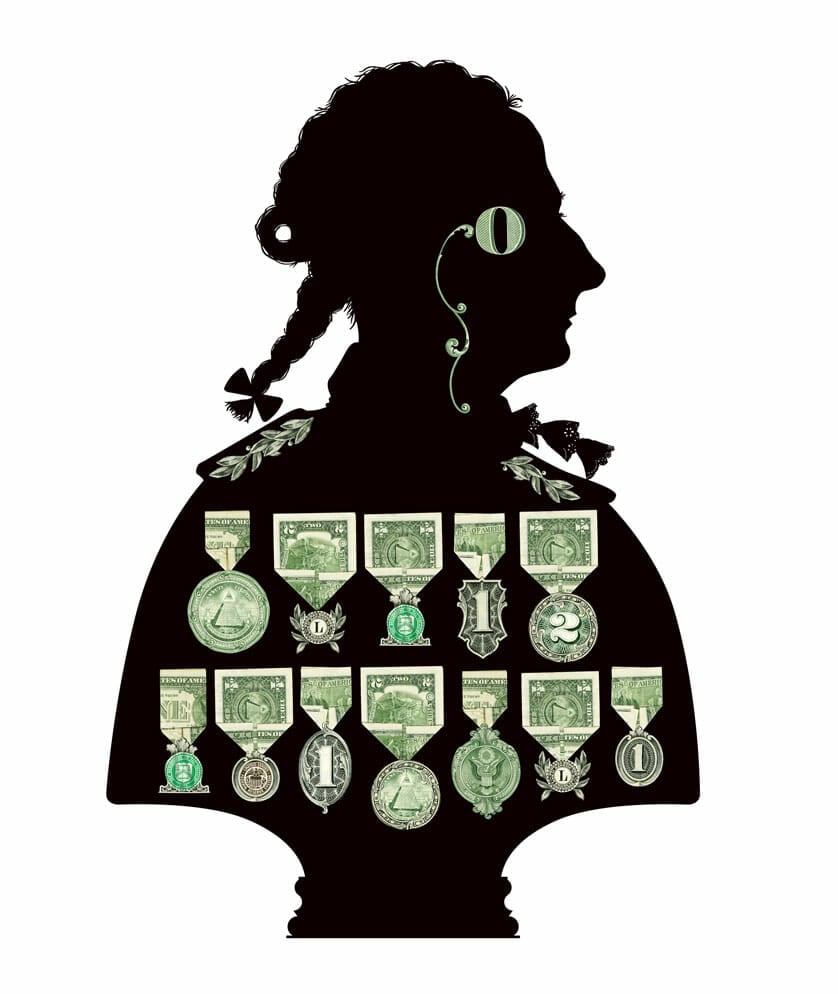
The Hamilton Hustle Why liberals have embraced our most dangerously reactionary founder, Matt Stoller No. 34 March 2017

The Hamilton Hustle

Why liberals have embraced our most dangerously reactionary founder

s

As Donald Trump settles into the White House, elites in the political class are beginning to recognize that democracy is not necessarily a permanent state of political organization. “Donald Trump’s candidacy is the first time American politics has left me truly afraid,” wrote Vox cofounder Ezra Klein just before the election. Andrew Sullivan argued in New York magazine that American democracy is susceptible, “in stressful times, to the appeal of a shameless demagogue.” Paul Krugman wrote an entire column on why republics end, citing Trump’s violations of political norms. But if you want to understand the politics of authoritarianism in America, the place to start is not with Trump, but with the cool-kid Founding Father of the Obama era, Alexander Hamilton.
I’m not just talking about the actual founder, though we’ll come back to him. I’m talking about the personage at the center of the Broadway musical, Hamilton.
The show is a Tony Award–winning smash hit, propelling its writer, Lin-Manuel Miranda, to dizzying heights of fame and influence. It is America’s Les Misérables, an achingly beautiful and funny piece of theater about a most unlikely icon of democratic inclusiveness, Alexander Hamilton.
I’m not going to dissect the show itself—the politics of it are what require reexamination in the wake of Trump. However, it should be granted one unqualified plaudit at the outset: Miranda’s play is one of the most brilliant propaganda pieces in theatrical history. And its construction and success tell us a lot about our current political moment. Before it was even written, the play was nurtured at the highest levels of the political establishment. While working through its material, Miranda road-tested song lyrics at the White House with President Obama. When it was performed, Obama, naturally, loved it. Hamilton, he said, “reminds us of the vital, crazy, kinetic energy that’s at the heart of America.” Michelle Obama pronounced it the best art she had ever seen.
The first couple’s comments were just the leading edge of a cultural explosion of praise. Actress Kerry Washington called it “life changing.” Lena Dunham said, “If every kid in America could see Hamilton they would thirst for historical knowledge and then show up to vote.” Saturday Night Live featured a sketch wherein Lorne Michaels begged guest host Miranda for Hamilton tickets (“I can do a matinee!”). It’s perhaps harder to list celebrities who haven’t seen Hamilton than those who have. And in Washington, D.C., politicians who haven’t seen the show are considered uncool.
Admiration for the play crossed the political spectrum. Conservative pop-historian Niall Ferguson opened up a book talk, according to one witness on Twitter, “with a rap set to music inspired by Hamilton.” Former secretaries of the treasury praised it, from Tim Geithner to Jack Lew to Hank Paulson. So did Dick Cheney, prompting Obama to note that the wonder of the play was perhaps the only thing the two men agreed on. Trevor Noah asked if Bernie Sanders, who had just seen the play, ran for president just so he would be able to get tickets. Rahm Emanuel, the mayor of Chicago and former White House chief of staff, raised eyebrows by jetting off to New York City to see a performance of Hamilton the night after Chicago teachers went on strike.
Much of the turn toward white supremacy in the early 1800s can be laid at Alexander Hamilton’s feet.
It’s not just that Hamilton is about a founding father, and thus inherently making statements about who we are as a culture. It’s become a status symbol within the Democratic establishment, offering them the chastened consolation that they might still claim solidarity with the nascent American democracy of the eighteenth century that’s stubbornly eluded them in the present-day political scene. Hillary Clinton quoted the play in her speech accepting the Democratic nomination, and told a young voter, “I’ve seen the show three times and I’ve cried every time—and danced hard in my seat.” The play has become a political football in the era of Trump. When Trump’s vice president, Mike Pence, saw the show, one of the cast members read him a special note, written by Miranda and several cast members, asking Pence to protect all of America. Hamilton cast members helped lead the Women’s March in Chicago to protest Trump’s inauguration. Right-wing website Breitbart has a hostile mini-Hamilton beat, noting that the play’s producers specifically requested non-white actors to fill the cast.
And after Trump won, Hamilton became a refuge. Journalist Nancy Youssef tweeted she overheard someone at the Pentagon say, “I am reaffirming my belief in democracy by listening to the Hamilton soundtrack.”
Beast Master
What’s strange about all of this praise is how it presumes that Alexander Hamilton was a figure for whom social justice and democracy were key animating traits. Given how Democrats, in particular, embraced the show and Hamilton himself as a paragon of social justice, you would think that he had fought to enlarge the democratic rights of all Americans. But Alexander Hamilton simply didn’t believe in democracy, which he labeled an American “disease.” He fought—with military force—any model of organizing the American political economy that might promote egalitarian politics. He was an authoritarian, and proud of it.
To assert Hamilton disliked democracy is not controversial. The great historian Henry Adams described an evening at a New York dinner, when Hamilton replied to democratic sentiment by banging the table and saying, “Your people, sir—your people is a great beast!” Hamilton’s recommendation to the Constitutional Convention, for instance, was to have a president for life, and to explicitly make that president not subject to law.
Professional historians generally avoid emphasizing Hamilton’s disdain for the people, at least when they write for the broad public. Better to steer safely clear of the freight train of publicity and money behind the modern Hamilton myth. One exception is amateur historian William Hogeland, who noted in a recent Boston Review essay that Hamilton had strong authoritarian tendencies. Hamilton, he wrote, consistently emphasized “the essential relationship between the concentration of national wealth and the obstruction of democracy through military force.”
Indeed, most of Hamilton’s legacy is astonishingly counter-democratic. His central role in founding both the financial infrastructure of Wall Street and a nascent military establishment (which supplanted the colonial system of locally controlled democratic militias) was rooted in his self-appointed crusade to undermine the ability of ordinary Americans to govern themselves. We should be grateful not that Hamilton structured the essential institutions of America to fit his vision, but that he failed to do so. Had he succeeded, we would probably be living in a military dictatorship.
Father of Finance
Viewers of the play Hamilton have a difficult time grasping this point. It just seems outlandish that an important American political official would argue that democracy was an actively bad system. Sure, America’s leadership caste has done plenty on its own to subvert the legal norms and folkways of self-rule, via voting restrictions, lobbying and corruption, and other appurtenances of access-driven self-dealing. But the idea of openly opposing the hallowed ideal of popular self-government is simply inconsistent with the past two hundred years of American political culture. And this is because, in the election of 1800, when Hamilton and his Federalist allies were finally crushed, America repudiated aristocracy and began the long journey toward establishing a democratic political culture and undoing some, though not all, of the damage wrought by Hamilton’s plutocratic-leaning Federalist Party.
Hamilton’s name practically became an epithet among Democrats of the New Deal era, which makes it all the more surprising that he is the darling of the modern party.
Indeed, the shifting popular image of Hamilton is itself a gauge of the relative strength of democratic institutions at any given moment. In the roaring 1920s, when Wall Street lorded it over all facets of our public life, treasury secretary Andrew Mellon put Hamilton’s face on the ten-dollar bill. Mellon was the third richest man in the country, famous for, among other things, having his brother and chairman of one of his coal mining subsidiaries extoll the virtues of using machine guns to enforce labor discipline. Mellon himself, who later presided over the Great Depression, was routinely lauded by big business interests as the “greatest secretary of the treasury since Alexander Hamilton.” Big business leaders in Pittsburgh, such as Andrew Carnegie and Henry Clay Frick, worshipped Hamilton (as well as Napoleon).
During the next decade, as populists put constraints on big money, Hamilton fell into disrepute. In 1925, Franklin Delano Roosevelt, then just a lawyer, recognized Hamilton as an authoritarian, saying that he had in his mind after reading a popular new book on Hamilton and Jefferson “a picture of escape after escape which this nation passed through in those first ten years; a picture of what might have been if the Republic had been finally organized as Alexander Hamilton sought.” By 1947, a post-war congressional report titled “Fascism in Action” listed Hamilton as one intellectual inspiration for the Nazi regime. Hamilton’s name practically became an epithet among Democrats of the New Deal era, which makes it all the more surprising that he is the darling of the modern party.
Within this context, it’s useful to recognize that Hamilton the play is not the real story of Alexander Hamilton; rather, as historian Nancy Isenberg has noted, it’s a revealing parable about the politics of the finance-friendly Obama era. The play is based on Ron Chernow’s eight-hundred-page 2004 biography of Hamilton. Chernow argues that “Hamilton was an abolitionist who opposed states’ rights, favored an activist central government, a very liberal interpretation of the Constitution and executive rather than legislative powers.” Hamilton, he notes, “sounds . . . like a modern Democrat.” The abolition arguments are laughably false; Hamilton married into a slaveholding family and traded slaves himself. But they are only part of a much broader obfuscation of Hamilton’s politics.
No Accidental Coup
To understand how outrageous Chernow’s understanding of Hamilton is, we must go through a few key stories from Hamilton’s life. We should probably start with the Newburgh Conspiracy—Hamilton’s attempt to foment a military coup against the Continental Congress after the Revolution. In 1782 several men tried to organize an uprising against the Continental Congress. The key leader was Robert Morris, Congress’s superintendent of finance and one of Hamilton’s mentors. Morris was the wealthiest man in the country, and perhaps the most powerful financier America has ever known, with the possible exception of J. P. Morgan. His chief subordinate in the plot was a twenty-seven-year-old Hamilton, former aide-de-camp of George Washington and delegate to the Congress.
After the war, army officers, then camped out in Newburgh, New York, had not been paid for years of service. Morris and Hamilton saw in this financial-cum-political crisis an opportunity to structure a strong alliance between the military elite and wealthy investors. Military officers presented a petition to Congress for back pay. Congress tried to pass a tax to pay the soldiers, while also withholding payments owed to bondholders. Hamilton blocked this move. Indeed, according to Hogeland, “when a motion was raised to levy the impost only for the purpose of paying army officers, Hamilton shot it down: all bondholders must be included.” Meanwhile, Morris and Hamilton secretly encouraged General Horatio Gates at Newburgh to organize a mutiny. After unifying investors and the military elite, Morris and Hamilton calculated that the military officer corps would threaten Congress with force unless the Articles of Confederation were amended to allow full federal taxing power by federal officials. This coup attempt would then, they reasoned, force Congress to override state governments that were more democratic in their approach to political economy, and place aristocrats in charge.
According to Hogeland,
In Morris’s plan these taxes, collected not by weak state governments but by a cadre of powerful federal officers, would be earmarked for making hefty interest payments to wealthy financiers—including Morris himself, along with his friends and colleagues—who held millions of dollars in federal bonds, the blue-chip tier of domestic war debt.
The mutiny itself failed due to a public statement by George Washington opposing a military uprising. But in broader terms, the plot succeeded, once Washington promptly warned Congress about the unstable situation and urged that they take drastic action to centralize and federalize the structure of the American republic. Military officers received what would be the equivalent today of multi-million-dollar bonuses, paid largely in federal debt instruments. This effectively institutionalized the elite coalition that Morris and Hamilton sought to weaponize into a tool of destabilization. The newly unified creditors and military officers formed a powerful bloc of aristocratic power within the Congress that pushed hard to dramatically expand federal taxing power. This group “set up [Hamilton’s] career,” Hogeland writes, because by placing him in power over their asset base—a national debt—they would assure a steady stream of unearned income. Chernow obscures Hamilton’s participation in the mutiny, claiming in a rushed disclaimer to preserve his hero’s honor that Hamilton feared a military uprising—but he then proceeds to note that Hamilton “was playing with combustible forces” by attempting to recruit Washington to lead the coup. It’s a howling inconsistency bordering on falsification.
Snobs at the Falls
When Hamilton became Washington’s secretary of the treasury, he swiftly arranged the de facto payoff of the officer group at Newburgh, valuing their bonds at par and paying them the interest streams they wanted. Here was perhaps the clearest signal that the Federalist Party was structured as an alliance between bondholders and military elites, who would use a strong central government as a mechanism to extract money from the farming public. This was Hamiltonian statecraft, and it was modeled on the political system of the Whigs in Great Britain, the party of “monied interests” whose power was anchored by the Bank of England.
Chernow, a longtime Wall Street Journal financial writer, portrays Hamilton as a visionary financial genius who saw beyond the motley array of foolish yeoman farmers who supported his ideological foe Thomas Jefferson. In lieu of the static Jeffersonian vision of a yeoman’s republic, Chernow’s Hamilton is reputed to have created a dynamic, forward-looking national economy—though it’s more accurate to say that Hamilton was simply determined to shore up the enduring basis of a financial and industrial empire. Hillary Clinton even quoted the play paraphrasing Hamilton’s line, “They don’t have a plan—they just hate mine.” But in fact, there were competing modern visions of finance during the period, as Terry Bouton showed in Taming Democracy. And the one we have today—a public central bank, substantial government involvement in credit markets, paper money—has characteristics of both.
We should be grateful for Hamilton’s failures. Had he succeeded, we
would probably be living in a military dictatorship.

True to their own aristocratic instincts and affiliations, Hamilton and his mentor Morris wanted to insulate decision-making from democratic influence. Morris told Congress that redistributing wealth upward was essential so that the wealthy could acquire “those Funds which are necessary to the full Exercise of their Skill and Industry,” and thereby promote progress. While in office, Hamilton granted a group of proto-venture-capitalists monopoly control over all manufacturing in Paterson Falls, New Jersey, the site of some of the most powerful waterfalls on the East Coast. Hamilton, who captained this group of investors, thought it would power a network of factories he would then control. Among the prerogatives enjoyed by the funders of the Paterson Falls project was the authority to condemn lands and charge tolls, powers typically reserved to governments. More broadly, in the fight to establish a for-profit national bank owned and controlled by investors, he placed control over the currency in the hands of the wealthy, linking it to gold and putting private financiers in charge.
Morris and Hamilton sought, as much as possible, to shift sovereign powers traditionally reserved for governments into the hands of new chartered institutions—private corporations and banks—that would be strategically immunized from the democratic “disease.” These were not corporations or banks as we know them; they were quasi-governmental institutions with monopoly power. Jefferson sought to place an anti-monopoly provision in the Constitution precisely because of this well-understood link between monopoly finance and political power.
Chernow portrays this far-reaching debate over the future direction of America’s productive life as a byproduct of Hamilton’s unassailably noble attempt to have the federal government retire the Revolutionary War debt. This is simply false (and a very common lie, expressed with admiration by other prominent Hamilton fans like Alan Greenspan and Andrew Mellon). Hamilton wanted a large permanent debt; he wanted it financed so his backers could extract a steady income from the people by way of federal taxes. To pay off the debt would be to kill the goose laying the golden egg. By constricting the question of democracy to a question of accounting, Chernow misrepresents what was really at stake. It was a fight over democracy, authoritarianism, and political economy—and in many ways, the same one we’re having today.
The Gold Standard and the Iron Fist
In the 1780s and 1790s, Hamilton won this battle, and the effects were catastrophic. Interest rates shot up as a monopoly of finance gathered in the hands of the merchant class. The debt was owned by the wealthy, while ordinary farmers who had fought in the Revolution had to pay the tax in gold that they didn’t have. It was a heavily deflationary policy, and the era after the Revolution saw an economic contraction similar in size to that of the Great Depression, with a foreclosure crisis as severe. According to Bouton, “There were more Pennsylvanians who had property foreclosed by county sheriffs during the post-war decades than there were Pennsylvania soldiers who fought for the Continental Army.”
Protests broke out in the western parts of the country, similar to pre-Revolution-era revolts against the British, who, in extracting revenues for the Crown and its allies, were pursuing the same policies that Hamilton did. These protests were a response not to taxes, but to the specific tax structure Hamilton constructed. Western farmers, though not poor, had little access to cash, so they used whiskey as currency—a medium of exchange that farmers in many cases produced sporadically in backyard stills. Hamilton’s tax was a political attack on these farmers, whom he saw as his political opponents. The levy targeted whiskey because western farmers had converted this commodity into a competitive monetary system. The whiskey levy was also regressive, with a low rate on industrial distillers and a high rate for small farmers, with the goal of driving the farmers out of the whiskey business. Furthermore, Hamilton placed the collection authority for the tax in the hands of the wealthiest big distillers, who could then use it to drive their smaller competitors out of business. This was all intended not only to destroy the political power of small farmers, but to foment a rebellion that Hamilton could then raise an army to crush. And that’s just what happened.
In 1795, Washington and Hamilton raised more than ten thousand troops to march into Western Pennsylvania, the strongest redoubt of opposition to the new tax (known forever after as the Whiskey Rebellion). Washington, halfway through the march and perhaps doubting the wisdom of this use of military power, handed over command to Hamilton, and went home. Entrusted with executive power, Hamilton used indefinite detention, mass arrests, and round-ups; seized property (including food stores for the winter); and had soldiers administer loyalty oaths. He also attempted to collect testimony to use against his political enemies, such as William Findley and Albert Gallatin (who would later be Jefferson’s and Madison’s secretary of the treasury), which he “hoped to use,” as Hogeland writes, “to silence his political opponents by hanging them for treason.” This is the strong-armed tyranny that David Brooks (to take one among countless exemplars of latter-day Hamilton worship) celebrates when he says that Hamilton gave us “the fluid capital markets that are today the engine of world capitalism.” It is also, far from incidentally, what John Yoo cited as precedent when defending George W. Bush’s national security policies.
Similarly, Hamilton’s fights with John Adams in the late 1790s represented one of the most dangerous periods in American history, akin to the McCarthy era on steroids. The latter part of the French Revolution was as shocking to Americans of the early republic as the 1917 Russian Revolution was to their modern successors. It stoked the widespread fear among Federalists that any talk of democracy would lead to similar guillotine-style massacres; they began referring to Jefferson’s supporters as “Jacobins”—an epithet that was the 1790s equivalent of “terrorist” or “communist.” This was the era of the Alien and Sedition Acts, which made criticism of the government a federal crime. But in addition, and more frighteningly, Hamilton constructed the only partisan army in American history (titled the “New Army”) and tried to place himself at the head of it. Only Federalists could be officers. He envisioned himself leading an expedition into Florida and then South America, and mused aloud about putting Virginia “to the test” militarily. Ultimately, Adams—perhaps the most unlikely savior of self-governance in the annals of our history—figured out what Hamilton was doing and blocked him from becoming a New World Napoleon. The New Army was disbanded, and our military established a tradition of nonpartisanship.
Another Near Miss
When Thomas Jefferson won the presidency, he described that year’s presidential election as the “Revolution of 1800,” precisely because it was proof that self-government could work. Unlike the succession from Washington to Adams, this was a change in party control, the first peaceful transfer of power in a republic in modern history. Most popular accounts of the hard-fought 1800 ballot focus on Hamilton’s relationship with John Adams, his endorsement of Jefferson, and the Burr-Jefferson soap opera—and how all of these personal intrigues culminated in an eventual tie among electors. In fact, this is so well known that liberals unhappy with the outcome of the 2016 election tried to convince members of the Electoral College to overturn Trump’s victory, and titled their project “Hamilton electors.”
But there’s a darker story of the 1800 deadlock. It involves the more extreme wing of the Federalist Party, which simply tried to have the election overturned, risking civil war to do so. Federalists were inflamed at a host of purported Republican outrages, including the party’s opposition to the Alien and Sedition Acts and to the creation of the New Army. They also claimed the Republicans were sympathetic to France (with which we were then engaged in a post-Revolutionary “quasi-war”) and abetted domestic disturbances like the Whiskey Rebellion and a similar uprising a few years later known as the Fries’s Rebellion. In 1799, Federalists put forward “the Ross bill” to have the Senate effectively choose the next president by empowering a select committee to disallow electors. The bill was defeated by House members who didn’t want to delegate their authority to the Senate.
The Obama era looks like an echo of the Federalist power grabs of the 1780s, both in its glorification of financial elites and its disdain for true economic democracy.
Then, after the election, Federalist allies in the lame duck session of Congress were considering, according to Jefferson, “a law for putting the government into the hands of an officer of their own choosing.” Jefferson threatened armed resistance, and both Pennsylvania and Virginia began military preparations. Ultimately, the Federalists backed down. As historian James Lewis pointed out, the election of 1800 produced a peaceful transition of power, but that was not necessarily a likely outcome.
Hamilton lost, but not without bequeathing to later American citizens a starkly stratified political economy. Bouton argues that the defeats of the middle class in the 1780s and 1790s narrowed democracy for everyone. As poor white men found the freedoms for which they fought undermined by a wealthy elite, they in turn “tried to narrow the concept to exclude others.” Much of the turn toward a more reactionary version of white supremacy in the early 1800s, in other words, can be laid at Hamilton’s feet. Later on, Hamilton’s financial elite were ardently in favor of slave power. Manhattan, not any Southern state, was the first political entity to follow South Carolina’s call for secession, because of the merchants’ financial and cultural ties to the slave oligarchy. In other words, Hamilton’s unjust oligarchy of money and aristocracy fomented a more unjust oligarchy of race. The aggrieved rites of ethnic, racial, and cultural exclusion evident in today’s Trump uprising would no doubt spark a shock of recognition among the foes of Hamilton’s plutocracy-in-the-making.
Rites of the Plutocrats
Hamilton had tremendous courage, insight, and brilliance. He is an important Founder, and not just because he structured early American finance. His life sheds light on some deep-rooted anti-democratic forces that have always existed in America, and in particular, on Wall Street. Much of the far-reaching contemporary Hamilton PR offensive is connected to the Gilder Lehman Institute, which is financed by bankers who back the right-wing Club for Growth and American Enterprise Institute (and support Hamilton’s beloved gold standard). Robert Rubin in 2004 started the Hamilton Project at the Brookings Institution, which laid out the framework for the Obama administration’s financial policies. Chernow has made millions on books fawning over J. P. Morgan, the Warburg financial family, and John D. Rockefeller. And thanks largely to the runaway success of Hamilton the musical, Chernow is now, bizarrely, regarded as a court historian of American democracy in the mold of Arthur Schlesinger Jr.
One of Hamilton’s biggest fans is Tim Geithner, the man who presided over the financial crisis and the gargantuan bank bailouts during the Obama presidency. In his 2014 memoir, Stress Test, Geithner wrote admiringly of Hamilton as the “original Mr. Bailout,” and said that “we were going to deploy federal resources in ways Hamilton never imagined, but given his advocacy for executive power and a strong financial system, I had to believe he would have approved.” He argues this was a financial policy decision. In doing so, he evades the pronounced anti-democratic impulses underlying the response to the financial crisis.
As economist Simon Johnson pointed out in a 2009 essay in The Atlantic titled “The Quiet Coup,” what the bailouts truly represented was the seizure of political power by a small group of American financiers. Just as in the founding era, we saw a massive foreclosure crisis and the evisceration of the main source of middle class wealth. A bailout, similar to one that created the national debt, ensured that wealth would be concentrated in the hands of a small group. The Citizens United decision and the ever-increasing importance of money in politics have strong parallels to the property disenfranchisement along class lines that occurred in the post-Revolutionary period. Just as turnout fell to record lows in much of the country in 2014, turnout collapsed after the rebellions were put down. And in another parallel, Occupy Wall Street protesters camped out across the country were evicted by armed guards—a martial response coordinated by banks, the federal government, and many Democratic mayors.
The Obama era looks like an echo of the Federalist power grabs of the 1780s and 1790s, both in its enrichment and glorification of financial elites and its open disdain for anything resembling true economic democracy. The Obama political elite, in other words, celebrates Hamilton not in spite of Hamilton’s anti-democratic tendencies, but because of them.
Set in contrast to the actual life and career of its subject, the play Hamilton is a feat of political alchemy—as is the stunningly successful marketing campaign surrounding it. But our generation’s version of Hamilton adulation isn’t all that different from the version that took hold in the 1920s: it’s designed to subvert democracy by helping the professional class to associate the rise of finance with the greatness of America, instead of seeing in that financial infrastructure the seeds of a dangerous authoritarian tradition.
In 1925, Franklin Roosevelt asked whether there might yet be a Jefferson to lead the forces of democracy against Hamilton’s money power. Perhaps someone—maybe Elizabeth Warren, who pointed out on PBS that Hamilton was a plutocrat—is asking that question again. That said, Hamilton is a great musical. The songs are catchy. The lyrics are beautiful. But the agenda is hidden, because in America, no political leader, not even Donald Trump, can credibly come right out and pronounce democracy a bad thing and agitate for rule by big finance. And the reason for that is that Alexander Hamilton, despite his success in structuring Wall Street, lost the battle against American democracy. Thank God for that.

Featured Story

Dejemos que la izquierda de Estados Unidos tenga cuidado! por Andrew Taylor 23.06.2021

La Administración Biden ha habilitado una nueva "Iniciativa contra el terrorismo doméstico" para defender "The Homeland"...