January 24, 2017

Developer Welfare: Trump’s Infrastructure Plan - MICHAEL HUDSON Jan 24 2017


Photo by Ninian Reid | CC BY 2.0

DONALD TRUMP: We are transferring power from Washington, D.C. and giving it back to you, the people.
CROWD: (applause)
DONALD TRUMP: For too long a small group in our nation’s capital has reaped the rewards of government while the people have borne the cost. Washington flourished but the people did not share in its wealth.


SHARMINI PERIES: On to discuss with me Trump’s infrastructure plan is Michael Hudson. Michael has a new book out, “J is for Junk Economics: A Guide to Reality in the Age of Deception” (February 2017). Michael is a Distinguished Professor of Economics at the University of Missouri, Kansas City. Thanks for joining us, Michael.
MICHAEL HUDSON: Good to be here.
SHARMINI PERIES: So, Michael, that first, I think it’s the third or fourth paragraph in, where he really talks about the establishment, how it benefitted Washington, I would think you would have objection to that.
MICHAEL HUDSON: Well, the establishment Trump talked about wasn’t really Wall Street. He said, “When Washington got rich.” Bernie Sanders would have said, “When Wall Street got rich, the country didn’t.” So I think when Donald Trump says “Washington,” what he means is the government regulatory agencies. He’s going to cut them back. And what he means is that the IRS, the tax collectors, he’s going to cut them back by cutting taxes on all the Americans, meaning all of the 1% that are his Americans.
So, basically, you’re seeing a cutback in government. I’m sure you will see a cutback in the CIA and the NSA that are parts of the Democratic National Committee and their Hillary supporters. So I think there is going to be a fight within the foreign policy and the national security establishment. But I think that what Trump is really doing is going to be supporting the same 1% that President Obama and George Bush were supporting.
SHARMINI PERIES: Right. And that’s pretty evident with the cabinet he’s lining up, as well — the richest cabinet in U.S. history. And he’s actually taking from the very establishment in Washington, as well as Wall Street. So I’m sure it’ll be doubled down on, in terms of the kind of establishment we’re talking about.
Michael, President Trump said something very interesting about building America, and building America in his own image, I think. Let’s have a look at what he had to say.
DONALD TRUMP: We will build new roads and highways and bridges and airports and tunnels and railways all across our wonderful nation. We will get our people off of welfare and back to work rebuilding our country with American hands and American labor. We will follow two simple rules: Buy American and hire American.
SHARMINI PERIES: So, Michael, what does he mean by this kind of infrastructure building?
MICHAEL HUDSON: Well, he’s talked a lot about infrastructure and there are a lot of different ways of doing infrastructure. I don’t think his way will be the way that it was done a hundred years ago. The whole idea of the Republican Party in the 19th century was for the government to finance infrastructure, and especially transportation, to lower the cost of living and doing business. But I don’t think that’s what Trump is going to do, because he wants to cut back government spending and he wants to cut back taxation. So what I worry about is when he says, “I’m going to build infrastructure” is that it means that he’s going to create a huge trillion-dollar market for Wall Street’s high finance.
They’re going to fund infrastructure by bondholders, and through private-public partnership, rail lines and transportation lines. Who are going to be the beneficiaries of this, and who’s going to pay for it all? If the government doesn’t pay for it, it’s going to be the bondholders and Wall Street. And the question is what is the cost of this transportation going to be, and who will be the main beneficiaries?
A hundred years ago, it was to build free roads and it was to lower the cost of living. But the reverse is happening today. Take for example the New York City subway’s Second Avenue Line, which was just finished a couple of weeks ago. It calls for $10 billion for just six stations.
The way this was funded is for the Metropolitan Transport Authority that runs the subways to borrow $10 billion from Wall Street. It pays bondholders interest, and will meet this cost by raising subway fares for all the riders in New York. To the extent that the New York City and New York State subsidize it, they’re going to raise sales taxes here, and also income taxes. So New Yorkers are going to have to pay more for the subway.
Who are the beneficiaries?
The politicians say, “Well, the people along the transport lines are going to be the beneficiaries – people who live on Second Avenue and First Avenue and York Avenue, who had to take those crowded Lexington subways.” But the real beneficiaries are the landlords. The $10 billion that’s been spent on the Second Avenue subway is probably increasing their land values, the real estate values of real estate developers by from $10 to $20 billion.
Already, wage-earners who live on Second Avenue – the supposed beneficiaries – are complaining that they’re being told their rents are going to go up by a couple of hundred dollars a month. Now that these neighborhoods have more easy transport, that makes it more valuable. So they’re worried that they can’t afford to live there anymore. They worry that they will have to move to Queens, Westchester or outside of New York City.
So there’s a giant windfall for the landlords, a give-away thanks to the subway that cost $10 billion, making $10-20 billion of “capital” (land-value) gains.
All this could have been financed by a windfall gains tax. If the subway and transportation, such as Mr. Trump wants to build throughout the United States, is going to increase the value of the rent of location for real estate landlords and developers, then there could have been a windfall gains tax. That would have captured all this $10 billion added value from the subway, to repay the MTA, the subway authority, for the cost of building it. But that hasn’t been done.
So what you have is the public paying for the 1% to benefit. That looks to me like the plan that Mr. Trump has. So when he says he wants to help all Americans, he means he wants to help all Americans in the 1% by really letting Wall Street get a huge debt from the 99% of the Americans. It’s just the opposite of what people believe.
The same fight is going on in Vancouver. They’re trying to spend about $6 billion in transportation up in Canada. How are they doing it? The transportation – the bus lines and train lines – are going to increase what already is the highest priced real estate in Canada. This promises to make a bonanza for the landlords. But they’re paying for this transportation by a 0.5% sales tax, that is going to cost consumers in Vancouver $250 million a year. So, again, the users of the transportation are having to pay, not the property owners along the route. They get the gains.
I think you could call this the Thorstein Veblen Law: that whenever there is a public expenditure on infrastructure, the benefits go to the absentee owners, the landlords. Civic improvement is basically a real-estate development.
So I think Mr. Trump wants to turn the U.S. economy into the kind of real estate development that has made him so rich in New York. It will make his fellow developers rich, and it will make the banks that finance this infrastructure rich, but the people are going to have to pay for it in a much higher cost for transportation, much higher cost for all the infrastructure that he’s proposing.
So I think you could call Trump’s plan “public investment to create private profit”. That’s really his plan in a summary, it looks to me.
SHARMINI PERIES: Right. And one interesting thing with the new administration coming in, and you have pointed to this, Michael, is that at least the good news here is that we’re not going to be going to war with Russia. Instead, I think we’re poking our finger in the eye of the Chinese government. Give us a sense of what your thoughts are on that.
MICHAEL HUDSON: Well, there’s been a whole argument in the establishment between Kissinger and Brzezinski. Both these men say, “We’ve got to divide and conquer. If another country tries to go its own way and be independent of America, we’ve got to smash it up. We’ve got to break up Russia and break up China.”
The question is what do the neocons do first? Kissinger says that the long-term enemy is China, because they’re smarter and larger. So you want to pry Russia away. You want to do nice to Russia and tell President Putin, “Look, if you go with us, we’ll give you Ukraine, we’ll pull back NATO, but we want to pry you back towards Europe and away from China.”
Brzezinski, being Polish, hates Russia and wants to go with China. So he says, “No, no. We’ve got to continue to fight Russia and back the Hillary group within the CIA and National Security Agency.”
It looks like Trump is following the Kissinger group, trying to split up Eurasia by backing Russia. I don’t think he has a chance in succeeding in this, because Putin can say, “Look, America changes its policies so much we can’t depend upon you. Obama and Secretary Kerry have broken every agreement that they have made with us. The Clintons have broken every agreement. We can’t trust America anymore. You’ve forced us to rely on China and Iran.” And, of course, China also is supporting Iran because of its oil investments there.
So I think the Trump administration will fail to break up Eurasia – to break up the Shanghai Cooperation Organization of Russia, China and Iran. At that point I think Trump may get angry and go back to the Hillary-type confrontation that looks very dangerous.
SHARMINI PERIES: What do you make of these allegations in terms of the intelligence agencies and the proximity of Trump and some of his aides in terms of their proximity to Russia?
MICHAEL HUDSON: I think the idea of proximity to Russia is fake. It’s a smear campaign, and President Putin has already warned Trump that this is an attempt by the Deep State, by the Russia haters, to threaten a coup d’etat.
I think one of the first things that Trump is going to do to roll back government is to clear out the fakers in the CIA – the people who’ve been faking or leaking these documents against him. He’s going to move against the fake news outlets, led by the New York Times and the Washington Post. They’re pushing unsubstantiated rumors. They’re claiming that it was Russia that somehow threw the election to Trump, instead of the leaks from the Democratic National Committee being leaks, not computer hacks.
So I think Trump is going to clean out the Democratic policy neocons from the CIA and NSA. That’s a good thing. I think he feels hostile enough toward Hillary after all of this. So a house-cleaning is probably the best thing that could happen.

The problem is, we don’t know whether the people he’ll bring in will just be mirror images on the other side, so that instead of being anti-Russian they’ll be anti-Chinese and have the same kind of fake news that they give to the New York Times and the Washington Post that they’ve been giving for the last few months. There’s certainly a crisis of real news reporting, a crisis of accusations. I’ve never seen anything like it.

Reflections on DC: Promises and Pitfalls in the Anti-Trump Uprising by ANTHONY DIMAGGIO, Jan. 24, 2017

JANUARY 24, 2017


The first mass protests of President Donald Trump represent a historic moment – one worth reflecting on so we can understand where we are and where we’re going as a nation. I traveled to Washington D.C. this weekend to take part in the Women’s March on Washington. The inauguration protests across the country provide an opportunity to analyze what is positive about the emerging anti-Trump movement, while also identifying weaknesses that must be addressed in the future. Speaking in general terms, the largest strength of this mass movement is its diversity, as related to gender, race and ethnicity, age, and economics. Such diversity is necessary for any meaningful bottom-up push for social change. If there is one glaring weakness coming out of these protests, it is the underdeveloped sense of economic grievance, in terms of the failure to spotlight the neoliberal, bi-partisan injustices that have emerged in recent decades.
First, the basic details.  In terms of turnout, the DC metro service estimates that approximately 600,000 people attended the protest events on Saturday, January 21 on the national mall. This number likely under-estimates the turnout, since it doesn’t include the more than 1,200 buses that made it to DC, in addition to DC residents near the downtown who participated, and those already in the downtown, housed in hotels and other accommodations, who did not use of the train. A more realistic estimate would perhaps be between 700,000 to 800,000 protesters. When accounting for demonstrations in Chicago, New York City, Los Angeles, and other cities, estimates suggest the number of protesters surpasses 3 million. These figures appear to be unprecedented in American history
I bring up these numbers to emphasize the sheer magnitude of these protests. I’ve been traveling to DC for mass protests for the last decade and a half. I’ve taken part in many demonstrations and marches, against the IMF, the World Bank, the Iraq war, nuclear power, the “War on Drugs,” sexism, and climate change. I’ve seen many protests during my time as an activist, some with hundreds of thousands turning out, but nothing equaling the size of this demonstration. The size and scope was unprecedented. Heading into the city from Arlington, Virginia, it was a struggle simply to get on the metro, with rail cars filled to maximum capacity and protesters packed in like sardines. Upon arrival at the mall, I struggled to even get out of the metro stop, and it was no better once I stepped out onto the streets above. The demonstrations took place near the Washington monument, but the streets were so incredibly crowded that it was difficult to move at all. March organizers predicted at least a few hundred thousand would turn out, but the numbers were far larger.
Organizationally, the march was marked by, and ended in chaos. But that was only because of the unprecedented turnout. By noon, although the march wasn’t slated to start for another hour, it was near impossible to get anywhere near the event speakers, let alone move around with any freedom. Once the march began, protesters were quickly blocked because of the feeder marches, which created choke points in main intersections. The spill over into neighboring streets outside the march route was massive. Between a half hour to hour into the rally, the planned march route was largely abandoned. The critical mass of people had grown so large that movement in any systematic, planned way was no longer possible. I sat in one intersection, waiting for nearly an hour, just to move a few feet.
I’ve heard some left dissidents criticize anti-Trump protesters for refusing to engage in radical disobedience via shutting down major traffic arteries in cities, and preferring instead to simply demonstrate and march along pre-planned routes. I completely understand the sentiment that civil disobedience is preferred to pre-planned “safe” marches, but this criticism largely misunderstands just how massive the DC protest was. Even if most demonstrators traveled to DC without the intent to block traffic and shut the city down, these outcomes were achieved nonetheless, simply due to the massive number of people saturating the downtown and the spillover outside the planned march route into adjacent streets.
In the end, radical activists couldn’t have asked for much more on this day than a pacified DC police force and a city that was shut down via the size of the march alone. The police presence in the national mall and surrounding areas could be described as minimal. Any hope of “containing” the protest to the pre-designated march route was futile, and the police knew it. Reflecting on the quiescence of local police, there is a radical message to be learned: how quickly authority structures dissipate when the masses of people use their bodies as weapons against repression. If I drew any major lesson from this protest, it is just how precarious systems of authority are when the masses of people choose to disobey them. Any talk about enforcing “permitted protest routes” was ultimately moot when demonstrators flooded the streets of our nation’s capital in historic numbers and greatly outnumbered the police forces brought in to “contain” their presence.
The politics of the protesters could be best described as mixed and eclectic. Contrary to silly outside caricatures of the demonstrators as pawns of MoveOn.org and George Soros, the ideologies of protesters were wide ranging, and could not be boiled down to one or two main issues, or simply to individuals being dupes of the Hillary Clinton presidential campaign. Based on discussions with protesters, placard messages, and various chants, it was clear just how varied individuals’ grievances are. They include anger over the Trump administration’s sexism, racism, and xenophobia, opposition to repeal of the Affordable Care Act and support for universal health care, protests of the mounting climate change crisis, condemnations of Trump’s proto-fascistic politics, support for Planned Parenthood, opposition to Islamophobia, support for Black Lives Matter, and distrust of Trump and his appointees due to their plutocratic backgrounds. If I had to pinpoint a single message that emerged from this protest, it was the need for Americans to develop a much deeper sense of empathy with all types of socially and economically disadvantaged groups, including people of color, women, the disabled, immigrants, and the poor. This is as positive a message for progressive change as I can think of, and it’s badly needed in a country with tens of millions of people who support or tolerate a reactionary political culture of narcissism, bigotry, extreme-individualism, discrimination, and class prejudice against the working class and poor.
The demographics in DC were quite diverse. Although there were clearly more women than men, the male presence was large, demonstrating that feminism is hardly just a “woman’s issue.” Protesters were a healthy mix of young and old, racially and ethnically diverse, and ideologically pluralistic. In a positive sign of the mainstreaming of protest in America, many parents brought their children, aged from infants through teens.  Clearly, the battle against Trump is fundamentally linked to the prospects for democracy and with the link to future generations in mind.
The above points are not meant to romanticize the DC protest. There were a few major shortcomings that should be identified, if we’re to understand how this movement must change as the Trump administration seeks to implement its reactionary, pro-business agenda. First, the anti-imperialist contingent of the protest was noticeably absent. Very few protesters openly identified as a primary concern any sort of opposition to U.S. militarism. To put it bluntly, without a clearly articulated anti-imperialist message, it will be difficult to impossible to build toward any real progressive future for this country that challenges the bi-partisan support for the military war machine. Secondly, the sense of economic grievance, as reflected in opposition to the mounting plutocracy and record inequality in America, was noticeably lacking and underdeveloped. Condemnation of corporate kleptocracy and the dominance of politics and society by a bi-partisan establishment of political-economic elites needs to be central to future protest messages, and it simply wasn’t a very strong part of this demonstration. Without developing a coherent message that rejects empire and neoliberal plutocracy, this movement will likely fall into the old trap of being co-opted by Democratic Party elites with little interest in addressing these grievances. This has already happened to a significant extent, in that I think any honest leftist would admit that the mass pre-inaugural protests would have been extremely unlikely had Hillary Clinton been the one sworn in.
Still, to dismiss the protesters as unwitting pawns of the Democratic-Wall Street establishment is silly. The messages sent to the incoming Trump administration and Congressional Republicans are substantive, and need to be taken seriously by the American people. Sexism, racism, xenophobia, fascism, climate catastrophe, and the assault on the social welfare safety net are real problems, and those protesting them are voicing legitimate grievances. They cannot be simply swept under the rug in favor of an exclusive focus on anti-imperialism and opposition to neoliberal economics. Rather, all these issues need to be brought together in future rallies and demonstrations. It is certainly fair to criticize many protesters for a naïve romanticization of the Obama administration and Hillary Clinton’s politics. There were, after all, a significant contingent of protesters who visibly articulated a pro-Democratic establishment message that is increasingly tone deaf to recognizing the ways in which the party contributes to economic inequality and corporate power, and resists dismantling the American plutocracy.
Fortunately, the effort to further radicalize many protesters on the liberal-progressive left may not be as difficult as some think. My conversations with many progressives who voted for Hillary Clinton over the last six months reveals a group of people who are actually far to the left of the Democratic establishment on issues such as strengthening the welfare state, universal health care, government regulation on Wall Street, climate change, and mounting inequality. The politics of this liberal-left contingent fit well within a Sanderist vision of political change. What is missing is a realization from many people that the Democratic Party, as currently constituted, is not up to the task of fighting for progressive or radical deviation from the status quo. Simply put, this is a “good” problem to have, in that it’s much easier to influence vote choices and future political behavior when engaging with people who share a pre-existing agreement with the leftist policy positions.
Contrary to many of the efforts from Democratic officials, much of the country is refusing to normalize a kleptocratic administration that openly flirts with fascist politics and gives little indication of any commitment to helping the masses of middle, working class, and poor Americans.  Ultimately, however, the anti-Trump movement must morph into something much grander if we are to reverse the march toward plutocratic politics. The protests of tomorrow cannot simply be about how bad Trump is. To limit protests to this issue means handicapping any movement toward positive, progressive change. Rather, the goal must be to oppose Trump by building an overarching message that prioritizes bottom-up democracy, inequality reduction, anti-imperialism, environmental sustainability, poverty reduction, and a roll back of racism, sexism, xenophobia, and protecting citizens’ basic rights.


Anthony DiMaggio is an Assistant Professor of Political Science at Lehigh University. He holds a PhD in political communication, and is the author of the newly released: Selling War, Selling Hope: Presidential Rhetoric, the News Media, and U.S. Foreign Policy After 9/11 (Paperback: 2015). He can be reached at: anthonydimaggio612@gmail.com

Welfare Dependency: The need for a historical critique, Andy Blunden April 2004

Andy Blunden April 2004
Welfare Dependency:
The need for a historical critique

The Welfare State is under sentence of death, and the charge is supporting a culture of ‘dependency.’
‘The problem with welfare is that it operates too much like charity. ... Patrons exercise their power and control without an expectation of reciprocity. Clients are denied a sense of social worth and equality. Dependency is the inevitable result. ... unconditional welfare is a crime against the poor.’ [The Enabling State, Mark Latham, 2001]
An ALP government would be in a better position to carry out this sentence, in fact, than any conservative government. As absurd as Latham’s rhetoric of “mass capitalism”, “mutual responsibility” and “self-reliance” may be, it must be taken seriously.
The idea of ‘dependency’ is at the centre of all critiques of the welfare state, and is a notion that has considerable traction right across the political spectrum. ‘Dependency’ is an historically constructed notion and working out a critique of the existing range of welfare policies requires a deconstruction of the whole notion of dependency itself.
Approaches to the problem of dependency must go into how it is constructed both as a concept and as a psychological, moral and social condition. Philip Mendes raised these questions in Arena Magazine No. 69, looking into the causes of dependency. However, it is not just that relations of dependence are structurally imposed, but that one and the same relation of dependency may be enjoyed as a powerful and respected social position, according to its political-ethical evaluation. Dependency is not just something to be cured.
Nancy Fraser’s 1997 book Justice Interruptus contains her article, co-authored with Linda Gordon, tracing the genealogy of the word ‘dependency’. Much of what I have to say below draws on insights provided by this article, though I also depart from Nancy Fraser’s analysis at times.
Over a period of two hundred years the meaning of dependency has moved from the honourable social condition of the overwhelming majority of the population to a highly stigmatised personality disorder. From beginning to end of the long history of dependency, however, the word has contained a curious contradiction.
In pre-modern times, dependency meant being part of a social unit (estate, family, empire) that was headed by someone else. Dependants (such as servants, retainers and peasants in an feudal estate, wives and children) were ‘dependent’ in the sense that they had no legal status in society at large, and were ‘represented’ by their ‘master.’ But in actuality (in retrospect, if you like), the ‘master’ was ‘dependent’ on everyone else in the unit for their material existence.
The young, single mother is today the icon of dependency and yet it is not she who is dependent in any material sense, but the children she looks after. If she did not accept legal responsibility for the child, then she would not need welfare payments. But she raises her children, generally under incredibly difficult conditions, while the father and the state, who are both also responsible for the support of the child, are free-riding on her efforts - depending on her, in fact - to do what they will not.
In Australia, the other icons of ‘dependency’ are Aboriginal communities; the settler nation is able to exist only by occupying their land and excluding the Indigenous people from the traditional use of their land. And yet the ideology of ‘dependency’ holds that is they, not us, who are ‘dependent.’
The stigma of dependency seems to rub off on the people who do the supporting. Being independent, on the other hand, is a socio-legal relation enjoyed by people who are supported by the labour of others. But let us follow how the notion of dependency has changed over time.
Pre-capitalist society
The earliest definition of the verb ‘to depend on’ in the Oxford English Dictionary is consistent with the usage of the word in Hegel’s Phenomenology, in the section entitled Independence and Dependence of Self-Consciousness, more widely known as ‘the master-slave dialectic.’ To ‘depend on’ meant ‘to be connected with in a relation of subordination’, sub-ordination equals lower in a status order. From the sixteenth century, a ‘dependent’ was one ‘who depends on another for support, position, etc.; a retainer, attendant, subordinate, servant’.
The points to note about the concept of dependency at this time, in pre-capitalist England, are that:
  • the concept was not differentiated into separate socio-legal, economic and psychological usages, but rather reflected the fusion of various forms of hierarchy in a society in which these forms of subordination were themselves fused and ubiquitous;
  • the condition of dependency was perfectly respectable and covered the vast majority of people, excluding only the top layer of the nobility on one side, and vagabonds and foreigners on the other. Everyone was subordinate to someone else but did not thereby incur individual stigma.
The term ‘independence’ was at first only applied to aggregate entities, not to individuals, ‘independence’ coming to be used in relation to churches or nations in the seventeenth century. By the eighteenth century, an individual could be said to have an ‘independency’, meaning an ownership of property that made it possible to live without labouring. Dependency, by contrast, was characteristic of the condition of the majority, of wage labourers as much as serfs, of men as well as women. Dependency, therefore, was a normal, as opposed to a deviant, condition - a social relation, not an individual trait.
To be outside this system of relations, such as was the case for those driven off their land during the Enclosures, was the worst of all possible fates. These paupers and vagabonds were the ‘human dust’ out of which the modern wage-labourer was fashioned. While wage-labour did enter the relations within the landed estates, more significantly, wage-labour grew from this human dust being sucked into the factories and the formerly independent craftspeople who lost their modest independence and were brought down to the condition of factory workers.
The distinctively modern relation of wage-labour became ‘respectable’, and recognised as a form of independence, through the battles for civil and electoral rights, which constituted the organised working class as a subject.
The idea that being a member of the retinue of a feudal noble was a form of dependency, while being a wage-worker was not a form of dependency, was therefore not merely the re-branding of a form of dependency - a real change in social relations had been achieved. Famously, wage-slavery differed from slavery by giving the worker the freedom to starve. The worker did not begin from a base of dependency within a feudal estate, but rather from ‘independence’, that is to say, from being outside the relations which guaranteed rights, both material and political, to the peasant or servant, subsumed within the personality of a feudal lord.
Capitalism did not, of course, abolish subordination of women by men and nor did it abolish colonialism. On the contrary, legal coverture of women, that is the ‘representation’ of married women by their husbands, and the subordination of the colonies, meant that dependency now took on an association with the normal condition appropriate to women, slaves and ‘natives’.
With the separation of economic dependency - now the honourable condition of wage-labour - from socio-legal dependency, still appropriate for paupers, slaves and ‘natives’, came a new kind of dependant, invented in the twentieth century, the ‘housewife’. Even while socio-legal forms of subjugation of women were being battered down by the suffragettes in the early twentieth century, new forms of economic subjugation were being put in place through the collaboration of trade unions, the courts and employers, and institutionalised in the Harvester Decision, the gender division of labour and female rates of pay. Domestic labour was institutionalised within a new form of patriarchal subjugation. Continuing the pre-industrial assumption that fathers headed households and ‘represented’ the other members of the household, the now-unsustainable socio-legal forms of ‘dependency’ were replaced by new forms of economic subordination. While wage-labour was deemed a form of independence, domestic labour was a form of dependency, moreover one deemed appropriate for women.
As the colonised nations threw off the mantle of dependency in the national liberation struggles of 1945-75, in the West dependency now took on a distinctively female connotation, not sustainable in its original socio-legal or political forms, but instituted in economic form. The feminisation of dependency, now economic in appearance, accentuated the stigmatisation of dependency already tied up in the racist connotation of dependency inherited from colonialism.
The aura of ‘independence’ for white male workers was built on consent in the economic subjugation of women. Employers backed up the idea by excluding women from well-paid jobs and governments introduced the category of ‘dependent’ for wage-earners to claim tax deductions for ‘supporting’ a wife.
Public Assistance
Economic hierarchy as exercised in the employment relationship, was made acceptable in the nineteenth century - an invisible kind of ‘voluntary’ subordination, not subsumed under the relation of dependency. Once political and socio-legal dependency had been formally abolished, it appeared that the only barrier to a person’s independence could be moral/psychological, a new register of dependency.
In Australia, old age pensions were introduced in the wake of the depression of the 1890s, and further benefits for the deserving poor flowed over the next 60 years. In the US, it was the New Deal in the wake of the 1930s Depression which introduced these ‘respectable’ benefits. Old age, sickness, unemployment benefits and so on, aggravated the stigma attached to ‘welfare dependency’ in direct proportion to the way they made other benefits ‘respectable.’ By setting up accounting fictions to create the appearance that people who received old age, widows’, veterans’ or unemployment benefits were only getting back what they had put in, they created the two-track benefit system. Those who were deemed not to have ‘contributed’ were paid out of general revenue, and subject to means tests, moral supervision and all kinds stigmatising humiliations on top of a miserly level of benefit; workers suffering temporary periods of unemployment, veterans and old age pensioners were deemed not to be receiving ‘public assistance’, but simply receiving their ‘just deserts.’
US Blacks and women were deliberately excluded from these ‘first-track’ schemes, just as in Australia indigenous people were excluded, while today’s ‘self-funded retirees’ live off the profits extracted by capital from those still in work, and yet enjoy the honourable status of being deemed to be ‘independent’. For selected groups, however, the stigma of ‘welfare dependence’ is added with correspondingly greater intensity to the insult of poverty.
The period of the rise of the welfare state corresponded to the institutionalisation of the organised working class movement. The early trade unions were just as much ‘friendly societies’ as they were ‘class struggle’ organisations; the ‘strike fund’ was an account alongside the ‘distress fund’; and the construction of working class consciousness was just as much tied to the protection of members in their times of need as it was to solidarity on the picket line. The objectification of workers’ ‘mutual aid’ in the welfare state meant that these functions were secured as rights, at the same time as separating them from voluntary class struggle associations. So long as people enjoyed these benefits as universal rights attached to citizenship, like public education, then this is hardly problematic, but this is not always the case.
The very formation of the working class was bound up in systems of mutual aid; a hundred years ago the workers’ movement succeeded in institutionalising these programs as universal rights and benefits provided by the state; the side effect of this institutionalisation, in which workers’ mutual aid was now mediated by the capitalist state, was the subjective and objective gutting of the working class as a class for itself. All answers to the problem of ‘dependency’ have to begin from this historic problem.
It is easy to see how, in this situation, working class organisations could become complicit in the exclusionary and discriminatory implementation of this regime as exemplified in female rates of pay, and exclusion of Indigenous people from use of their land.
Every opportunity for a claimant to qualify as ‘deserving’ adds stigma to another person thereby deemed ‘undeserving’. The point about universal entitlement as opposed to targeted assistance based on either need or desert, is two-fold. From the social-psychological point of view, targeted assistance inevitably carries a stigma whatever the basis for targeting, and separating out the ‘deserving’ poor only accentuates the stigma for those deemed ‘undeserving’. From the point of view of distributive justice, universal benefits ensure that no one slips through the net.
However, so long as wage-labour is ubiquitous, there is little reason to work other than to earn a living, so universal benefits have a tendency to become very expensive. The other problem with universalist provision is that although it avoids exposing groups to exploitation and stigmatisation, it does not prevent free-riding - not so much the iconic dole-bludger, but the men who free-ride on the care-giving of women, and the capitalist who can free-ride on the backs of underpaid workers. The only answer to this is to change the behaviour of those who free-ride. It cannot be fixed by any system of payments.
Thus, even universalist provision of welfare as of right, does not prevent exploitation and stigmatisation so long as a real hierarchy of subordination exists in society; universal welfare can actually underwrite exploitation. Also however, provision of welfare as of right relies on citizenship as the form of subjectivity by means of which a person relates to the benefits they receive from the state. State-provided benefits are only as secure and meaningful as is citizen control over the state. People who cannot exercise political pressure on the state, and cannot see the state as really an expression of their own subjectivity, are not only going to feel excluded, they are going to be excluded.
Dependency as a Personality Trait
In this environment, efforts by pressure groups to establish welfare benefits as rights are pushing uphill to say the least. All the arguments now are about ‘incentives’: Do child benefits encourage women to have more out-of-wedlock children? Do they discourage them from accepting jobs? Can reducing or withholding benefits serve as a stick to encourage recipients keep their children in school, get married? Dependency is now a synonym for poverty, with moral/psychological dependency now widely accepted as a personality disorder, whether taken as the cause or the effect of poverty. The relations of subordination hidden within the discourse of dependency have disappeared from view.
The idea that welfare may create ‘habits of dependency’ dates back to the Depression of the 1930s. In the 1950s, psychiatrists began to diagnose dependence as a medical disorder, specifically as form of immaturity among women, particularly among single mothers. These psychological themes are now ubiquitous.
Colette Dowling’s 1981 The Cinderella Complex talked of ‘women’s hidden fear of independence’ and the ‘wish to be saved’. Melody Beattie’s Co-Dependency No More set off an avalanche of books blaming carers for the dependency of those they care for, casting it as a form of addiction just like ‘drug dependency’, ascribed invariably to women and rubbing off in a stigma attached to all the feminised caring professions. In 1980, the American Psychiatric Association officially listed the term Dependent Personality Disorder (DPD), ‘apparently common and diagnosed more frequently in females’.
Take ‘drug dependency’, for example. It is rather uncommon to hear ‘dependency’ used in relation to genuine medication, or even tobacco and alcohol. Dependency is used mostly in relation to illegal drugs; that is, the stigmatised condition which is marked as dependency is the relation of subordination, in this case the subordination that the addict is exposed to by the illegalisation of their need. Any wonder that use of such drugs is sustained by the formation of a counter-culture in which use of the drug is normalised.
Likewise, and this is most important, welfare is an instrument used in combination with policing in order to dissuade people from earning a living by crime. Whether we like the idea or not, welfare is part and parcel of the suppression of ways of life which the state deems socially undesirable. No able-bodied adult human being will fail to do whatever is necessary to stay alive. Welfare is an essential part of the apparatus by means of which socially-excluded ways of life are suppressed, and those who would practice them subordinated.
Building Capacity vs Philanthropy
The end-point of the ideology of ‘dependency’ is the concept that the ‘real’ economy is in the private sector and that government cannot act in this arena. The state itself is then cast in a kind of relation of dependency in relation to the ‘real’ economy, with its own services rendered as costs relative to the services of the private sector deemed as products. The state, it is argued, must hand over responsibility for capacity building to those qualified to play in the economy. Government intervention is therefore to be mediated by private companies (or charities) rather than bureaucracies - a kind of ‘franchising’ of government activity.
The idea here is that welfare-dependency cannot be overcome by philanthropy, i.e. by bridging the deficit in wealth, but only by assisting people in building the ‘assets’ that they need in order to lift themselves out of dependency. Without skills (called ‘human capital’) and social connections or networks of trust (called ‘social capital’) people have no way of earning a living.
In this discourse, rather than governments providing education and training, public safety and infrastructure, the responsibility for ‘capacity building’ is handed over to capital (a.k.a. ‘the community’), who are encouraged to fulfil their social responsibilities by entering ‘partnerships’ with people to build ‘social capital.’ A central concept for this exercise is ‘social enterprise’, which means helping people start up small businesses, employ people in their neighbourhood and provide services, usually back into the same community. This is a kind of ‘import substitution’ which has the by-product of facilitating the accumulation of small-scale capital. The result is a kind of privatisation of welfare which has the effect of subsuming under capital relationships which, to their detriment, have been outside of capital.
The key word here is ‘inclusion’. Dependency now denotes being outside of capital; independence is achieved by being subsumed under capital, either as employee or as small-scale capitalist. Capacity building involves assisting ‘entrepreneurship’ and ‘investing in human capital’, to facilitate ‘inclusion’ under capital.
The problem is that it is the action of capital which separates people from their means of livelihood in the first place. Still, it is better to be employed and exploited than to be unemployed and marginalised. But isn’t there something deeply problematic about instrumentalising whatever relations of trust and collaboration exist within a community as relationships of domination (i.e. employment relations)? Both the small-scale capitalist and their semi-marginalised employees remain in a position of total powerlessness in the face of ‘market forces.’ The formation of companies is one possible step towards self-determination, but it is by no means the only one, let alone the best one for poor communities.
There is an implied interpretation of ‘dependency’ here which holds that getting things off government is dependence, while engaging in a business relationship with a private company is being independent, and what people need is the capacity to do business. But the kind of ‘independence’ people get this way is just in proportion to their economic muscle; what is left out of the picture altogether is the political and socio-legal muscle that people have or don’t have.
Independence is far more about empowerment on the social, legal and political domains than it is about capacity on the productive plane or moral/psychological causes. In fact, dependence is more often associated with being productive than with not being productive, and with being responsible rather than irresponsible. Historically, the usual precursor to being subordinated is being excluded, and subordination is the essential condition which underlies dependence.
What is nasty about being a ‘welfare dependent’ is that you are subordinated to others - bureaucrats, philanthropists, police, landlords. No welfare claimant is going to complain about the benefits they receive; it is the subordination that goes along with getting the benefit which is the problem, and the stigmatisation associated with that subordination. No doubt, a company turning up and offering work in a small community would be welcome. But if the relationship is just a charade, and benefits which rightfully belong to the community are being channelled via a company and offered as a private favour, this is a slender basis for overcoming ‘dependency’. So long as the differential power between the giver and the receiver of benefits is there - and passing benefits via a company hardly addresses that differential - then subordination is the likely result, even if it is a benign subordination. When the giver is setting the conditions, the receiver is subordinated.
To overcome subordination, what is needed is self-determination. Self-determination is not an individual question: no individual can attain self-determination except by means of participation in a social subject - be it a company, a social movement or administrative agency. The difference between ‘dependency’ and ‘independence’ is the difference between subjugation or participation in a social subject which expresses one’s own subjectivity through some particular organisational link. The usefulness of a practice is defined by the subjectivity within which it is enacted.
The only answer to dependence, welfare dependence or any other kind of subordination, is getting organised.
The Ideology of Self-reliance
All institutions have systems of reward and punishment to support the practices which they constitute, inclusive of allowing people to earn a living by furthering their activities. This is the mortar that binds social subjects together. But it is the enjoyment of the essential mission of a social subject which lifts human beings from subsistence and creates a basis for social solidarity. Reward and punishment, far from alleviating the stigma of dependency, are its usual accompaniment.
One of the most pervasive ideological prejudices which support the neo-liberal analysis of ‘dependency’ and their policies for ‘welfare reform’ is the thesis that ‘self-esteem’ flows from ‘helping yourself’. In this ‘theory’, which is a perversion of the aesthetics of labour and pragmatist social psychology, a person sees an image of their own worth in the value of what they have acquired for themselves by their own efforts. Thus the billionaire is the happiest person imaginable, and the welfare claimant, who has been given what they have without any effort on their part, is totally lacking in self-esteem. What welfare claimants need, therefore, is a chance to develop self-esteem by working for their dole.
This is an outrageous lie! The origin of self-esteem is the perception of oneself through the eyes of another who esteems you, above all because you have met their needs through your labour, not because you have helped yourself.
The caveat has to be added, admittedly, that providing for the needs of your own family or contributing to the needs of any larger institution, by whatever means, is indeed a source of self-esteem, but this is equally well met by stock market swindling, welfare benefits or crime. What the unemployed person needs, if they are not raising a family or busy with voluntary work, is not a means of acquiring a fortune, but simply some way of making themself useful to someone else, something which work-for-the-dole is not likely to provide so long as it is just the hurdle through which you must jump to qualify for your pittance.
Further, the origin of virtue is the enjoyment of values intrinsic to social practices, rather than their external rewards. Once a person finds themself doing something only for the reward they are given for it, rather than the value intrinsic in the practice itself, then their life has lost all meaning. That this is the condition of millions of wage-workers and celebrities alike is no comfort. If someone does ‘community work’ simply as the hurdle which they have to jump to get their entitlement, then it is hard to see what good will flow from this.
The opposite of ‘dependency’ is self-determination, subjectivity, which, for an individual, means participating in a social subject. In modern conditions, this cannot mean subsumption within a society-wide hierarchy headed by the King, since modernity is characterised by a multiplicity of subjectivities. Nevertheless, to be second fiddle in the orchestra or a rank-and-file member of the union is hardly experienced as ‘subordination’. In such a social subject, the individual sees in the agency of the social subject, an expression of their own will. Conversely, a social subject sees to the sustenance of their individual members and struggles for recognition on the political and economic arena.
The shattering of various forms of social subjectivity by commodification, and the suppression of ways of life inconsistent with capital accumulation, has reduced millions of people to the status of objects. The answer to poverty and exclusion lies not in economics, but in politics.
The Enabling State, Mark Latham Ed., Pluto Press 2001.
Justice Interruptus, Nancy Fraser, Routledge 1997.


Cuban 'Left' Opposition and Annexationists: 2 Wings, Same Eagle, Arnold August


A boy stands in the street in Havana, Cuba, Jan. 12, 2017. | Photo: Reuters

Both the “leftist” opposition and the openly right-wing annexationists are two wings of the same American eagle.

In my previous article, titled “The End of Ideology in Cuba?” I created a fair amount of controversy in stating, “I have always maintained that the most dangerous opposition to the Cuban Revolution comes from the so-called left, and not from the openly right Plattists, or annexationists.” The majority of readers praised the article; many others participated in the serious debate; and only a couple very strongly objected to it, mainly singling out that particular sentence.

Thus, let us deconstruct the perception. It mentions the “openly right Plattists, or annexationists.” This means that there exists in Cuba both the openly pro-U.S. opposition and the hidden annexationists. The latter comprises these so-called “leftists.” Their narratives are carefully constructed to include some (mild) criticism of the American economic, social and political systems. They do not openly accept capitalism as an alternative, as opposed to the annexationists, who quite frankly do hold the U.S. up as their model. An American who has been living in Cuba as the adopted country for a number of years wrote some thoughtful positive comments on the article and the issue of socialism versus capitalism: 

"Up North, in its simplest form, you could reduce it to acceptance of the ‘lesser evil.’ Both systems are flawed, but conveniently, socialism is more flawed, so let’s simply not go there. Any changes to capitalism are purely cosmetic with the objective of avoiding socialism. Here [in Cuba], since we have already arrived at socialism, the argument presented is: capitalism has some good features, let us just add (‘sumar’) those to socialism. Since the approach is to add to (‘sumar’), rather than subtract from (‘restar’), capitalism — that is what makes the objective here reverse to the one up North. Instead of improving socialism with the goal of avoiding capitalism, their idea is to adopt capitalism’s best features, as though both systems were compatible, with interchangeable parts, which of course they are not."

This is a very good point indeed. One Cuban whom I consulted likened it to “using the spare parts of a Timex watch to fix a Rolex.” In this analogy, of course, the Rolex is socialism, while the Timex is capitalism. Nevertheless, the pieces making up both brands are just not compatible. It may be argued by some of the so-called “left” that Cuba is introducing certain market economy measures that amount to capitalism. However, the market economy existed long before capitalism, even in the most “primitive” systems. It is not an exclusive feature of any one system: capitalism did not invent it. In contrast, Cuba’s changes amount to improving the Rolex but with Rolex brand parts, and not some old pieces from a totally different and incompatible brand. 

IN DEPTH:


Thus, the “left” opposition objectively contributes to the American Dream of restoring capitalism in Cuba, even though they of course vehemently deny this. To portray their anti-capitalist image, some of them even define themselves as “democratic-socialists” as opposed to the Cuban socialist system, which is supposedly an authoritarian-type of socialism. The U.S.-centric view of systems specializes in adding hyphenated tickets to concepts, such as democratic-socialists. “Democracy” is perhaps the most manipulated concept in politics, an analysis that goes beyond the scope of this short article.
Suffice it to mention for the moment that, based on the U.S.-centric view, the term democracy serves as a code word to contradict socialism. In Cuba, when this “democracy” tag is appended by sleight-of-hand, those in the North interested in subverting the Cuban Revolution know that the individuals espousing hyphenated socialism are in their ideological camp. 

These and other similar trends within the “leftist” opposition, although seemingly in contradiction with each other, have at least one feature in common. Coming from different angles, they all converge into one common mindset: the Cuban system and government are “authoritarian,” the Communist Party of Cuba and the Army are omnipresent, and the system is centralized whereby the state plays too much of a leading role (even though Cuba has been decentralizing since 2008, but on its own terms within socialism). This opposition outlook ostensibly favours socialism, but their “socialism” is so very democratic. In order to foster this image, every incident in the Cuban system is pounced upon in order to paint Cuba as authoritarian. By relying mainly on some intellectuals, the “leftists” have set their sights on atomizing and dividing Cuban society, with the goal of destroying the unity it has been building since 1959.

In contrast, other Cuban commentators supporting the openly right annexationist trend criticize the Cuban government for not going far enough or fast enough in adopting what they also call “capitalist measures.” The annexationists openly advocate capitalism for Cuba under the tutelage of the U.S. This tendency also blames the “authoritarian” government for holding back what they envisage as Cuba’s inevitable slide into capitalism. Thus, “democracy” is manipulated by both the so-called “leftists” and the openly pro-U.S. and capitalist right.


There is another common denominator linking these two seemingly opposite extremes. There is no doubt that in Cuba today people engage in lively discussion and debate about improving Cuba’s socialism and political system. The attitude toward the U.S. in the new and complicated post-Dec. 17, 2014 context is, of course, tied to these controversies. These deliberations are taking place at many levels and in various circumstances in the Cuban social and political systems. Carrying on a long-standing tradition, these debates constitute a feature of Cuban political culture. If, at this time, one takes the Cuban media as an example, a range of opinion articles is increasingly being published in the official press, such as Granma and Juventud Rebelde. Some of the pieces are written by what one could call “alternative” journalists and writers, such as Iroel Sanchez, Elier Ramirez, Enrique Ubieta, Luis Toledo Sande and Esteban Morales, just to name a few. These intellectuals and many others have their own active blogs and they participate daily through social media to resist the U.S.-led cultural war.

However, when the “left” or right opposition describes Cuba for the benefit of both foreign and some domestics consumption — and make no mistake about it, their views can be found in the foreign press hostile to Cuba — they invariably applaud and highlight what they call “opposition” or “alternative” journalists. The “leftist” opposition forces, supposedly the epitome of pluralism, cite only themselves and like-minded opponents, a very monolithic approach. This is also how the U.S. establishment media deals with debate. They cite only their own kind: a perverse consanguinity. In contrast, the real Cuban alternative intellectuals — only some of whom are mentioned above — those who work within the system for improvements, are blacklisted, or even vilified, by the “leftists.” They bestow these credentials on what they consider bona fide “alternatives,” invariably stirring up a backwash of invitations for both the “left” and right to travel to the U.S. or appear on foreign media in Cuba in exchange for delivering the goods: “Cuba is authoritarian or a dictatorship. Amen.” This quid pro quo is quite flagrant, to the extent that for a Cuban to receive these credentials from them could be considered the kiss of death. 

Thus, both the “leftist” opposition and the openly right-wing annexationists are two wings of the same American eagle. One cannot underestimate their influence on some intellectual sectors in Cuban society — it would be naive to do so. However, it would also be wrong for the two wings to overestimate their appeal to Cuban society, because Cuban socialism is characterized by an exceptionally high level of political consciousness broadly accumulated over many decades. This allows Cuban revolutionaries and patriots to see through their manipulation and thus in the process further enrich the Cuban Revolution’s ideological heritage.


Arnold August, a Canadian journalist and lecturer, is the author of Democracy in Cuba and the 1997–98 Elections and, more recently, Cuba and Its Neighbours: Democracy in Motion. Cuba’s neighbours under consideration are, on the one hand the U.S. and on the other hand, Venezuela, Bolivia and Ecuador. Arnold can be followed on Twitter @Arnold_August and Facebook 

January 22, 2017

Canada's New Foreign Minister Chrystia Freeland Lying About Family's Ukrainian Nazi Past

Canada's New Foreign Minister Lying About Family's Ukrainian Nazi Past

Chrystia Freeland's grandfather made a lucrative business in Nazi-occupied Europe selling hatred of Jews, Poles and Russians. Freeland is now doing the same preaching race hatred of Russians
Thurs Jan 19 2017
Chrystia Freeland (lead image), appointed last week to be the new Canadian Foreign Minister, claims that her maternal family were the Ukrainian victims of Russian persecution, who fled their home in 1939, after Adolf Hitler and Josef Stalin agreed on a non-aggression pact and the division of Poland between Germany and the Soviet Union. She claims her mother was born in a camp for refugees  before finding safe haven in Alberta, Canada. Freeland is lying.     
The records now being opened by the Polish government in Warsaw reveal that Freeland’s maternal grandfather Michael (Mikhailo)  Chomiak was a Nazi collaborator from the beginning to the end of the war. He was given a powerful post, money, home and car by the German Army in Crakow, then the capital of the German administration of the Galician region. His principal job was editor in chief and publisher of a newspaper the Nazis created. His printing plant and other assets had been stolen from a Jewish newspaper publisher, who was then sent to die in the Belzec concentration camp.  During the German Army’s winning phase of the war, Chomiak celebrated in print the Wehrmacht’s “success” at killing thousands of US Army troops. As the German Army was forced into retreat by the Soviet counter-offensive, Chomiak was taken by the Germans to Vienna, where he continued to publish his Nazi propaganda, at the same time informing for the Germans on other Ukrainians. They included fellow Galician Stepan Bandera, whose racism against Russians Freeland has celebrated in print, and whom the current regime in Kiev has turned into a national hero.
Just before Vienna fell to the Soviet forces in March 1945, Chomiak evacuated with the German Army into Germany, ending up near Munich at Bad Worishofen.  On September 2, 1946, when Freeland says her mother was born in a refugee camp, she was actually in a well-known spa resort for wealthy Bavarians.  The US Army then controlled that part of Germany; they operated an Army hospital at Bad Worishofen and accommodated Chomiak at a spa hotel.  US Army records have yet to reveal what the Americans learned about Chomiak’s war record, and how he was employed by US Army Intelligence, after he had switched from the Wehrmacht.  It took Chomiak another two years before the government in Ottawa allowed the family to enter Canada.
The reason the Polish Government is now investigating Freeland is that Chomiak’s wartime record not only victimized Galician Jews, but also the Polish citizens of Crakow.  In a salute to Freeland as a “great friend of Poland” by the Polish Embassy in Ottawa last week, Warsaw officials now believe a  mistake was made.  
Last July, Freeland, then trade minister, was in a large delegation of Canadians accompanying Prime Minister Justin Trudeau on a visit to the Auschwitz-Birkenau concentration camp in southern Poland.  Freeland is not included in the press photographs; Trudeau wept. A statement issued by one of the Canadian Jewish organizations in the delegation said: “Prime Minister Justin Trudeau’s visit to Auschwitz-Birkenau signifies the importance of remembering the six million Jews and countless others who died at hands of the Nazi regime. The Holocaust will forever stand as the ultimate expression of human hatred. That is why every Canadian should use this as an opportunity to reflect upon their personal role in combating the forces of antisemitism, racism and bigotry wherever they are found.” 
image
Trudeau (above) and his staff, as well as Foreign Minister at the time Stephane Dion, and the Jewish representatives appear not to have known this was familiar territory for Freeland and her family. Michael Chomiak and his wife Alexandra, parents to Freeland’s mother Halyna, spent the war from 1939 to 1945 working and living just 68 kilometres away in Cracow.
image

According to the autobiographical details Freeland has provided herself to the Canadian media, Freeland’s family were victims of war. “My maternal grandparents,” she wrote in May 2015,  “fled western Ukraine after Hitler and Stalin signed their non-aggression pact in 1939…  they saw themselves as political exiles with a responsibility to keep alive the idea of an independent Ukraine.”  In November 2015 Freeland told the Toronto Star: “Michael Chomiak was a lawyer and journalist before the Second World War, but they knew the Soviets would invade western Ukraine (and) fled … and, like a lot of Ukrainians, ended up after the war in a displaced persons camp in Germany where my mother was born.”
image
Centre: Michael Chomiak and wife Alexandra, with their children in Canada in 1952. Freeland’s mother Halyna is second from left. Source: https://www.thestar.com/news/insight/2015/11/29/how-chrystia-freeland-became-justin-trudeaus-first-star.html
According to Freeland, “they were also committed to the idea, like most in the (Ukrainian) diaspora, that Ukraine would one day be independent and that the community had a responsibility to the country they had been forced to flee … to keep that flame alive.”
The Edmonton, Alberta, newspaper obituary for Halyna Chomiak Freeland says she had been “born on September 2, 1946 in Bad Worishofen, Germany in a displaced person's camp.”   The Alberta provincial government library reports it holds Michael Chomiak’s  papers. He is described as having  “graduated from Lviv University with master's degree in law and political science. In 1928, as a journalist, he started work in the Ukrainian daily Dilo, and from 1934 to 1939 he served on the editorial staff. During the Nazi occupation, he was the editor of Krakivski Visti,published first in Crakow and then in Vienna.”
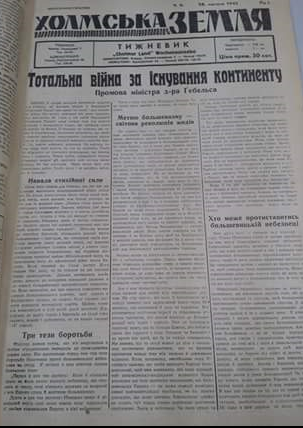
There is much more to the story which Freeland has not revealed. The details can be found in Polish and Ukrainian  sources; from the archived files of Krakivski Visti (“Cracow News”); imageand from the evidence of Jewish Holocaust museums around the world.  Chomiak was editor in chief of the newspaper after a Jewish editor was removed. The newspaper itself was set up in January 1940, publishing three times weekly in Cracow, until October 8, 1944. It was then published in Vienna from October 16, 1944, until March 29, 1945. The precision of the dates is important. They coincide with the movement of the German Army into Cracow, and then out of the city and into Vienna. The newspaper itself was established by the German Army; and supervised by German intelligence. Chomiak was employed by an officer named Emil Gassner (above).  His title in German indicates he was the German administrator in charge of press in the region. When Gassner moved from Cracow to Vienna, he took Chomiak with him.
Chomiak’s publication was an official one of the German administration in Galicia, known at the time as the General Gouvernement. The printing press, offices and other assets which provided Chomiak with his work, salary, and benefits had been confiscated  by the Germans from a Jewish publisher, Moshe Kafner. Kafner was a native of the region; he and his family were well educated and well known until the Germans arrived, and replaced Kanfer with Chomiak.   Kanfer was forced to flee Cracow for Lviv. From there he was taken by the Germans to the Belzec concentration, where he was murdered some time in 1942. From Chomiak’s office to Belzec the distance was 300 kilometres.
image
Left: SS guards at Belzec; right: Ukrainian guards about to kill a Belzec inmate
Krakivsti Visti was “the most important newspaper to appear in the Ukrainian language under the German occupation during World War II,” according to this history from the Harvard Ukrainian Research Institute, published in 1998.  Chomiak --  reports the Harvard history by John-Paul Hinka from a contemporary source --  “had the ability to sense what could be written and how in the severe German reality, and he gained some trust among the German officials, without which the work would have been impossible.”
In print, according to this archive of Krakivsti Visti, when Chomiak was in charge, there were reports of the “success” of the German Navy in killing 13,000 US Army soldiers, when their transports were torpedoed and sunk in the Atlantic enroute to England. Chomiak editorialized; “this last German attack [was] a smashing blow to the solar plexus of the alliance.”
Chomiak also reported the US “colonization” of Australia and Canada . “Americans who are now living in Australia believe that the economic possibilities of Australia are even much better than those of the USA, and many US soldiers are thinking about staying in Australia after the war… as they feel  much better there than in their own Fatherland… There are such close relations between the USA and Canada and Australia that there will be a special trade and tax [agreement] between these countries after the war. In other words, the United States does not hide the intention of the US to begin full economic penetration of Canada and Australia.”
By the standard of Trudeau at Auschwitz, Freeland’s grandfather also produced race hatred to Nazi order, including antisemitism and racism against several other nationalities, including Americans, Poles and Russians. 
Chomiak not only justified the death camps surrounding Cracow. He attempted to foster Ukrainian sentiment against the Poles in the region. The German objective was to support the Ukrainian takeover of Galicia and cleanse it of its Jewish and Polish populations. For this reason Chomiak and his newspaper were given special favour by the German administration; Chomiak himself was reportedly held in high esteem by the Nazis. In the Harvard history it is reported “there can be no doubt that Krakivs'ki visti enjoyed more autonomy than any other legal Ukrainian-language publication under the German occupation.”
Himka, a Ukrainian-Canadian academic, composed his history of Krakivtsi Visti from Chomiak’s personal papers in Alberta. He mentions the newspaper’s backing for ethnic cleansing of Poles. He omits to mention Jews. Chomiak’s antisemitic record can be found in the files of the Los Angeles Museum of the Holocaust. For details, read this
Chomiak didn’t flee from the Ukraine in 1939, as Freeland claims. Five years were to elapse before he left Cracow; that was when the German Army pulled out in defeat, as the Soviet Army advanced from the east to liberate the city. Gassner was moving the media operation to his home town, Vienna.
image
Chomiak closed down Krakivsti Visti in Vienna in March of 1945 for the same reason. The Soviet Army was days away, and a new Austrian government replaced the Third Reich in April of that year.  With the retreating Wehrmacht Chomiak then moved westwards into Germany. But a full year is missing from the official records available publicly. That’s between March of 1945 and April of 1946, when the displaced persons camp was opened in the Bavarian town of Bad Worishofen, where Freeland says her mother was born.
image
As the name indicates, Bad Worishofen was (still is) a thermal waters resort for wealthy Bavarians and day-trippers from Munich.  Freeland claims her mother was born as a victim in a refugee camp. In fact, she was born in a hospital administered by the US Army, while her parents were living in a spa hotel managed by a US Army intelligence unit.
image
A US Army parade in Bad Worishofen after the US took the town on April 27, 1945; http://www.augsburger-allgemeine.de/mindelheim/Der-Tag-an-dem-der-Frieden-kam-id33776287.html
During the war there had been a Luftwaffe training aerodrome at Bad Worishofen. But it was so insignificant operationally, it wasn’t bombed by the allies. More or less intact, along with the spa hotels, the town welcomed new paying guests from the US Army when they arrived in April of 1945.
According to US records, a US Army Intelligence “training unit” was established, as well as a US Army hospital. The trainees weren’t Americans; they were East Europeans, including Lithuanians, Ukrainians, Poles and others who had been fighting on the German side.
On June 28, 1945, the 2nd Hospitalization Unit of the 30th Field Hospital left a forward position at Ebsenee, Austria, where it had been caring for the survivors of the Ebensee-Matthausen concentration camp. 
image
The war in Europe now over, the hospitalization unit regrouped in the rear at Bad Wörishofen, where its role was to support the 80th Infantry Division. The unit history says: “As usual, living quarters proved excellent (buildings), with many conveniences added to make living conditions very comfortable.” Among the people the American Army doctors now cared for were Mr and Mrs Chomiak.
The camp for displaced persons or refugees at Bad Worishofen was not formally established for another year, until April 1946. Ukrainians who were there at the time say the camp housed mostly Lithuanians, and also 490 Ukrainians.  The term camp is a misnomer. The records show that many of the Ukrainians were living in spa hotels when they were subject to the administration of the camp.  Although the subsequent records of the Ukrainians are voluble on what happened there between 1946 and 1948, including testimony from Ukrainians who moved on to the US and Australia, there is no reference to the Chomiak family at all.
 “All the camps in Bad Worishofen were liquidated in May 1948 due to consolidation of the various camps by IRO (International Relief Organization),” remembers this Ukrainian.  
It is not (yet) known when Chomiak presented himself to US Army Intelligence, offering the same services he had been performing for  Gassner and the Wehrmacht. Journalism, however, wasn’t what the US occupation authorities wanted from him.   In return,  Chomiak received accommodation; living expenses; and the hospitalization which produced Freeland’s mother in September of 1946.
Two years were to elapse before Chomiak left Bad Worishofen for Canada, arriving there in October 1948. He already had a sister in Canada, but no job of a professional kind to which his university education and experience qualified him. In Alberta Chomiak worked as a manual labourer. Why the Americans didn’t offer him intelligence and propaganda employment in the US may be revealed in the Chomiak files in Washington. The Canadian government file on his admission in 1948 is likely to include some of the details Chomiak revealed about his work with the Americans.  Unless he kept that secret.
Last week the Polish Embassy in Ottawa issued this tweet in celebration of Freeland’s promotion:
image
This week Polish political analyst and journalist Stanislas Balcerac has opened the dossier on Freeland and Chomiak. The Polish Foreign Minister, Witold Waszczykowski, has been asked to investigate, and to decide if, according to Balcerac, “the circumstances and family loyalties of Mrs  Freeland may affect the support that Canada provides the pro-Bandera Government of Ukraine, so they can have a direct impact on Polish interests.”
Regarding Bandera (right), the record of Chomiak’s involvement with him when they were under German,image then US supervision, Freeland did not reveal in the Financial Times when she reported Bandera as one of the Ukraine’s all-time heroes. “Yaroslav the Wise, the 11th-century prince of Kievan Rus, was named the winner in a last-minute surge, edging out western Ukrainian partisan leader Stepan Bandera, who led a guerrilla war against the Nazis and the Soviets and was poisoned on orders from Moscow in 1959….The Soviet portrayal of Bandera as a traitor still lingers. That would be a mistake.”
Freeland was asked directly to clarify her own claims about Grandfather Chomiak’s war record. Her press spokesman, Chantal Gagnon, asked for more time, but then the two of them refused to answer.
“The sins of the grandfather can hardly be attributed to the granddaughter,” says Polish investigator Balcerac, “—except for two, race hatred and lying. Chomiak made a lucrative war selling hatred of Jews, Poles and Russians. Freeland is doing the same preaching race hatred of Russians. To mask what she’s doing, she has lied about the Nazi record of her family. The Chomiaks weren’t victims; they were aggressors.”
A Washington source adds: “Chomiak was recruited by US intelligence to wage war in the Ukraine against the Russians.  Let’s see what the US Army and intelligence files reveal about his role, and let’s compare that to the one Freeland is now playing in Canada.”

Featured Story

Dejemos que la izquierda de Estados Unidos tenga cuidado! por Andrew Taylor 23.06.2021

La Administración Biden ha habilitado una nueva "Iniciativa contra el terrorismo doméstico" para defender "The Homeland"...