July 02, 2020

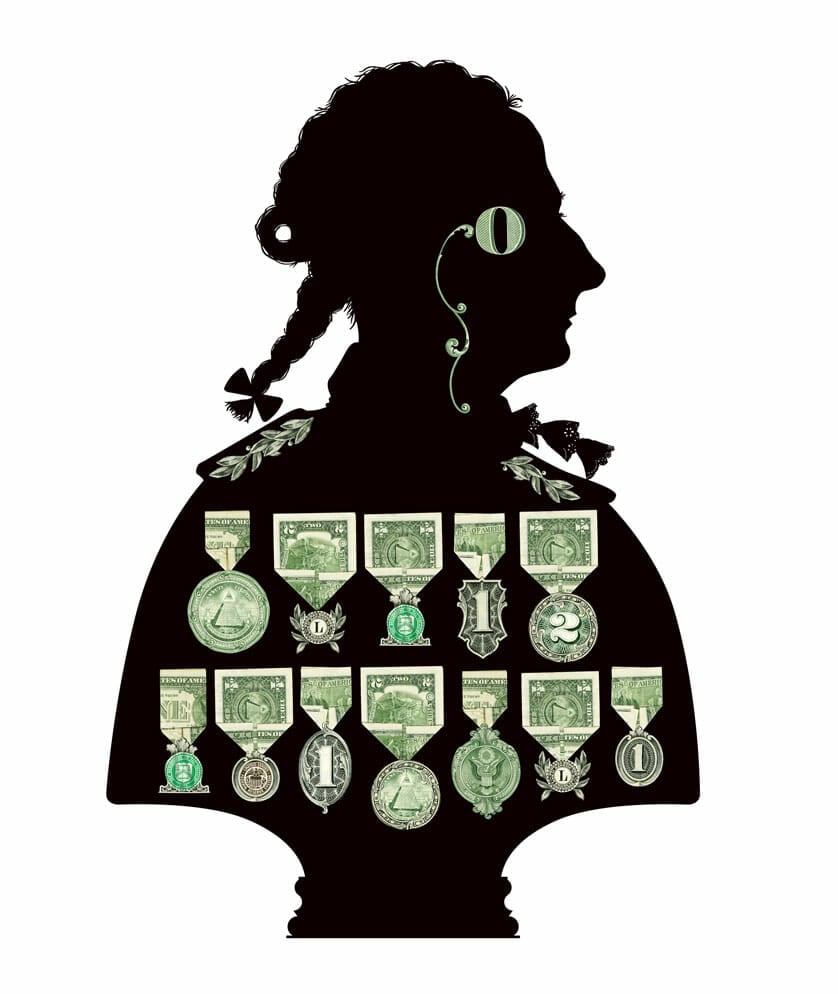
The Hamilton Hustle Why liberals have embraced our most dangerously reactionary founder, Matt Stoller No. 34 March 2017

The Hamilton Hustle

Why liberals have embraced our most dangerously reactionary founder

s

As Donald Trump settles into the White House, elites in the political class are beginning to recognize that democracy is not necessarily a permanent state of political organization. “Donald Trump’s candidacy is the first time American politics has left me truly afraid,” wrote Vox cofounder Ezra Klein just before the election. Andrew Sullivan argued in New York magazine that American democracy is susceptible, “in stressful times, to the appeal of a shameless demagogue.” Paul Krugman wrote an entire column on why republics end, citing Trump’s violations of political norms. But if you want to understand the politics of authoritarianism in America, the place to start is not with Trump, but with the cool-kid Founding Father of the Obama era, Alexander Hamilton.
I’m not just talking about the actual founder, though we’ll come back to him. I’m talking about the personage at the center of the Broadway musical, Hamilton.
The show is a Tony Award–winning smash hit, propelling its writer, Lin-Manuel Miranda, to dizzying heights of fame and influence. It is America’s Les Misérables, an achingly beautiful and funny piece of theater about a most unlikely icon of democratic inclusiveness, Alexander Hamilton.
I’m not going to dissect the show itself—the politics of it are what require reexamination in the wake of Trump. However, it should be granted one unqualified plaudit at the outset: Miranda’s play is one of the most brilliant propaganda pieces in theatrical history. And its construction and success tell us a lot about our current political moment. Before it was even written, the play was nurtured at the highest levels of the political establishment. While working through its material, Miranda road-tested song lyrics at the White House with President Obama. When it was performed, Obama, naturally, loved it. Hamilton, he said, “reminds us of the vital, crazy, kinetic energy that’s at the heart of America.” Michelle Obama pronounced it the best art she had ever seen.
The first couple’s comments were just the leading edge of a cultural explosion of praise. Actress Kerry Washington called it “life changing.” Lena Dunham said, “If every kid in America could see Hamilton they would thirst for historical knowledge and then show up to vote.” Saturday Night Live featured a sketch wherein Lorne Michaels begged guest host Miranda for Hamilton tickets (“I can do a matinee!”). It’s perhaps harder to list celebrities who haven’t seen Hamilton than those who have. And in Washington, D.C., politicians who haven’t seen the show are considered uncool.
Admiration for the play crossed the political spectrum. Conservative pop-historian Niall Ferguson opened up a book talk, according to one witness on Twitter, “with a rap set to music inspired by Hamilton.” Former secretaries of the treasury praised it, from Tim Geithner to Jack Lew to Hank Paulson. So did Dick Cheney, prompting Obama to note that the wonder of the play was perhaps the only thing the two men agreed on. Trevor Noah asked if Bernie Sanders, who had just seen the play, ran for president just so he would be able to get tickets. Rahm Emanuel, the mayor of Chicago and former White House chief of staff, raised eyebrows by jetting off to New York City to see a performance of Hamilton the night after Chicago teachers went on strike.
Much of the turn toward white supremacy in the early 1800s can be laid at Alexander Hamilton’s feet.
It’s not just that Hamilton is about a founding father, and thus inherently making statements about who we are as a culture. It’s become a status symbol within the Democratic establishment, offering them the chastened consolation that they might still claim solidarity with the nascent American democracy of the eighteenth century that’s stubbornly eluded them in the present-day political scene. Hillary Clinton quoted the play in her speech accepting the Democratic nomination, and told a young voter, “I’ve seen the show three times and I’ve cried every time—and danced hard in my seat.” The play has become a political football in the era of Trump. When Trump’s vice president, Mike Pence, saw the show, one of the cast members read him a special note, written by Miranda and several cast members, asking Pence to protect all of America. Hamilton cast members helped lead the Women’s March in Chicago to protest Trump’s inauguration. Right-wing website Breitbart has a hostile mini-Hamilton beat, noting that the play’s producers specifically requested non-white actors to fill the cast.
And after Trump won, Hamilton became a refuge. Journalist Nancy Youssef tweeted she overheard someone at the Pentagon say, “I am reaffirming my belief in democracy by listening to the Hamilton soundtrack.”
Beast Master
What’s strange about all of this praise is how it presumes that Alexander Hamilton was a figure for whom social justice and democracy were key animating traits. Given how Democrats, in particular, embraced the show and Hamilton himself as a paragon of social justice, you would think that he had fought to enlarge the democratic rights of all Americans. But Alexander Hamilton simply didn’t believe in democracy, which he labeled an American “disease.” He fought—with military force—any model of organizing the American political economy that might promote egalitarian politics. He was an authoritarian, and proud of it.
To assert Hamilton disliked democracy is not controversial. The great historian Henry Adams described an evening at a New York dinner, when Hamilton replied to democratic sentiment by banging the table and saying, “Your people, sir—your people is a great beast!” Hamilton’s recommendation to the Constitutional Convention, for instance, was to have a president for life, and to explicitly make that president not subject to law.
Professional historians generally avoid emphasizing Hamilton’s disdain for the people, at least when they write for the broad public. Better to steer safely clear of the freight train of publicity and money behind the modern Hamilton myth. One exception is amateur historian William Hogeland, who noted in a recent Boston Review essay that Hamilton had strong authoritarian tendencies. Hamilton, he wrote, consistently emphasized “the essential relationship between the concentration of national wealth and the obstruction of democracy through military force.”
Indeed, most of Hamilton’s legacy is astonishingly counter-democratic. His central role in founding both the financial infrastructure of Wall Street and a nascent military establishment (which supplanted the colonial system of locally controlled democratic militias) was rooted in his self-appointed crusade to undermine the ability of ordinary Americans to govern themselves. We should be grateful not that Hamilton structured the essential institutions of America to fit his vision, but that he failed to do so. Had he succeeded, we would probably be living in a military dictatorship.
Father of Finance
Viewers of the play Hamilton have a difficult time grasping this point. It just seems outlandish that an important American political official would argue that democracy was an actively bad system. Sure, America’s leadership caste has done plenty on its own to subvert the legal norms and folkways of self-rule, via voting restrictions, lobbying and corruption, and other appurtenances of access-driven self-dealing. But the idea of openly opposing the hallowed ideal of popular self-government is simply inconsistent with the past two hundred years of American political culture. And this is because, in the election of 1800, when Hamilton and his Federalist allies were finally crushed, America repudiated aristocracy and began the long journey toward establishing a democratic political culture and undoing some, though not all, of the damage wrought by Hamilton’s plutocratic-leaning Federalist Party.
Hamilton’s name practically became an epithet among Democrats of the New Deal era, which makes it all the more surprising that he is the darling of the modern party.
Indeed, the shifting popular image of Hamilton is itself a gauge of the relative strength of democratic institutions at any given moment. In the roaring 1920s, when Wall Street lorded it over all facets of our public life, treasury secretary Andrew Mellon put Hamilton’s face on the ten-dollar bill. Mellon was the third richest man in the country, famous for, among other things, having his brother and chairman of one of his coal mining subsidiaries extoll the virtues of using machine guns to enforce labor discipline. Mellon himself, who later presided over the Great Depression, was routinely lauded by big business interests as the “greatest secretary of the treasury since Alexander Hamilton.” Big business leaders in Pittsburgh, such as Andrew Carnegie and Henry Clay Frick, worshipped Hamilton (as well as Napoleon).
During the next decade, as populists put constraints on big money, Hamilton fell into disrepute. In 1925, Franklin Delano Roosevelt, then just a lawyer, recognized Hamilton as an authoritarian, saying that he had in his mind after reading a popular new book on Hamilton and Jefferson “a picture of escape after escape which this nation passed through in those first ten years; a picture of what might have been if the Republic had been finally organized as Alexander Hamilton sought.” By 1947, a post-war congressional report titled “Fascism in Action” listed Hamilton as one intellectual inspiration for the Nazi regime. Hamilton’s name practically became an epithet among Democrats of the New Deal era, which makes it all the more surprising that he is the darling of the modern party.
Within this context, it’s useful to recognize that Hamilton the play is not the real story of Alexander Hamilton; rather, as historian Nancy Isenberg has noted, it’s a revealing parable about the politics of the finance-friendly Obama era. The play is based on Ron Chernow’s eight-hundred-page 2004 biography of Hamilton. Chernow argues that “Hamilton was an abolitionist who opposed states’ rights, favored an activist central government, a very liberal interpretation of the Constitution and executive rather than legislative powers.” Hamilton, he notes, “sounds . . . like a modern Democrat.” The abolition arguments are laughably false; Hamilton married into a slaveholding family and traded slaves himself. But they are only part of a much broader obfuscation of Hamilton’s politics.
No Accidental Coup
To understand how outrageous Chernow’s understanding of Hamilton is, we must go through a few key stories from Hamilton’s life. We should probably start with the Newburgh Conspiracy—Hamilton’s attempt to foment a military coup against the Continental Congress after the Revolution. In 1782 several men tried to organize an uprising against the Continental Congress. The key leader was Robert Morris, Congress’s superintendent of finance and one of Hamilton’s mentors. Morris was the wealthiest man in the country, and perhaps the most powerful financier America has ever known, with the possible exception of J. P. Morgan. His chief subordinate in the plot was a twenty-seven-year-old Hamilton, former aide-de-camp of George Washington and delegate to the Congress.
After the war, army officers, then camped out in Newburgh, New York, had not been paid for years of service. Morris and Hamilton saw in this financial-cum-political crisis an opportunity to structure a strong alliance between the military elite and wealthy investors. Military officers presented a petition to Congress for back pay. Congress tried to pass a tax to pay the soldiers, while also withholding payments owed to bondholders. Hamilton blocked this move. Indeed, according to Hogeland, “when a motion was raised to levy the impost only for the purpose of paying army officers, Hamilton shot it down: all bondholders must be included.” Meanwhile, Morris and Hamilton secretly encouraged General Horatio Gates at Newburgh to organize a mutiny. After unifying investors and the military elite, Morris and Hamilton calculated that the military officer corps would threaten Congress with force unless the Articles of Confederation were amended to allow full federal taxing power by federal officials. This coup attempt would then, they reasoned, force Congress to override state governments that were more democratic in their approach to political economy, and place aristocrats in charge.
According to Hogeland,
In Morris’s plan these taxes, collected not by weak state governments but by a cadre of powerful federal officers, would be earmarked for making hefty interest payments to wealthy financiers—including Morris himself, along with his friends and colleagues—who held millions of dollars in federal bonds, the blue-chip tier of domestic war debt.
The mutiny itself failed due to a public statement by George Washington opposing a military uprising. But in broader terms, the plot succeeded, once Washington promptly warned Congress about the unstable situation and urged that they take drastic action to centralize and federalize the structure of the American republic. Military officers received what would be the equivalent today of multi-million-dollar bonuses, paid largely in federal debt instruments. This effectively institutionalized the elite coalition that Morris and Hamilton sought to weaponize into a tool of destabilization. The newly unified creditors and military officers formed a powerful bloc of aristocratic power within the Congress that pushed hard to dramatically expand federal taxing power. This group “set up [Hamilton’s] career,” Hogeland writes, because by placing him in power over their asset base—a national debt—they would assure a steady stream of unearned income. Chernow obscures Hamilton’s participation in the mutiny, claiming in a rushed disclaimer to preserve his hero’s honor that Hamilton feared a military uprising—but he then proceeds to note that Hamilton “was playing with combustible forces” by attempting to recruit Washington to lead the coup. It’s a howling inconsistency bordering on falsification.
Snobs at the Falls
When Hamilton became Washington’s secretary of the treasury, he swiftly arranged the de facto payoff of the officer group at Newburgh, valuing their bonds at par and paying them the interest streams they wanted. Here was perhaps the clearest signal that the Federalist Party was structured as an alliance between bondholders and military elites, who would use a strong central government as a mechanism to extract money from the farming public. This was Hamiltonian statecraft, and it was modeled on the political system of the Whigs in Great Britain, the party of “monied interests” whose power was anchored by the Bank of England.
Chernow, a longtime Wall Street Journal financial writer, portrays Hamilton as a visionary financial genius who saw beyond the motley array of foolish yeoman farmers who supported his ideological foe Thomas Jefferson. In lieu of the static Jeffersonian vision of a yeoman’s republic, Chernow’s Hamilton is reputed to have created a dynamic, forward-looking national economy—though it’s more accurate to say that Hamilton was simply determined to shore up the enduring basis of a financial and industrial empire. Hillary Clinton even quoted the play paraphrasing Hamilton’s line, “They don’t have a plan—they just hate mine.” But in fact, there were competing modern visions of finance during the period, as Terry Bouton showed in Taming Democracy. And the one we have today—a public central bank, substantial government involvement in credit markets, paper money—has characteristics of both.
We should be grateful for Hamilton’s failures. Had he succeeded, we
would probably be living in a military dictatorship.

True to their own aristocratic instincts and affiliations, Hamilton and his mentor Morris wanted to insulate decision-making from democratic influence. Morris told Congress that redistributing wealth upward was essential so that the wealthy could acquire “those Funds which are necessary to the full Exercise of their Skill and Industry,” and thereby promote progress. While in office, Hamilton granted a group of proto-venture-capitalists monopoly control over all manufacturing in Paterson Falls, New Jersey, the site of some of the most powerful waterfalls on the East Coast. Hamilton, who captained this group of investors, thought it would power a network of factories he would then control. Among the prerogatives enjoyed by the funders of the Paterson Falls project was the authority to condemn lands and charge tolls, powers typically reserved to governments. More broadly, in the fight to establish a for-profit national bank owned and controlled by investors, he placed control over the currency in the hands of the wealthy, linking it to gold and putting private financiers in charge.
Morris and Hamilton sought, as much as possible, to shift sovereign powers traditionally reserved for governments into the hands of new chartered institutions—private corporations and banks—that would be strategically immunized from the democratic “disease.” These were not corporations or banks as we know them; they were quasi-governmental institutions with monopoly power. Jefferson sought to place an anti-monopoly provision in the Constitution precisely because of this well-understood link between monopoly finance and political power.
Chernow portrays this far-reaching debate over the future direction of America’s productive life as a byproduct of Hamilton’s unassailably noble attempt to have the federal government retire the Revolutionary War debt. This is simply false (and a very common lie, expressed with admiration by other prominent Hamilton fans like Alan Greenspan and Andrew Mellon). Hamilton wanted a large permanent debt; he wanted it financed so his backers could extract a steady income from the people by way of federal taxes. To pay off the debt would be to kill the goose laying the golden egg. By constricting the question of democracy to a question of accounting, Chernow misrepresents what was really at stake. It was a fight over democracy, authoritarianism, and political economy—and in many ways, the same one we’re having today.
The Gold Standard and the Iron Fist
In the 1780s and 1790s, Hamilton won this battle, and the effects were catastrophic. Interest rates shot up as a monopoly of finance gathered in the hands of the merchant class. The debt was owned by the wealthy, while ordinary farmers who had fought in the Revolution had to pay the tax in gold that they didn’t have. It was a heavily deflationary policy, and the era after the Revolution saw an economic contraction similar in size to that of the Great Depression, with a foreclosure crisis as severe. According to Bouton, “There were more Pennsylvanians who had property foreclosed by county sheriffs during the post-war decades than there were Pennsylvania soldiers who fought for the Continental Army.”
Protests broke out in the western parts of the country, similar to pre-Revolution-era revolts against the British, who, in extracting revenues for the Crown and its allies, were pursuing the same policies that Hamilton did. These protests were a response not to taxes, but to the specific tax structure Hamilton constructed. Western farmers, though not poor, had little access to cash, so they used whiskey as currency—a medium of exchange that farmers in many cases produced sporadically in backyard stills. Hamilton’s tax was a political attack on these farmers, whom he saw as his political opponents. The levy targeted whiskey because western farmers had converted this commodity into a competitive monetary system. The whiskey levy was also regressive, with a low rate on industrial distillers and a high rate for small farmers, with the goal of driving the farmers out of the whiskey business. Furthermore, Hamilton placed the collection authority for the tax in the hands of the wealthiest big distillers, who could then use it to drive their smaller competitors out of business. This was all intended not only to destroy the political power of small farmers, but to foment a rebellion that Hamilton could then raise an army to crush. And that’s just what happened.
In 1795, Washington and Hamilton raised more than ten thousand troops to march into Western Pennsylvania, the strongest redoubt of opposition to the new tax (known forever after as the Whiskey Rebellion). Washington, halfway through the march and perhaps doubting the wisdom of this use of military power, handed over command to Hamilton, and went home. Entrusted with executive power, Hamilton used indefinite detention, mass arrests, and round-ups; seized property (including food stores for the winter); and had soldiers administer loyalty oaths. He also attempted to collect testimony to use against his political enemies, such as William Findley and Albert Gallatin (who would later be Jefferson’s and Madison’s secretary of the treasury), which he “hoped to use,” as Hogeland writes, “to silence his political opponents by hanging them for treason.” This is the strong-armed tyranny that David Brooks (to take one among countless exemplars of latter-day Hamilton worship) celebrates when he says that Hamilton gave us “the fluid capital markets that are today the engine of world capitalism.” It is also, far from incidentally, what John Yoo cited as precedent when defending George W. Bush’s national security policies.
Similarly, Hamilton’s fights with John Adams in the late 1790s represented one of the most dangerous periods in American history, akin to the McCarthy era on steroids. The latter part of the French Revolution was as shocking to Americans of the early republic as the 1917 Russian Revolution was to their modern successors. It stoked the widespread fear among Federalists that any talk of democracy would lead to similar guillotine-style massacres; they began referring to Jefferson’s supporters as “Jacobins”—an epithet that was the 1790s equivalent of “terrorist” or “communist.” This was the era of the Alien and Sedition Acts, which made criticism of the government a federal crime. But in addition, and more frighteningly, Hamilton constructed the only partisan army in American history (titled the “New Army”) and tried to place himself at the head of it. Only Federalists could be officers. He envisioned himself leading an expedition into Florida and then South America, and mused aloud about putting Virginia “to the test” militarily. Ultimately, Adams—perhaps the most unlikely savior of self-governance in the annals of our history—figured out what Hamilton was doing and blocked him from becoming a New World Napoleon. The New Army was disbanded, and our military established a tradition of nonpartisanship.
Another Near Miss
When Thomas Jefferson won the presidency, he described that year’s presidential election as the “Revolution of 1800,” precisely because it was proof that self-government could work. Unlike the succession from Washington to Adams, this was a change in party control, the first peaceful transfer of power in a republic in modern history. Most popular accounts of the hard-fought 1800 ballot focus on Hamilton’s relationship with John Adams, his endorsement of Jefferson, and the Burr-Jefferson soap opera—and how all of these personal intrigues culminated in an eventual tie among electors. In fact, this is so well known that liberals unhappy with the outcome of the 2016 election tried to convince members of the Electoral College to overturn Trump’s victory, and titled their project “Hamilton electors.”
But there’s a darker story of the 1800 deadlock. It involves the more extreme wing of the Federalist Party, which simply tried to have the election overturned, risking civil war to do so. Federalists were inflamed at a host of purported Republican outrages, including the party’s opposition to the Alien and Sedition Acts and to the creation of the New Army. They also claimed the Republicans were sympathetic to France (with which we were then engaged in a post-Revolutionary “quasi-war”) and abetted domestic disturbances like the Whiskey Rebellion and a similar uprising a few years later known as the Fries’s Rebellion. In 1799, Federalists put forward “the Ross bill” to have the Senate effectively choose the next president by empowering a select committee to disallow electors. The bill was defeated by House members who didn’t want to delegate their authority to the Senate.
The Obama era looks like an echo of the Federalist power grabs of the 1780s, both in its glorification of financial elites and its disdain for true economic democracy.
Then, after the election, Federalist allies in the lame duck session of Congress were considering, according to Jefferson, “a law for putting the government into the hands of an officer of their own choosing.” Jefferson threatened armed resistance, and both Pennsylvania and Virginia began military preparations. Ultimately, the Federalists backed down. As historian James Lewis pointed out, the election of 1800 produced a peaceful transition of power, but that was not necessarily a likely outcome.
Hamilton lost, but not without bequeathing to later American citizens a starkly stratified political economy. Bouton argues that the defeats of the middle class in the 1780s and 1790s narrowed democracy for everyone. As poor white men found the freedoms for which they fought undermined by a wealthy elite, they in turn “tried to narrow the concept to exclude others.” Much of the turn toward a more reactionary version of white supremacy in the early 1800s, in other words, can be laid at Hamilton’s feet. Later on, Hamilton’s financial elite were ardently in favor of slave power. Manhattan, not any Southern state, was the first political entity to follow South Carolina’s call for secession, because of the merchants’ financial and cultural ties to the slave oligarchy. In other words, Hamilton’s unjust oligarchy of money and aristocracy fomented a more unjust oligarchy of race. The aggrieved rites of ethnic, racial, and cultural exclusion evident in today’s Trump uprising would no doubt spark a shock of recognition among the foes of Hamilton’s plutocracy-in-the-making.
Rites of the Plutocrats
Hamilton had tremendous courage, insight, and brilliance. He is an important Founder, and not just because he structured early American finance. His life sheds light on some deep-rooted anti-democratic forces that have always existed in America, and in particular, on Wall Street. Much of the far-reaching contemporary Hamilton PR offensive is connected to the Gilder Lehman Institute, which is financed by bankers who back the right-wing Club for Growth and American Enterprise Institute (and support Hamilton’s beloved gold standard). Robert Rubin in 2004 started the Hamilton Project at the Brookings Institution, which laid out the framework for the Obama administration’s financial policies. Chernow has made millions on books fawning over J. P. Morgan, the Warburg financial family, and John D. Rockefeller. And thanks largely to the runaway success of Hamilton the musical, Chernow is now, bizarrely, regarded as a court historian of American democracy in the mold of Arthur Schlesinger Jr.
One of Hamilton’s biggest fans is Tim Geithner, the man who presided over the financial crisis and the gargantuan bank bailouts during the Obama presidency. In his 2014 memoir, Stress Test, Geithner wrote admiringly of Hamilton as the “original Mr. Bailout,” and said that “we were going to deploy federal resources in ways Hamilton never imagined, but given his advocacy for executive power and a strong financial system, I had to believe he would have approved.” He argues this was a financial policy decision. In doing so, he evades the pronounced anti-democratic impulses underlying the response to the financial crisis.
As economist Simon Johnson pointed out in a 2009 essay in The Atlantic titled “The Quiet Coup,” what the bailouts truly represented was the seizure of political power by a small group of American financiers. Just as in the founding era, we saw a massive foreclosure crisis and the evisceration of the main source of middle class wealth. A bailout, similar to one that created the national debt, ensured that wealth would be concentrated in the hands of a small group. The Citizens United decision and the ever-increasing importance of money in politics have strong parallels to the property disenfranchisement along class lines that occurred in the post-Revolutionary period. Just as turnout fell to record lows in much of the country in 2014, turnout collapsed after the rebellions were put down. And in another parallel, Occupy Wall Street protesters camped out across the country were evicted by armed guards—a martial response coordinated by banks, the federal government, and many Democratic mayors.
The Obama era looks like an echo of the Federalist power grabs of the 1780s and 1790s, both in its enrichment and glorification of financial elites and its open disdain for anything resembling true economic democracy. The Obama political elite, in other words, celebrates Hamilton not in spite of Hamilton’s anti-democratic tendencies, but because of them.
Set in contrast to the actual life and career of its subject, the play Hamilton is a feat of political alchemy—as is the stunningly successful marketing campaign surrounding it. But our generation’s version of Hamilton adulation isn’t all that different from the version that took hold in the 1920s: it’s designed to subvert democracy by helping the professional class to associate the rise of finance with the greatness of America, instead of seeing in that financial infrastructure the seeds of a dangerous authoritarian tradition.
In 1925, Franklin Roosevelt asked whether there might yet be a Jefferson to lead the forces of democracy against Hamilton’s money power. Perhaps someone—maybe Elizabeth Warren, who pointed out on PBS that Hamilton was a plutocrat—is asking that question again. That said, Hamilton is a great musical. The songs are catchy. The lyrics are beautiful. But the agenda is hidden, because in America, no political leader, not even Donald Trump, can credibly come right out and pronounce democracy a bad thing and agitate for rule by big finance. And the reason for that is that Alexander Hamilton, despite his success in structuring Wall Street, lost the battle against American democracy. Thank God for that.

June 29, 2020

Bill Barr and the Ghost of Fascism: Lawlessness in Trump’s Fascist State, By Henry Giroux | June 28, 2020


US Attorney General Bill Barr attends a roundtable meeting on seniors with US President Donald Trump in the Cabinet Room at the White House in Washington, DC, June 15, 2020. - President Donald Trump holds a roundtable discussion with senior citizens called Fighting for Americas Seniors on Monday. (Photo by SAUL LOEB / AFP) (Photo by SAUL LOEB/AFP via Getty Images)

Bill Barr and the Ghost of Fascism

Lawlessness in Trump’s Fascist State
Bill Barr and the Ghost of Fascism
Theodor W. Adorno argued in “The Meaning of Working Through the Past” that “the past that one would like to evade is still very much alive.” [1] This is particularly evident in the debilitating pronouncements of William Barr, Trump’s Attorney General, regarding his defense of unchecked executive authority, which he believes should be unburdened by any sense of political and moral accountability. Tamsin Shaw is right in suggesting that Barr bears a close resemblance to Carl Schmitt, “the notorious…‘crown jurist’ of the Third Reich.” [2] Barr places the President above the law, defining him as a kind of unitary sovereign. In addition, he appears to relish in his role as a craven defender of Trump, all the while justifying a notion of blind executive authority in the face of Trump’s endless lies, racist policies, and lawlessness that echo the dark era of the 1920s and 30s. His attack on the FBI, the Justice Department’s Inspector General, and his threat to remove police protection from Black communities who are not loyal to Trump are at odds with any viable notion of defending the truth and “the most basic tenets of equality and justice.”[3] James Risen claims that Barr “has turned the Justice Department into a law firm with one client: Donald Trump [and that] under Barr, the Department of Justice has two objectives: to suppress any investigation of President Trump and his associates, and to aggressively pursue investigations of his political rivals.”[4]
Joan Walsh writing in The Nation rightly states that “Barr’s decline into blatant but ineffectual lawlessness is proof that Trumpism is a degenerative disease.” To prove her point, she writes:
…as Barr has gotten more brazen in his attempts to subvert the law, he’s gotten sloppier. His four-page memo of lies about the Mueller report last year fooled too much of the media, at least temporarily. There’s been more skepticism about his shocking interventions to reduce his department’s own sentencing request for Roger Stone, and to drop perjury charges against former national security adviser Michael Flynn (though Flynn admitted the crime). Both moves resulted in career attorneys resigning and widespread criticism from the legal establishment and the media.[5]
Shamelessly, Barr issued a directive to National Guard soldiers and police to attack individuals peacefully protesting the police killing of George Floyd in Lafayette Square in order to clear a path for Trump’s walk to St. John’s Episcopal Church for a photo op. In the photo op, Trump stood before the church awkwardly holding a bible in his hand, echoing a history one associates with the Ku Klux Klan and iconographic images right out of D. W. Griffith’s 1915 racist film, The Birth of a Nation.
On Barr’s order “National Guard soldiers and police proceeded to club peaceful protesters with batons and fire tear gas canisters into crowds as Trump delivered a speech on the nationwide uprising sparked by the killing of George Floyd.”[6] One pastor, Michael Wilker, one of the leaders of the Washington Interfaith Network called Trump’s actions an “abomination,” placing Trump’s actions in the context of an earlier fascist history. According to Wilker,
During Nazi Germany, Adolf Hitler used the symbols of the Lutheran church—our own church—as a way to divide Christians from one another, and especially to deny the humanity of Jews in Germany. It’s the same thing Trump is doing here: he is using the symbols of the church as a way to divide the church from one another and to divert our attention from the actual suffering and killing that’s going on.[It was] a demonic act.[7]
Wilker’s comments indict both Trump, Barr, and the other ignominious luminaries that stood with Trump in front of St. John’s church. In addition, Barr’s support for Trump’s silly Bible photo op cannot be separated from the speech Trump gave in the Rose Garden before the police and National Guard attacked the peaceful protesters. In that speech, Trump appointed himself as the “president of law and order” and came close to declaring war on the American people. As Kristen Clarke put it on Democracy Now:
Here, Trump single-handedly seeks to deploy the military to states all across our country over the objections of state officials and with the sole and singular purpose of silencing Americans. In many ways, this is the death of democracy, because people who are out right now have one singular goal: to ensure that at this moment we not turn our backs on the long-overdue work that’s necessary to rid our nation of the scourge of police violence that has resulted in innumerous deaths of unarmed African Americans.[8]
In spite of the overwhelming evidence of a police culture in the US rooted in racism, Barr has stated publicly that “he did not believe racism was a systemic problem in policing, echoing other top administration officials’ defense of an important part of President Trump’s base as protests against police killings of unarmed black people continued across the nation.”[9] Barr along with Trump’s acolytes are not simply the victims of bad judgment, they lack a moral compass, embrace the banner of white supremacy, willingly support what appears to be racial anxieties about the decline of “white civilization,” and have emerged as a menace to the American people and to democracy itself. A strong believer in an imperial presidency, Barr has relinquished the role of the justice department as an independent agency and has repeatedly attempted to subvert the law he should be upholding.
In light of such actions and the refusal of the Republican members of Congress to speak out against such activities, it is not surprising for conservative journalist George Will to declare that Barr and Trump’s congressional enablers “gambol around [Trump’s] ankles with a canine hunger for petting.”[10] This criticism is not unfounded given Barr’s legal and ideological cover for Trump’s dangerous lackeys, such as Senate Majority Leader Mitch McConnell and Senator Lindsay Graham, both of whom shamed themselves again during the impeachment hearings. For example, McConnell’s Vichyite propensity for collaboration with the White House was on full display when he publicly denounced the impeachment process and as an unabashed defender of Trump stated that he would work hand in hand with the Trump administration on the impeachment process to make sure Trump would not be removed from office.
In addition, Senator Lindsay Graham stated that he had already made up his mind about Trump committing a criminal conspiracy, which he dismissed, and that he would do everything he could to make impeachment “die quickly” in the Senate.[11] As was well noted in the mainstream press, Republican senators decided not to hear evidence, never took seriously the charge of impeachment, and in doing so shamed themselves by refusing to “use the opportunity to rid the country of a president whose operative value system—built around corruption, nascent authoritarianism, self-regard, and his family’s business interests—runs counter to everything that most of them claim to believe in.”[12] Such blind and dangerous support for Trump the vulgarian warrants Will’s claim that Trump is a “malignant buffoon” and that those who support him should be removed from office.[13]
There appears to be no limits to Barr’s defense of the indefensible, particularly as a way of placating Trump’s vindictive and vengeful actions towards those he believes have wronged him or his close associates. In June of 2020, Barr convinced Trump to fire, Geoffrey S. Berman, the United States attorney in Manhattan. Berman had pursued a number of cases on members of Trump’s inner circle that irked Trump. The latter include the arrest and prosecution in 2018 of Michael D. Cohen, Trump’s longtime lawyer and fixer, an investigation into the wrongdoings of a Turkish state-owned bank (an investigation Trump had promised Turkish president, Recep Tayyip Erdogan, he would end), and more recently Berman’s office had started an inquiry into Rudolph W. Giuliani, Trump’s close supporter and personal lawyer. Speaking on CNN, Rep. Adam Schiff (D-CA), Chairman of the House Permanent Select Committee on Intelligence, stated that Barr “is the second most dangerous man in the country.”[14]
Since Trump’s impeachment, he has fired 6 inspector generals, weakening the power of the federal government’s internal watch dogs to conduct oversight of their various agencies. Not by coincidence, Steve Linick, an inspector general at the State Department was investigating Mike Pompeo. Barr’s use of the Department of Justice as a tool to implement the president’s personal and political demands was on full display when a justice department official recounted to Congress that Barr had intervened in a sentencing recommendation “because of politics.” Aaron S. J. Zelinsky, a prosecutor, stated that Bar overrode the decisions of career prosecutors to “seek a more lenient prison sentence for Mr. Trump’s longtime friend Roger J. Stone Jr.”[15] This is not merely about corruption and incompetence, but lawlessness, which is the essence of fascist politics. As Hannah Arendt noted in her work on totalitarianism: “If lawfulness is the essence of non-tyrannical government and lawlessness is the essence of tyranny, then terror is the essence of totalitarian.”[16]
Some influential commentators such as Cass Sunstein have argued that America’s system of checks and balances protects the US against the threat of a full-blown authoritarianism. Bill Barr has made it clear that the law is just as susceptible to the reactionary forces of political power as is any other institution and can succumb to the depths of depravity and even worse. A criminal state is not contained by the law; in fact, it corrupts it as has been made clear by the rebellions taking place across the globe in the aftermath of the murder of George Floyd by police who believe they are above any just notion of the law. Trump and Barr are apostles of white supremacy, avatars of racial cleansing, and their lawlessness is a testimony to their belief in a politics of disposability. Nazi Germany proved with frightening clarity that the rule of law and its institutions can be easily transformed and implemented into agents of state violence, if not domestic terrorism. What Trump and Barr have proven with utmost audacity and little regret is that no institution is immune from the reach and power of a fascist politics. As William Robinson points out, one of the first elements of a fascist politics is the emergence of the state as a reactionary and repressive political power. In addition, the state is reconfigured to meet the needs of the financial and corporate elite, and on the cultural front the emergence and mobilization of fascist wannabe groups such as nativist movements, neo-Nazis, right-wing militia groups, and corporate controlled right-wing media apparatus.[17] Trump and Barr support all of these elements, and wear their commitment to lawlessness and state violence like a badge. The thousands marching in the streets and the Black Lives Matter movement have forcefully maintained that lawlessness is not about the transgressions of a few bad cops, however egregious, or a few corrupt politicians such as Trump and Barr, or even a Republican Party dominated by white supremacists and Vichy apologists. They have made it clear that the struggle is about dismantling a system that has made violence its organizing principle and echoes a past in which horrors of that past must not be either normalized nor repeated.
Notes.
1 Adorno, Theodor W., “The Meaning of Working Through the Past,” Guild and Defense, trans. Henry W. Pickford, (Cambridge: Harvard University Press, 2010), p. 213. 
2 Tamsin Shaw, “William Barr: The Carl Schmitt of Our Time,” New York Review of Books (January 15, 2020). Online: https://www.nybooks.com/daily/2020/01/15/william-barr-the-carl-schmitt-of-our-time/?utm_medium=email&utm_campaign=NYR%20Daily%20Tamsin%20Shaw&utm_content=NYR%20Daily%20Tamsin%20Shaw+CID_fab36e70a506d2d42e8747691ecb4ebd&utm_source=Newsletter&utm_term=William%20Barr%20The%20Carl%20Schmitt%20of%20Our%20Time 
3 Eric H. Holder, “William Barr is unfit to be attorney general,” Washington Post (December 11, 2019). Online: https://www.washingtonpost.com/opinions/eric-holder-william-barr-is-unfit-to-be-attorney-general/2019/12/11/99882092-1c55-11ea-87f7-f2e91143c60d_story.html 
4 James Risen, “William Barr Has Turned the Justice Department Into a Law Firm With One Client: Donald Trump,” The Intercept (June 22, 2020). Online: https://theintercept.com/2020/06/22/william-barr-has-turned-the-justice-department-into-a-law-firm-with-one-client-donald-trump/?utm_medium=email&utm_source=The%20Intercept%20Newsletter 
5 Joan Walsh, “As Bill Barr Flails, Trump Is Losing His Roy Cohn,” The Nation (June 22, 2020). Online: https://www.thenation.com/article/politics/william-barr-berman-trump/ 
6 Jake Johnson, “’He Must Resign’: Attorney General Barr Personally Ordered Police Assault on Peaceful DC Protesters, Report Says,” Common Dreams (June 2, 2020). Online: https://www.commondreams.org/news/2020/06/02/he-must-resign-attorney-general-barr-personally-ordered-police-assault-peaceful-dc 
7 Cited in Susan B. Glasser, “#BunkerBoy’s Photo-Op War,” The New Yorker (June 3, 2020). Online: https://www.newyorker.com/news/letter-from-trumps-washington/bunkerboys-photo-op-war 
8 Amy Goodman, “‘A Declaration of War Against Americans’: Trump Threatens to Deploy Military to Quell Protests,” Democracy Now (June 2, 2020). Online: https://www.democracynow.org/2020/6/2/trump_insurrection_act_military_against_protests 
9 Katie Benner, “Barr Says There Is No Systemic Racism in Policing,” New York Times (June 7, 2020). Online: https://www.nytimes.com/2020/06/07/us/politics/justice-department-barr-racism-police.html 
10 George Will, “Trump must be removed. So must his congressional enablers,” The Washington Post (June 1, 2020). Online: https://www.washingtonpost.com/opinions/no-one-should-want-four-more-years-of-this-taste-of-ashes/2020/06/01/1a80ecf4-a425-11ea-bb20-ebf0921f3bbd_story.html 
11 Peter Wade, “Trump Sycophant Lindsey Graham: ‘I Will Do Everything I Can to Make Impeachment Die Quickly’ in the Senate,” Rolling Stone (December 14, 2019). Online: https://www.rollingstone.com/politics/politics-news/trump-sycophant-lindsey-graham-i-will-do-everything-i-can-to-make-impeachment-die-quickly-927279/ 
12 Anne Applebaum, “History Will Judge the Complicit: Why have Republican leaders abandoned their principles in support of an immoral and dangerous president?,” The Atlantic (July/August 2020). Online: https://www.theatlantic.com/magazine/archive/2020/07/trumps-collaborators/612250/ 
13 Ibid. 
14 Rachel Frazin, “Schiff calls Barr ‘the second-most dangerous man in the country’,” The Hill (June 25, 2020). Online: https://thehill.com/homenews/house/446895-schiff-calls-barr-is-the-the-2nd-most-dangerous-man-in-the-country 
15 Nicholas Fandos, “Justice Dept. Officials Outline Claims of Politicization Under Barr,” New York Times (June 24, 2020). Online: https://www.nytimes.com/2020/06/24/us/politics/justice-department-politicization.html 
16 Hannah Arendt, The Origins of Totalitarianism (New York: Harvest Book, 1973), p. 464. 
17 William Robinson, “How Capitalism’s Structural and Ideological Crisis Gives Rise to Neo-Fascism,” The Real News, [February 5, 2020]. Online https://therealnews.com/stories/capitalism-structural-ideological-crisis-neo-fascism 

June 22, 2020

America Surrendered to Coronavirus — the Result is a Tidal Wave of Death


Coronavirus in America has done something bizarre, nightmarish, and gruesome.
America’s line towers over the rest of the world. And then, unlike many other countries, rich and poor, . It doesn’t crest, like a wave. Instead, it plateaus.
The only accurate way to describe it, I think is this.
Americans struggle these days, asking: is this the first wave? What about the second wave? The descriptions feel wrong because they are. America doesn’t have a wave. America has a tsunami.
There’s a very, very big difference.
Do you see how odd looks? How it’s strangely, grotesquely misshapen, lopsided, humpbacked? It doesn’t look like a wave because it’s not one. No crest, no trough. It is something else entirely, that points to a very different story unfolding.
The strange, unfamiliar, weird shape of this chart — it contains multitudes. — one so surreal that I have to reach back into history to really explain it well. Let me begin here.
When we encounter a pandemic, we — modern people — expect something like a wave. We instinctively look for one. We see in our minds something like this. An exponential rise, a crest, and a rapid fall. That never happened in America, and it is not about to happen anytime soon, but we’ll get to that.
The wave is the shape we expect in this day and age when it comes to a pandemic for one of two reasons. One, some killer diseases, like Ebola, burn themselves out — let’s leave those aside for now. Two, measures are put in place to “flatten” the exponentially rising curve. Hence, the shape of a wave — a rising crest, and a falling trough — develops. A disease spreads, and we tamp it down. If we’re very good at this — preventative measures, limiting the spread of a disease, and so forth — then we get a proper wave. We have — meaning we’ve produced a recognizable trough. Or at least we’ve flattened it, meaning we’ve made the crest fall.
That’s what happened in many countries, to South Korea to Vietnam. They tested, traced, took swift, decisive action. The wave-shape emerged. Explosive rise — sudden, swift fall. Crunch. Others flattened the curve — Italy, France, Germany. Not quite such a symmetrical wave — but a decisive decline, nonetheless.
Here’s my point. We’re used to thinking of “waves” precisely because we ‘re lucky enough to live in an age in which we can combat and thwart disease, quickly and decisively.
But it wasn’t always like this.
If we don’t, or couldn’t, take measures, though — fast, strong, quick enough — what happens? Well, centuries ago, there would just be an exponential rise, and then a long, long decay. The rise might take a year or two — but then that disease might take a very, very long time to go away. How long? In the middle ages, for example, it took for the plague to finally relent. From their perspective, “waves” would recur every five years or ten years or so — but looking at it over time, we’d see the strange, misshapen hump of a tsunami, with water bubbling on top, a disease that spread like wildfire — but plateaued, before decaying.
Think of a disease like smallpox. Sometime in the deep past, it emerged. Bang! There wasn’t a wave. There was an explosion, and then a tsunami. One that never really relented, until the 1970s, after the invention of the smallpox vaccine. Before that, smallpox just took up permanent residence in the human population, at a stable level of infection. No wave. Just a terrible plateau, that went on generation after generation. See the difference?
We expect a “wave” precisely because we live in a modern world. We have tools and mechanisms and ways to combat the spread of disease. Back then?
The world was poor, and civilization was ignorant of how disease worked. And so disease like polio and smallpox and the plague so forth spread like wildfire, in huge, terrible pulsations. People had some basic idea that disease was contagious — but nobody really knew quite how. There was no choice but to suffer this terrible hump-backed shape, , over and over again. Smallpox’s tsunami — not wave — lasted for much of human history.
We are not in that era of history anymore. We know how disease works. And people have enough resources to isolate themselves for a few weeks and months, for that very reason. We have modern governments and societies, too, who, putting all that together,
We should never, ever see a tsunami shape like the one we do see in America. Ever again in history. That’s why this shape looks so unnatural, so weird, so eerie and strange because it is, at this juncture of human history.
It’s frightening because it’s something out of our experience. It harkens back to much, much darker times in history, times made of ignorance and poverty, which are the true handmaidens of disease and death.
This weird, misshapen tsunami-like chart feels so unnatural, so strange, because it is. It’s something we should expect to see from a plague in medieval times, or a smallpox explosion somewhere in farm country before modern theories of disease really emerged.
This eerie tsunami shape, in this day and age — it carries a deep meaning in it, therefore. It is the kind of thing we’d only really expect to see in failing societies, in , but resemble something much more like medieval or feudal or tribal ones than 21st century democracies.
And that is exactly what we do see.
Which other countries have Coronavirus charts which resemble America’s — that misshapen hump? It’s really, really not a club you want to be a member of. Britain, Russia, Brazil. Probably places like Pakistan and India will join that list. Dirt poor countries with few resources at all, spread across Africa and Latin America. It’s only a dismal collection of the world’s failed states mirrors . We don’t see that bent hump-shape anywhere in the world outside , and desperately poor ones, or both.

June 21, 2020

Wasp Network review: Penélope Cruz dazzles in Cuban political thriller, The Independent


She plays Olga Gonzalez, whose husband René, without warning, left behind his family and fled from Cuba to Miami in 1990, Source: The Independent

Dir: Olivier Assayas. Starring: Penélope Cruz, Édgar Ramírez, Gael García Bernal, Ana de Armas, Wagner Moura. 15 cert, 123 mins.


Wasp Network, a political thriller about Cuban espionage, ends with a masterclass in expression from Penélope Cruz. Her face, blotchy and streaked with tears, slides imperceptibly between readings of love and loss. A smile comes first, then a choked sob. She’s doing her best to be strong for her children, but we’re watching a woman faced with the depth of a sacrifice that was not her own choosing.
Cruz plays Olga Gonzalez, whose husband René (Édgar Ramírez), without warning, left behind his family and fled from Cuba to Miami in 1990. There, he declared himself a defector. What Olga doesn’t know is that he’s part of the Wasp Network, a group of state-funded spies who have infiltrated anti-Castro groups within the exile community in America. Soon they discover that Brothers to the Rescue, a humanitarian organisation that helps refugees make the dangerous crossing, has links to the drug trade and to a series of bombings of Havana hotels. The aim is to disrupt the tourist trade and tank Cuba’s economy, crippling Fidel Castro’s rule.
René is later joined in the cause by pilot Juan Pablo Roque (Wagner Moura, star of Netflix’s Narcos). In Miami, they meet fellow exile Ana Magarita Martinez (Ana de Armas), who’s recently escaped a violent relationship. She falls for Roque’s movie-star looks, but his Rolex and $2,000 suits are proof he’s hiding something from her. When she tries to question it, his subsequent threats hang over her head like a dagger. And so these two women, Ana and Olga, are forced to carry a burden whose true nature they can’t even be privy to.
Director Olivier Assayas offers a political thriller that’s rich in detail, but primarily invested in human cost. It’s exactly what should be expected of the French director, whose past work – including 2012’s Something in the Air and 2016’s Personal Shopper – has shown a deep empathy for those feel sidelined by society. Paranoia is filtered here through the film’s female characters – they may not be the central focus of the plot, but you’re always aware of their souls quietly withering away back home.
The men, meanwhile, execute their orders with dutiful solemnity. González and Roque answer to Gerardo Hernandez (Gael García Bernal), the appointed ringleader – a suitably stern, grizzled presence. Wasp Network is adapted from Fernando Morais’s The Last Soldiers of the Cold War: The Story of the Cuban Five; Assayas’s film stumbles when it comes to plotting out such a vast and complex history. His approach seems to favour treating individual events as snatches of memory. Each time the screen fades to black (as it has a tendency to do), we never know quite where and when in the narrative we’ll be dropped into next. It can be confusing at times.
Made with the full cooperation of the Cuban authorities, Assayas’s film indulges in gorgeous, kaleidoscopic visions of the heat-baked streets of Havana. Yet, though he’s always had the heart of a revolutionary, the director is careful here to keep his tone even and documentary-like. Wasp Network may carefully document what’s politically at stake, but its real concerns lie with the those ready to make impossible sacrifices – for love or country.

June 15, 2020

The Pandemic Road to Serfdom Joel Kotkin Essay 05.01.2020

The Pandemic Road to Serfdom


Essay
05.01.2020

Our Covid-era oligarchs are fitting us for feudalism.

Even before the outbreak of the Covid-19 pandemic, America, like most higher-income countries, was already heading toward a neo-feudal future: massive inequality, ever-greater concentrations of power, and increasingly widespread embrace of a uniform (albeit secular) religion. The pandemic, all too reminiscent of the great plagues of the Middle Ages, seems destined to accelerate this process.
This can be seen by looking at something that many Americans, particularly conservatives, often long to ignore: class. In contrast to the post-World War II order, which engendered growing opportunity for the middle and working classes, the last few decades have seen the rapid concentration of wealth in virtually every major country in Europe and Asia.
The oligarchic class now owns as much as 50% of world’s assets. Just five companies—Alphabet, Amazon, Apple, Facebook, and Microsoft—account for over 20% of the market capitalization of the entire S&P 500 index.
Today’s new oligarchs constitute a modern-day equivalent of the Medieval aristocracy. Like the barbarians who seized control of land during the demise of Rome, they seem well-positioned to benefit from the emerging social distance-driven recession. The dislocation caused by the pandemic has greatly expanded the financial assets of the country’s increasingly hegemonic giant banks. But the biggest long-term winners are the big tech firms that dominate digital pathways at a time when the analog world, already failing, now faces inexorable obliteration.
Today’s other ascendant class is what I call the clerisy, who today fulfill the role played by the clergy in the Middle Ages. Known as the First Estate in pre-revolutionary France, the clerisy today is largely secular but consists of the key influencers in the media, academia, the upper bureaucracy and the ever-expanding “non-profit” sector. This new middle class enjoys something of a symbiosis with the oligarchic elites who mainly finance non-governmental organizations and the universities, and tends to a share a similarly progressive world view.
The people losing out most in the pandemic are the remnants of what was once dubbed the Third Estate: the commoners, long the bastion of democracy and liberal ideas. Millions of owners of small businesses have been devastated by the lockdowns, their lifetime investments allowed to turn to dust because the clerisy has declared them “non-essential” and hopes to keep them in lockdown well into the summer.
Worse still, as the promise of becoming business owners and homeowners has faded—particularly for the young—many increasingly fall into the insecure “precariat” of gig and part-time workers. These modern-day serfs are suffering the most from the pandemic. Millions of low-wage workers in hospitality, retail, and restaurants have lost their jobs and possess only meager prospects of getting them back in the near- or even medium-term future. Many others, largely low-wage service workers in “essential” jobs, are still working, but at high risk to themselves, often without adequate health and other protections.
How the Pandemic Drives Oligarchic Power
The new regime of social distancing, likely to remain influential for years to come, works most directly for the interests of the technologized oligarchy. The long-term decline of travel, convention, and traditional entertainment may mean disaster for millions of workers and many businesses, but it represents an enormous opportunity for those who can deliver food, goods, diversions, and experiences over the relative safety of digital networks.
But as jobs are destroyed on Main Street, others, like those at well-positioned Amazon, are created by the hundreds of thousands. It is also a rosy new dawn for online collaboration applications like Zoom, Google Hangouts, Facebook Rooms, Microsoft Teams, and Slack, the fastest-growing business app on record. Also greatly enhanced will be those who provide the infrastructure for the conquering digital economy, including chipmakers like Intel and cloud-computing behemoths like (yet again) Amazon and Microsoft.
The pandemic seems likely to further consolidate the tech industry shift from its garage-based startup past, with firms like Google, Facebook, Microsoft, and Amazon increasingly resembling Japan’s long-dominant keiretsu. The pandemic may have squashed many new companies that are now short on capital. In contrast, the oligarchic firms, which control upwards of 80% of such key markets as search, social media, cloud computing, and computer operating systems, now enjoy an even greater edge in garnering ever more of the nation’s technical talent.
Ultimately the pandemic will provide the new elite with opportunities to gain control of a whole set of coveted industries, from entertainment and media to finance and space travel. Perhaps most concerning will be their ability to control all aspects of information as the last vestiges of local and small-town journalism face Covid-driven “extinction level” events. What is now left of the “legacy” media—the Atlantic, Time, the Washington Post, and the Los Angeles Times—has fallen increasingly under their control. Nine of the 13 richest people under age 40 are in the tech industry: the odds are favorable that the new elite will maintain their control over information for generations.
The Secular Priesthood
The barbarians who seized Roman lands took advantage of chaos to fuel their ascendancy in what became the Middle Ages. Pestilence-driven depopulation and weakened political institutions enabled them to establish their hegemony over shrinking economies. Yet to assure their power, the Medieval aristocracies needed more than just swords and armor: they needed a belief system that would allow them to control the lower classes effectively.
Today this role is played by a far-reaching “expert class” teeming with highly-credentialed functionaries. The power of the “expert” professions—education, consulting, law, policymaking, and health and medicine, to name a few—has waxed in recent decades. To a large extent, the gradual demise of the analog economy is hastened by medical experts—at least those largely favored by the media—who call for lockdowns and restrictions that could easily extend to summer and even, according to Ezekiel Emanuel, lead medical advisor to Joe Biden, as long as eighteen months.
Like their Medieval counterparts in the old First Estate, members of today’s clerisy see their intrusions motivated not by self-interest but rather the good of society. They constitute “the privileged stratum,” as the French leftist Christophe Guilluy argues in his recent book Twilight of the Elites, operating from an assumption of “moral superiority” that justifies their right to instruct others.
From the pandemic to the climate, many of the expert class’s marquee predictions have been exaggerated or even plain wrong. (In the 1970s, hysteria among educated elites was mostly directed toward dire predictions that our natural resources, including energy and food, were about to run out, leading to imminent mass starvation.) Like the Medieval clergy, the clerisy, especially in the dominant media and academia, rarely takes itself to task. Instead, it makes deference to “the science” into a form of quasi-religious zealotry. For some, the pandemic is being hailed as “test run” for the true green agenda of less material progress and, ultimately, “de-growth.”
The parallels with the Middle Ages are profound. The lockdowns and economic depression associated with the pandemic will help, as Psychology Today suggests, cure “the human beast,” a phraseology not too distinct from early Christian assessments of humanity’s capacity for sin. This “eco-medievalist” view sees the pandemic as the latest punishment meted out by an increasingly angry and wounded Mother Nature. Conservatives, some of whom predict the pandemic will undermine support for climate extremism, fail to understand the mass appeal of a media-powered movement largely couched in quasi-religious terms.
The Coming Crisis of the Third Estate
In contrast, the pandemic has proven an utter disaster for much of the Third Estate. The most evident damage can be seen at the malls, or on Main Street, where millions of small firms have been forced to close and, at least in some locations, may be forced to stay locked down for many more months—even as some states and, in some parts of Europe, whole countries, are opening up.
In the aftermath of the lockdowns, small independent firms will be harder-pressed to compete against larger competitors with better access to capital and better positioning to wait out the pandemic. In the coming months, we might see many of our favorite local gyms and bars, or taco stands and family-owned Chinese restaurants, replaced by either online options or larger chains.
Well-financed large restaurant chains moved to the front of the line to secure their place atop the food chain, but the National Restaurant Association estimates that more than 8 million restaurant employees have been laid off or furloughed since the beginning of the coronavirus outbreak in March. This represents more than two-thirds of the 12 million employees that were working at the nation’s eating and drinking establishments in February.
Sadly these workers, and local business, can’t expect much help from Washington’s current stimulus plans. Even the Wall Street Journal admits the stimulus plan is “putting Wall Street ahead” of competing Main Street businesses. Republicans may talk a good game about smaller firms, arguably Trump’s strongest base, but at the end of the day they tend to take direction from large, globalized corporations and well-connected financial interests. Democrats, for their part, have little interest in smaller business as these tend to be owned by conservatives and are not amenable to unionization.
The generation of workers clipped by the Great Recession is now suffering the largest share of the job losses. Even those still working are stuck in the precariat, with little ability to control working conditions, terms of employment, or guarantees for health coverage. Such workers may try to use their leverage as “essential” to boost wages and improve conditions. We already see labor strife at Amazon, Instacart, Perdue, and McDonald’s. If nothing else, as Michael Lind suggests, the pandemic could “alter the balance of power among workers and employers.”
With the yeomanry thundering mostly from the Right, the protests of “essential” blue-collar workers could help boost the socialist cause. Roughly half of American households have no emergency savings and face an uncertain future as jobs disappear. A new class of ex-workers now finds the dole a more amenable or viable option than hard and dangerous work for relatively low pay. Bernie Sanders may have lost the nomination, but the message he ran on is amplified at a time when soup kitchens, as during the Depression, are now serving New York artists, writers, and musicians. The pandemic will likely increase the strong socialist tendency among both millennials and the successor Z generation.
More dangerous still may be the potential return to anarchy, particularly in the barrios and ghettos of the nation. In New York, the working-class transit-dependent communities of the outer boroughs can’t flee to second homes, work at home, walk to work, or take cabs like the Manhattan rich. As occurred in the wake of the great aerospace depression in Southern California in the early ’90s, diminished prospects can help light the flames of violent anarchy from the home on up. Family violence is already increasing in many countries.
Add to this toxic stew the fact that some jurisdictions, citing infection fears, have released dangerous criminals onto the streets. Crime has predictably spiked from New York to San Francisco. Even before the pandemic set in, the big American cities—unable to curb large homeless populations spreading filth and Medieval disease—took on the hazardous cast of ancient Rome, Victorian London, New York’s Five Points, or the favelas and ghettos of Third-World cities like Sao Paulo, Mexico City, or Manila. The rising number of people unable to pay rent—now one in three—could provide fodder for a new round of urban disorder.
Ultimately such disorder threatens the power of both the oligarchs and the clerisy. Their likely response may be embracing what I call “oligarchal socialism,” where the very notion of work disappears in favor of a regime of cash allotments. This notion of providing what Marx called “proletarian alms,” widely supported in Silicon Valley, could prove a lasting legacy of the pandemic. This is how Rome, as slaves replaced the middle orders, kept its citizenry in line, and how the Medieval order in times of economic stress relied on the charitable efforts of the Church.
The virus that now dominates our daily lives may soon begin to slowly fade, but it will have a deep, protracted impact on our society and class structure. Covid-19 will likely leave us with conditions that more resemble feudalism than anyone could have imagined just a few years ago.
is the Presidential Fellow in Urban Futures at Chapman University and executive director of the Urban Reform Institute. His forthcoming book, The Coming of Neo-Feudalism, is out from Encounter later this spring.

June 12, 2020

Jacob Cohen:“The Zionists have become masters in the art of propaganda” Publié le 12 juin 2020

Jacob Cohen:“The Zionists have become masters in the art of propaganda”

Publié le
Jacob Cohen. DR.
Mohsen Abdelmoumen: What is your analysis of the annexation of the West Bank this July 1?
Jacob Cohen: The Zionist regime is not crazy enough to annex the entire West Bank, because then it would have to naturalize all Palestinians. It only wants to annex the « useful » West Bank, i.e. the Jordan Valley, thus preventing a possible Palestinian State to control its own borders and the large Jewish settlement blocs. It would thus continue to have a submissive and cheap labor force at its disposal, and the cooperation of a docile Palestinian police force to maintain colonial order.
It is not sure that this annexation will take place on July 1. Zionists are pragmatic people and know how to step back to jump better.
But in any case, annexation or not, the Zionists will never give up these territories they claim. The Jordan Valley is already implicitly recognized to them by all the great powers, even Russia, to ensure « the security of Israel ». And no one can imagine that the Zionist regime would bring 700,000 settlers below the Green Line.
These are the main lines of a possible Israeli-Palestinian agreement, and the Palestinian Authority pretends to believe, madly or stupidly, that it could recover the whole of the West Bank.
How do you explain that twenty ministers of the Israeli government are of Moroccan origin? Israeli security and defense companies are based in Morocco. How do you analyze these facts? Is not Morocco a real launching pad for the normalization policy advocated by the Zionist entity of Israel?
Only ten ministers have a distant connection with Morocco, which they do not care about. It is the Judeo-Zionist lobby in Morocco, led by the « sayan » (Mossad agent) André Azoulay, advisor to the monarchy for forty years, who does everything to maintain the illusion of perfect understanding between Morocco and its former Jewish citizens. Everything is done in Morocco to rekindle an almost extinguished flame. This to allow the visit of Israelis to Morocco, tourists, artists, businessmen, to push towards an official normalization of Israeli-Moroccan relations.
It is true that Morocco, since the installation of Mossad in that country in the 1950s to send Moroccan Jews to Israel, and the agreement obtained from Hassan II in 1961 for this purpose, is Israel’s de facto ally and support for its legitimization in the Arab world. In 1986, in the middle of the Intifada, the King received with great pomp the Israeli leaders Rabin and Peres.
Furthermore Morocco, on the other hand, which needs American diplomatic support to ensure its stranglehold on Western Sahara, does everything possible to please Israel, whose influence on American institutions is known.
How do you explain the strategic redeployment of the Zionist entity of Israel throughout Africa?
This redeployment had begun in the fields of construction and agriculture as early as the 1960s, after African independences. A redeployment stopped by the June 1967 war and the military occupation of vast Arab territories. The non-aligned movement at the time was still very influential.
The Oslo Accords restored some good repute to the Zionist regime, because it was assumed that it would give a State to the Palestinians in the long run.
Africa from the 1990s was no longer this non-aligned bloc sensitive to a form of international justice. It had joined the globalist circuit and security issues had become paramount.
Israel had become an important and feared partner. Did it not contribute to the amputation of the southern part of Sudan? Its networks in East Africa are very active and their strike force is well known.
Finally, little by little, the Zionist regime has managed, something inconceivable 20 years ago, to win the diplomatic support of many African countries in crucial votes in international institutions.
Algeria is one of the few countries that does not recognize Israel. Doesn’t Algeria still remain a permanent target of the Zionist entity of Israel?
All Arab countries are a permanent target of the Zionist entity. Even countries that submit are not definitively spared. Thus, even Morocco is not immune to Mossad’s attempts to stir up separatism in the Berber areas. If for no other reason than to keep the pressure on this country and make it understand that it has an interest in keeping its nose clean.
Let us remember the fate of Iraq and Syria, which the Zionist regime contributed to destroying.
Algeria will not escape the Zionist vindictiveness, which will try to reach it in one way or another. But this country is far away, not very sensitive to foreign influence, sitting on a large income, with a long history of national resistance, and a strong sense of patriotism. This is what makes it one of the few countries to stand up to the Zionist entity. And because of its geographical position and size, it is a country that is essential to regional security and therefore preserved.
We know the weight of the Zionist lobby in the United States through AIPAC. What is the weight of the Zionist lobby in Europe?
No difference except from a formal point of view. In the United States, the Zionist lobby has a legal existence, with its recognized networks of influence, its buildings in Washington and elsewhere, its congresses, where any candidate for an important post, be it senator or president, must appear and express his support to Israel.
Whereas in Europe, the lobby is more discreet but no less effective. Practically all European countries have banned the BDS movement, and adopted the definition of anti-Semitism proposed by a Jewish organization fighting against the « Shoah ». With this in particular that any criticism of Israel is equated with anti-Semitism. European countries have not even been able to implement their resolution to label products that come from the Zionist settlements in the West Bank.
In France, at the CRIF (note: Representative Council of Jewish Institutions in France) dinner, the entire establishment of the French Republic, including the President, bowed down and received instructions from the Judeo-Zionist lobby.
The European Union has set up a body to combat anti-Semitism headed by the German Katharina Von Schnurbein. How do you explain the fact that the European Union is setting up a body to defend Israel’s interests with European taxpayers’ money and that there is no hesitation in condemning all those who are against the criminal and fascist policies of Israel by calling them anti-Semites?
« Antisemitism » has been an extraordinary discovery of the Judeo-Zionist lobby in Europe. Of course, we know the history of the Second World War. But for the past 30 years or so, this lobby has been working hard to make it the greatest scourge of the 21st century. A few arranged or staged attacks, a few so-called verbal aggressions, a few desecrations that come in at the right time, a swastika lost here or there, and all the media networks are being used to make it look like there’s a resurgence of anti-Semitism. European governments are under pressure. They cannot afford any weakness.
But from criticism of Israel, we move on to anti-Semitism. The argument is fallacious, but it works. When you criticize Israel, you stir up « hatred » against that country and European Jewish citizens, and thus anti-Semitic aggression. Therefore, Israel should not be criticized. Anti-Zionism becomes an offense because it is equated with anti-Semitism. Pro-Palestinian demonstrations are banned because they lead to anti-Semitism.
Anti-Semitism has become a kind of blank cheque given to the Zionists to do whatever they like in Palestine without being worried, condemned or criticized.
You are a great anti-Zionist activist and a defender of the just cause of the Palestinian people. In your book « Le printemps des Sayanim » (The Spring of the Sayanim), you talk about the role of the sayanim in the world. Can you explain to our readership what sayanim are and what exactly is their role?
The « sayanim », in Hebrew « those who help », are Jews who live outside Israel and who, by Zionist patriotism, collaborate with the Mossad in their fields of activity.
They were created as early as 1959 by the Mossad chief at the time, Méir Amit. They’re probably between 40,000 and 50,000. Victor Ostrovsky, a former Mossad agent and refugee in Canada, talks about it for certain cases. He estimated that in the 1980s, in London alone, there were 3,000 sayanim.
What is their utility? Mossad recruits sayanim who work voluntarily in all major areas. For example, the media: these Jewish journalists or press bosses around the world will orient information in such a way as to favor Israel at the expense of Arabs.
In the United States, the Jewish power in the film industry is well known. Just an example. In 1961, Hollywood produced the film « Exodus » with Paul Newman, which tells the story of the birth of Israel in 1948 from a Zionist point of view. This film has shaped Western consciousness for at least a generation.
The same could be said for the financial institutions based in New York and dominated by Judeo-Zionists.
In France, advertising, publishing, the press, television, university, etc. are more or less controlled by « sayanim ».
It is therefore easy to understand the Zionist lobby’s strike force, a strike force that remains moreover invisible.
Isn’t Zionism, which is the direct product of the Talmud and the Jewish Kabbalah, an ideology that is both racist and fascist?
If we take Zionism in its political sense, that is, in the nationalist vision of the political movements of the 19th century, it was a secular and progressive ideology. It had seduced tens of thousands of activists, particularly in Russia and Poland, who sought to realize their revolutionary ideal outside the progressive movements of the time. They wanted to transform the Jewish people, to make it « normal ».
Despite these characteristics, these activists, upon arriving in Palestine, had excluded the Arabs from their national project from the outset. The seeds of racism were already planted. The Arabs had to be expelled or got rid of somehow. Even the kibbutzim, the flagships of « Zionist socialism », did not admit Arabs within them.
Wars and conquests, especially of the « biblical » cities in the West Bank, have plunged Israeli society into a messianic fascism and racism that no longer even hide. The latest « Law on the Nation of the Jewish People » clearly establishes racist elements, such as the possibility for a Jewish municipality to refuse Arab inhabitants, even though they have Israeli nationality.
Doesn’t the just cause of the Palestinian people need a more intense mobilization in the face of the criminal offensives of the fascist Israeli colonial army? Don’t you think that the role of BDS is very important to counter Israeli fascism?
For the reasons I mentioned earlier, the Zionist regime has managed to stifle, at least in part, the legitimate demands of the Palestinian people. As far as the media and relations with the governments of the major powers are concerned, the balance is tipped in favor of Zionism. That’s a fact. Even the majority of Arab countries, for reasons that cannot be confessed, are turning away from it.
BDS is an extraordinary weapon, but as I said, it is increasingly banned in the West because it is considered as an  » anti-Semitic  » movement. It’s absurd, sure, but it’s so. Example: Germany withdrew a European prize from a woman writer because she had tweeted pro-BDS a few months before.
How do you explain that at a time when freedom-loving Westerners support BDS, Arab countries such as Saudi Arabia, Emirates, Qatar, etc. are normalizing their relations with the Zionist entity of Israel as part of the « deal of the century » spearheaded by Jared Kushner?
Historically, these monarchies have never supported the Palestinians, or at least with lip service, because they feared the revolutionary potential of the Palestinian movements in the 60s and 70s. The Arab world was then divided between « conservatives » and « progressives ». Following the example of Hassan II mentioned above, these monarchies were just waiting for the historic opportunity to normalize their relations with the Zionist regime. It is in their interest, the interest of the castes in power. We have seen what could happen to nationalist or progressive Arab regimes (Iraq, Syria, Libya). They were given a choice: fall in line and collaborate with Israel or some « Daesh » or separatist movements will drop on them. These monarchs do not have the suicidal instinct for a Palestine that has become an increasingly evanescent myth.
What is your opinion about the infamous blockade that the Palestinian people are suffering in Gaza while the world is in the midst of the Covid-19 pandemic?
The Zionist regime is submitting the people of Gaza to a concentration camp quasi-regime. Why quasi? Because the Zionist conqueror remains just below, cynically and intelligently, the level that could no longer leave the world indifferent. The blockade is not hermetic, allowing to pass through it in dribs and drabs at the occupant’s discretion, just enough to not sink. The fishing area is reduced or increased so as to keep this sword of Damocles on any fisherman who dares to go out. Electricity is limited to a few hours a day. Information from the inside is reduced, travels are limited. Israel even took the liberty about two years ago of banning European parliamentarians from entering the Gaza Strip. All the more so as Egypt’s complicity makes it possible to maintain this situation, and the Palestinian Authority withhold all payments to officials in Gaza. The world is given the impression that the Gazans are struggling, indeed, but that they had something to do with it, because they launch a few rockets from time to time and Hamas is considered a « terrorist » organization. The Zionists have become masters in the art of propaganda, with the complicity of Western governments. And Gaza is paying a terrible price.
You have been threatened and attacked on several occasions, including by the LDJ (Jewish Defense League), for supporting the cause of the Palestinian people and for being anti-Zionist. How do you explain the fact that in France, a country that prides itself on being a State governed by the rule of law and which is a champion of human rights and freedom of speech, fascist militias like Betar (note: radical Zionist Jewish youth movement), LDJ, CRIF, which defend the interests of Israel can act with impunity?
First there is the history of the Second World War and the Vichy regime, which leaves a sense of guilt, a feeling cleverly exploited by the Judeo-Zionist lobby with the multiplication of films on the Shoah which are shown over and over again on French channels.
Then there is the action of the « sayanim » very presents in the media and other institutions, and who terrorize, the word is not too strong, all those who deviate even a little. Take Dieudonné (note: French humorist, actor and political activist), he has been made the devil to such an extent that he can be assassinated with impunity. On the other hand, saying two or three wrong words to Eric Zemmour (note: French political journalist, writer, essayist and polemicist) in the street, and the President of the Republic calls him on the phone for 40 minutes.
Finally, there is great cowardice on the part of French intellectuals, journalists and politicians who do not say what they think. The fear of the CRIF is paralyzing them. Remember Etienne Chouard, a very famous intellectual who became well known during the referendum on Europe in 2005 and for his support for Yellow Vests. He was summoned to explain himself about the gas chambers on the site « Le Média« . The unfortunate man tried to clear out. He’s been bombarded with insults. He went to apologize on « Sud Radio« . He has since lost all credibility.
How do you explain the fact that all the media remain silent about the crimes of the Zionist entity of Israel and do not give voice to people like you? Where is the freedom of speech those western countries brag about? In your opinion, doesn’t the mass media serve an oligarchy?
Modern media are not supposed to track down the truth and proclaim it. See the way they treated covid19 and big-pharma. See also the coverage of Presidents Trump and Putin by these media, or the Syrian case. The major media belong either to the State (public radio and television) or to the financial oligarchies, all of which are, as I have shown, close to the interests of the Zionist lobby. So, when they boast about being free and promoting freedom of speech, they’re just self-promotion by brazenly lying. Moreover, the tendency in the name of this « freedom to inform » is to track down the so-called fake news, in fact the information that don’t fit the mould. And as long as this balance of power lasts, the crimes of the Zionist entity will be silenced or diminished, and the rights of the Palestinian people will be ignored.
In your opinion, weren’t the Oslo Accords a big scam that harmed the Palestinians by depriving them of their rights?
The Oslo Accords were one of the finest diplomatic scams of the century. With the Palestinians’ consent. In a SM (sadomasochistic) relationship, the master and the slave freely assume their role. The Zionist master found in Arafat the ideal slave to play the role.
I say this with great sadness and rage. But the reality is there. Arafat disappeared from the international scene in 1992. When Rabin beckons him, he no longer holds back. He was about to come back into the limelight.
It’s Rabbi’s stroke of genius. Israel was in a very difficult, let’s say catastrophic situation. The Intifada showed an over-armed and brutal army of occupation in the face of stone-throwing kids. The Palestinian cause was at the top. If Rabin had contacted Barghouti, the leader of the Intifada, the latter would have had strict and inflexible demands: Independence or nothing.
Arafat has given up everything. On all the sensitive issues, the refugees, Jerusalem, the settlements, the borders, the independent State, Rabin told him: « we will see later ». And Arafat agreed.
And furthermore, he delivered 60 % of the West Bank under the total sovereignty of Israel. This is the Zone C, on which the major cities of occupation are built.
Ultimately, Arafat could have realized after 2 or 3 years that he had been manipulated, that the Zionists will never give him a State, and slam the door, and put the occupier back in front of his responsibilities. But no, he continued until his death and Mahmoud Abbas is continuing along the same path, which lead to the progressive strangulation of what remained of Palestine.
But for Rabin, and the Zionist regime, the gain was fantastic. Israel was no longer the occupant. The whole world was pretending to proclaim the need for 2 States. It was just a matter of being patient and negotiating. The Zionist regime has thus restored much of its international credibility and legitimacy.
We saw the United States and the whole world shocked by the way George Floyd was murdered by a police officer. However, Palestinians suffer the same abuses on a daily basis, as this hold (a technique known as strangulation) is often used by the Israeli army, Tsahal. How do you explain the fact that nobody protests this? The world was rightly moved by the murder of George Floyd, why does it not react when Palestinians are murdered?
We keep coming back to the same problem. It is the media that make the news. And who controls the media? The Palestinians do not have a voice for the reasons mentioned above. Because when the media decides to inflate a problem, they do.
Interview realized by Mohsen Abdelmoumen
Who is Jacob Cohen?
Jacob Cohen is a writer and lecturer born in 1944. Polyglot and traveler, anti-Zionist activist, he was a translator and teacher at the Faculty of Law in Casablanca. He obtained a law degree from the Faculty of Casablanca and then joined Science-Po in Paris where he obtained his degree in Science-Po as well as a postgraduate degree (DES) in public law. He lived in Montreal and then Berlin. In 1978, he returned to Morocco where he became an assistant lecturer at the Faculty of Law in Casablanca until 1987. He then moved to Paris where he now focuses on writing. He has published several books, including « Le commando de Hébron » (2014), « Dieu ne repasse pas à Bethléem » (2013), « Le printemps des Sayanim » (2010), « L’espionne et le journaliste » (2008), « Moi, Latifa S. » (2002).
He has a blog and performs on YouTube where he discusses various topics.
Published in American Herald Tribune June 11, 2020: https://ahtribune.com/interview/4217-jacob-cohen.html

Featured Story

Dejemos que la izquierda de Estados Unidos tenga cuidado! por Andrew Taylor 23.06.2021

La Administración Biden ha habilitado una nueva "Iniciativa contra el terrorismo doméstico" para defender "The Homeland"...