April 21, 2020

Odetta, the Shy Folk Singer Who Defied McCarthyism’s Fear Tactics, Via Beacon Press, By Ian Zack

Odetta, the Shy Folk Singer Who Defied McCarthyism’s Fear Tactics

Among Her Fans Were Rosa Parks, Bob Dylan, and Martin Luther King

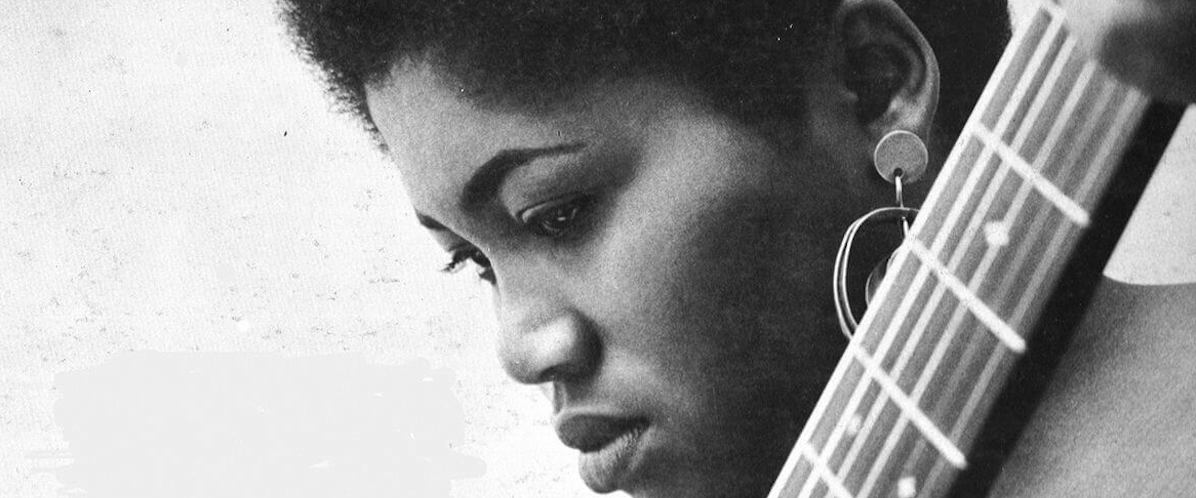
Despite the success of The Weavers, a New York City-based quartet, folk music was still largely a bottom-up phenomenon in the early 1950s, driven by small clusters of teens and twenty-somethings in song circles, regional folk music clubs, square dance societies, and progressive organizations. Big record companies hadn’t yet found a way to reliably monetize folk music, nor were they especially trying to at that point.
With the Communist scare in full swing, having already ruined or dampened the careers of performers like Pete Seeger, Josh White (who voluntarily testified before the House Un-American Activities Committee), and Burl Ives (who testified and named names), it would have been hard to fathom who would take up the call in their place. That it was a black woman with natural hair, barely a year removed from picking up a guitar for the first time, is remarkable. Then again, Odetta was brimming with such talent that she would have been hard to ignore.
She began generating buzz in the overlapping worlds of folk music and progressive politics by the end of 1952. At the hootenanny in Topanga Canyon, Seeger had become an instant fan. Although his star was then dimming because of the McCarthy-era witch hunts, he remained a force in folk music, and he began spreading the word about Odetta wherever he went. “She was astonishingly strong and direct and wanted her songs to help this world get to be a better place,” he recalled.
Whatever the extent of Odetta’s shyness or self-hatred—and it seems to have been quite severe during her early years—she fought through it. Still unknown in early January of 1953, she performed before an audience of 1,300 people during a meeting of the Southern California Peace Crusade at the Embassy Auditorium on Grand Avenue in Los Angeles. The group was a local branch of the American Peace Crusade, another organization that would face accusations of being a Communist front.
Article continues after advertisement
Speakers that night reported on the recent Peking Peace Conference, presenting favorable reports about Communist China and charges (disputed to this day) that the United States was employing germ warfare against North Korea. “Oletta [sic] Felious, young Negro singer, thrilled the Embassy audience with songs of peace,” reported the next day’s Daily People’s World, a Communist newspaper published in San Francisco. Misspelling aside, it was her first write-up as a folk singer.
That meeting, and Odetta’s performance, would later draw the attention of the House Un-American Activities Committee, though there’s no evidence the committee ever pursued Odetta directly and she was never called to testify. Very early in her career, still feeling her way, she avoided saying anything overtly political on stage, preferring to let her music do her talking, which may have saved her a trip to Washington.
In June, with a few more gigs under her belt, Odetta returned to the Embassy, this time to sing in front of a crowd of 2,000, as the opening act in a concert by her hero Paul Robeson. “He had heard about me on the grapevine,” Odetta recalled, and Robeson had asked for her to appear, a passing of the torch to a new generation of black radical singers, though neither could have fully known it at the time. Robeson sang “Old Man River,” “Water Boy,” songs in Yiddish, and “American working class songs,” according to the Daily People’s World. “Odetta Felius [sic] opened the program with songs and guitar accompaniment,” the paper said.
Although the concert was advertised as benefiting local Negro causes, it took place only five days before the Rosenbergs’ execution, when left-wing groups were in a fever pitch trying to convince President Dwight Eisenhower to issue an eleventh-hour pardon. It’s highly likely that Robeson addressed the situation during the show. Odetta, in fact, recalled it later as a benefit concert for the Rosenbergs, which is doubtful, considering that the Communist newspaper failed to mention it. “It was the only time my knees shook,” Odetta remembered, although that too seems unlikely given her early problems with stage fright. She would later take “Water Boy” and make it one of her signature songs.
However Odetta felt about Julius and Ethel Rosenberg, she later said the FBI had kept a file on her, which “likely came out of [my] involvement in collecting signatures to save the Rosenbergs.” It’s not clear whether Odetta ever saw an FBI file. Whatever its contents, the FBI appears to have destroyed it in the 1990s.
Article continues after advertisement
It wasn’t only Odetta’s selection of material that set her apart from many other white folk singers in the early 1950s. It was also her extraordinary interpretive ability. By the time of the Robeson concert, Odetta had already gone to San Francisco to visit Jo Mapes and her daughter, Hillary—Odetta’s goddaughter—who had been born the previous year. The real beginning of Odetta’s professional career came when she and Mapes took in a show at the Hungry I, a bohemian basement club on San Francisco’s Columbus Street run by a flamboyant former concert violinist named Enrico Banducci. The club would later become a launching pad for envelope-pushing comedians, including Mort Sahl, Lenny Bruce, Woody Allen, and Dick Gregory. But on this particular night, a young balladeer named Nan Fowler graced the stage.
Convinced of Odetta’s blossoming talents, Mapes decided that her shy friend needed a bit of a push if she was going to get paid for her singing. At one point, Mapes excused herself from the table and, without telling Odetta, went to talk to Banducci, informing him that “there was a folk singer in the audience who is on tour.” Banducci fell for the pitch and invited Odetta to sing a few songs. On the spot, he offered her a job.
Odetta returned to Los Angeles, quit her housekeeping job, and moved up to San Francisco, living at first with the Mapeses. When she reported for work at the Hungry I, however, she ran into a roadblock: the club’s regular headliner, a black folk singer named Stan Wilson, refused to share a bill with her, perhaps out of a fear of being overshadowed. Odetta was relegated to Wednesday nights, Wilson’s one night off, earning $10 a week—not even enough to join the local musicians’ union.
She eventually found another gig at a jazz club called Cable Car Village at California and Hyde streets. When the smooth-talking emcee tried to get Odetta to add extra sets on the house, she refused—she’d performed for too many union groups by then to take that kind of treatment sitting down—and the engagement ended after just three nights. But sitting in the crowd for one of those shows was Peggy Tolk-Watkins, owner of a new club called the Tin Angel, who offered Odetta her first steady job.
The Tin Angel had just set up shop in a converted warehouse across from Pier 23 on the Embarcadero, the San Francisco Bay waterfront that had once been the region’s shipping and transportation hub. Embarcadero means “place to embark” in Spanish, so it’s a fitting starting point for Odetta’s career. The piers, ferry boats, and short line railroad that once gave the waterfront life had fallen into decline following construction of the Golden Gate Bridge and the migration of shipping traffic across the Bay to Oakland. But the trains still ran on the tracks outside the club, its whistles providing an unsolicited counterpoint to the music emanating from the stage.
Tolk-Watkins, a lesbian poet, painter, and raconteur, is remembered as one of the real characters of North Beach bohemia. She drove to work in an old Ford sedan covered in pink and blue polka dots and was rarely without a cigarette in one hand and a martini in the other. She painted the Tin Angel’s walls red, blue, and green and decorated the club with assorted kitsch, artwork, and a player piano, giving it a decidedly campy feel. She’d pilfered the club’s namesake mascot, a two-and-a-half-foot-tall tin angel, which hung over the club’s door, from a defunct church in Brooklyn, New York.
Odetta opened at the Tin Angel on August 25th, 1953, a Wednesday. It’s here, from witnesses, music reviewers, and a live recording from the period, where we begin to get, for the first time, a sense of her fledgling stage act and the extraordinary impact it had on her audiences. Her repertoire already included work songs (“John Henry,” “No More Cane on the Brazos”), spirituals (“Children, Go Where I Send Thee,” “I’ve Been ’Buked and I’ve Been Scorned”), British ballads (“I Know Where I’m Going”), and songs from Lead Belly (“Rock Island Line”) and Woody Guthrie (“The Car-Car Song”).
It wasn’t only Odetta’s selection of material that set her apart from many other white folk singers in the early 1950s. It was also her extraordinary interpretive ability. She could evoke a small child asking a parent a million bedtime questions or a convict singing while toiling on a road gang and do both equally convincingly. Her deep contralto, especially on songs about black prisoners or railroad workers or forlorn slaves, seemed to roar from the depths of her being.
Her rendition of “Take This Hammer,” set to driving guitar, built tension so dramatically that by the time she ended the song, interspersing verses with guttural cries to mimic the crack of a nine-pound hammer, her listeners could actually begin to feel the pain and sweaty exhaustion of a convict laborer.
Take this hammer—hah!—and carry it to the captain—hah!
Tell him I’m gone boys—hah!—tell him I’m gone
The force of her singing contrasted, in an almost bewildering way, with her bashfulness on stage. Odetta’s spoken introductions to songs, delivered in a near whisper, came across almost apologetically. In fear of the audience, or engaged in an inner struggle against her sense of inferiority, she sang with her eyes closed beneath a short halo of natural hair.
By Saturday night, the club was packed to the rafters for Odetta’s 9 p.m. show—a terrifying prospect for a stage-shy singer. One reporter, who showed up a bit later during her Tin Angel run, described a typical scene: “The large woman came out of the back room marked ‘private’ and walked between the scarred tables onto the stage. She sat on a stool, tuning her guitar . . . her eyes downcast. ‘This is the story of a man and a machine. The man’s name was John Henry,’ she spoke so softly . . . barely audible.” But after she started to sing, “[a]ll of a sudden the room was filled with a voice so magnificent and powerful . . . beyond any description.”
That snapshot is echoed by Pauline Oliveros, who went to Odetta’s debut performance and later became a noted avant-garde composer. “She was so very modest, almost self-effacing in her presentation, but her voice was so very powerful,” Oliveros recalled decades later, the memory still intense. “So when she sang she was really transformed from this young person who seemed almost reticent to present herself.”
Jo and Paul Mapes were there too. Once again, without Odetta’s knowledge, Jo had seen to it that her old friend got some attention. Jo had dialed up the San Francisco Chronicle and one of its music reviewers, Robert Hagen, had picked up the line. “There’s going to be a new singer” and “you must go down and hear her,” she told him. Hagen arrived a bit late, as Odetta was in the middle of shouting a cappella the prison song “Another Man Done Gone,” with just her hand claps keeping time.
Hagen was so impressed that he invited her to his office the next day to find out more about her. When Odetta showed up, wearing the large hoop earrings that would become one of her trademarks, he was surprised to learn that she hadn’t arrived straight from Alabama but had actually grown up mostly in Los Angeles.
His review appeared in Friday’s paper. “After hearing her sing ‘Why Can’t a Mouse Eat a Street Car’ and such folksy items as ‘I Was Born Ten Thousand Years Ago’ and ‘You Gotta Haul That Timber Before the Sun Goes Down’ in a low-down voice that sounded like an impossible amalgamation of Bessie Smith and Lead Belly, I was permanently convinced that Odetta is that rare but happy occurrence in the music business—a natural.” He described her as looking like a young Bessie Smith, “if she had worn a crew cut.”
If attention was Mapes’s goal, she succeeded admirably. By Saturday night, the club was packed to the rafters for Odetta’s 9 p.m. show—a terrifying prospect for a stage-shy singer. “I drove up, I got there, and I looked into the door, and I saw all those people,” Odetta recalled. “Scared me half to death. I turned around to walk back to the car.” But she steeled herself and snuck into her dressing room, literally a broom closet.
It just so happened that Herbert Jacoby, co-owner of the posh Blue Angel nightclub in New York, was vacationing in San Francisco and had gotten wind of the glowing review in the Chronicle. He decided to see what the fuss was about. Jacoby, a gay Frenchman with a long, birdlike nose, knocked on the broom closet after the show. “We’d like to have you at the Blue Angel someday,” he said.
Odetta hadn’t heard of the famous club, so her nonchalant reply—the equivalent of “Sure, sounds great”—might have come off as quiet confidence. A week later, Jacoby called Tolk-Watkins and told her they had a sudden opening. Could Odetta fill in? Barely weeks into her professional career, she was headed to New York.
The Blue Angel was a swanky after-theater club on East 55th Street with a red carpet at the entrance, a beautiful hatcheck girl, and a main room with pink leather banquettes and walls of gray tufted velour. (Lenny Bruce was said to have likened the decor to the inside of a coffin.) Jacoby and his partner, Max Gordon, made sure audiences were racially mixed, an uncommon feature in the early 1950s; white and black performers were equally welcomed and treated well, largely due to Gordon, who often booked black singers into his downtown Village Vanguard before moving them to the uptown venue. By the time of Odetta’s appearance, Josh White, Pearl Bailey, and Harry Belafonte had already had successful runs at the Blue Angel. “Oh, I had graduated from the deep dishmop sink at the Tin Angel to a real dressing room and this place!” Odetta remembered. “I mean, it was a classy jernt!”
When Harry Belafonte saw Odetta at the Blue Angel, he was astounded. “From the very beginning, she was just an absolute marvel,” he recalled. She debuted at the Blue Angel in the middle of September. She made no changes in her act for her nattily attired new audience, performing a mix of work songs, spirituals, and children’s songs, and attracted immediate attention, not all of it for her singing. Billboard’s reporter called her “a kinky-haired, pleasant, round-faced, chubby gal.” Indeed, early in her career, writers would wear out thesauri describing her hair and weight. Aside from the superficiality of the entertainment press, whose mostly male reviewers often reduced women to the sum of their measurements, none had come upon a black female with natural hair.
The put-downs quietly trampled Odetta’s soul, but she wouldn’t say so publicly until much later. This reviewer nevertheless concluded that she showed considerable potential: “There’s a peculiar quality in Miss Felious’s voice that should interest record people. Audience reaction was only tepid. But this could change, once the nervousness and minor amateur traits are eliminated.”
The gossip columnist Walter Winchell weighed in too. “The Blue Angel’s new stardust is a blues thrush named Odetta Felios [sic]. She landed in N.Y. after being ‘discovered’ in a San Francisco spot on her 2nd week in Show Biz.” Winchell was far from alone in flubbing her last name. Robert Dana of the New York World Telegram and Sun, calling her “Miss Felois,” described Odetta as a “buxom Negro lass” and pronounced her “probably the most exciting folk singer to hit town since Harry Belafonte switched from bop to folk tunes.”
One night, Jacoby brought Belafonte to Odetta’s dressing room. If the meeting was memorable for Odetta—she recalled her mouth nearly agape at the sight of him—it was equally so for Belafonte. He’d started out as an actor in the mid-1940s, then begun crooning standards like “Pennies from Heaven” and “Stardust” with a jazz band and recording Tin Pan Alley ballads with an eighteen-piece orchestra. By the early 1950s, his movie career had just begun to take off, and he’d started recording folk songs like “Shenandoah,” but as a singer, he still channeled Bing Crosby more than Lead Belly. Down-Beathad dismissed him as “synthetic in folk singing.”
When Belafonte saw Odetta at the Blue Angel, he was astounded. “From the very beginning, she was just an absolute marvel,” he recalled. “She was such an imposing figure. She was very majestic, and then when she opened her mouth, out came that voice, which was unlike any other anybody had ever heard.”
__________________________________
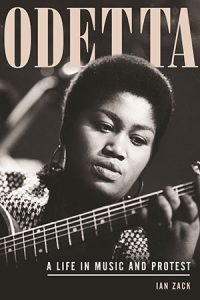
Excerpted from Odetta: A Life in Protest and Music by Ian Zack (Beacon Press, 2020).

April 20, 2020

Only socialism saves! by Carlos Luque. granmai.cu, april 17, 2020


Careful observers of the COVID-19 tragedy agree that the root cause of the present situation is the capitalist system, the pandemic of globalized economic interests
Photo: Carlos Luque
Contemplating the painful global panorama as the pandemic advances seemingly unstoppable, claiming thousands of lives; unburied corpses on the street with no space in funeral homes or private cemeteries; forcing doctors to violate their oath and choose who will die; tens of thousands of workers idle, halting the senseless commercial frenzy that never appeared so alien to us; and straining health systems to the point of collapse, it may not seem important to focus on what is happening in Cuba, a barely visible spot on the map, a small island that Hitler, they say, arrogantly erased with one stroke and dozens of U.S. administrations have attempted to drown in hunger and despair. But given the corporate media’s insistence on attempting to hide the obvious, and discount the recognition we have received, Cuba, for the sake of humanity, cannot remain silent.
Careful observers of the tragedy agree that the root cause of the present situation is not worldwide trading and consumption of wild animals, leading to zoonoses - the viral leap from nature to human beings - or overcrowding in industrial farming and the inherent overuse of antibiotics, antivirals and transgenic foods to prevent disease and increase the weight of pigs and poultry in search of greater profits. All of these are results, the last links in a chain.
The most lucid minds, committed to the facts and truth, insist that the fundamental cause is the capitalist economic system itself, the pandemic of globalized economic interests, the globalization of poverty, the greed of elites who demand austerity from the people and the usual liberalism, repeating endlessly that we have no alternative. Herein lies the explanation of the shameful implosion we are witnessing today in the richest, "model" countries of democracy. There is but one antidote to this deadly virus: rebellion and a civilizing socialist revolution.
At the same time, we are witnessing the apparent paradox that peoples and governments that have chosen to support systems and policies taking the difficult route of constructing a different economic, social and cultural model, are those which - unable to completely avoid the viral invasion given the tightly woven commercial and human fabric of our interconnected world - have taken action to combat the pandemic in a manner that differs significantly from the solutions neoliberal governments have attempted. The much-touted failure of socialism, of simply progressive, non-revolutionary governments, is collapsing today, along with lies about the mythical superiority of private property and the capacity of the market to respond to the most urgent human needs, and the most sacred of rights, the right to live.
Despite media lies that intoxicate naive readers and more astute ones, alike, Cuba has always enjoyed prestige and recognition. The strength of its moral example and capacity to resist - rooted in the ideas of our Mambi struggle for independence, of Martí and Fidel - has always prevailed over lies, aggression and material hardship. Unfortunately, and very painfully, yes, amidst such tragedy, Cuba’s image will ascend, to be seen from all points of the planet. Perhaps we need to list the reasons. Not in the spirit of foolish complacency at this dangerous time, amidst so much suffering, but because, if peoples want to rid themselves of exploiters, of murderous politicians, they must learn from the experience of those who have made the attempt and succeeded. May those who have eyes to see, see; and those who has ears to hear, hear.
When great thinkers are asked how long they prepared for the task undertaken, they reply, forever, all my life. Thus, Cuba has always armed itself with the minimum conditions necessary to implement a strategy to confront a disease such as this, allowing for such a different response, not only in advance of other countries in the region, but also with respect to nations that yesterday were the world’s colonial powers, with wealth that owes much to plunder, and are now unable to put themselves at the service of human beings, prostrated before material interests, and drowning in their own failures, to the pained, astonished amazement of the world. Cuba's advantage is systemic, of a cultural essence. The ultimate explanation lies in the nature of its way of life, its humanitarian policies, centered on human needs, life, and fundamental rights.
The speed with which our country moves from the rhythm of normal times - which, by the way, has never in more than 60 years enjoyed the normality of countries not under attack - to the effective management of emergencies, be they natural/climatic phenomena or epidemics, imported or not, is due, above all, to an institutional structure that is conceived to make a reality of an aspiration that emerged during the ancient cultural Renaissance, during the dawn of a capitalism that later betrayed it: true democracy, with human beings at the center.
Cuba’s best citizens also know how to be companions, in the etymological sense: those who eat the same bread and share material and spiritual goods in solidarity, to the degree they are able within an ocean of aggression and global inequality that forces the assumption of certain market mechanisms, the unwanted breeding ground of inequalities alien to the socialist project.
Our best sons and daughters, who show solidarity in daily life, assume sacrifice and resistance naturally, and although the inevitable diversity of different human destinies frustrates some and allows others to grow, the distinguishing characteristic of our daily functioning is solidarity with our neighbors, and with humanity. This is a profound reality only revealed in crises, usually unnoticed, invisible, in the grey of daily life.
The soulless individuals who today bury the pain they should feel for their own pettiness, and believe that only money can move Cuban doctors, are unable to assimilate that only an education of nobility sustained over time, and a social climate like Cuba’s, can generate attitudes that are not only personal, but take shape in the spirit of a nation. When our grandchildren clap their hands on balconies every night, to thank our healthcare workers, they also shout, "Long live Cuba," this is a seed that always germinates, from the innocence of the enthusiasm they see in their elders, who believe a better world is possible.
The first stone laid was literacy, reflecting Fidel's long view, and today Cuba can count on the immediate availability of skilled professionals, not only in the area of health, highly specialized and trained in responding to events of this type or similar to the one we now face.
Cuba does not suffer from the fragmentation and balkanization of the social fabric caused by the existence of opposing economic and political interests, with individuals and sectors asserting narrow self-interest in the political arena, but rather the natural existence of a diversity of human aspirations, some of which have been affected by capitalist culture now in ruins. This is what we recognize as unity, so indispensable to the majority social discipline that allows us to act as we do in the face of the pandemic, and precisely why it is attacked by our adversaries, because they know that herein lies the most solid of our principles. While elitist political cannibalism cannot be imposed in moments of crisis, unity comes through, providing the necessary social and political support to make coordinated action involving all possible.
The country's authorities’ condition as public servants is never more evident than in times like these. It is not necessary to defend our government or health leaders, unnecessarily citing their qualifications, when the facts speak for themselves. Unfortunately, today, given the voracity of the virus, we are witnessing the virulence of the capitalist system with the personification of irresponsibility, seen in the inability of its politicians to manage or alleviate the crisis.
Not all are as thick-headed and arrogant as the number one imperialist president, or as ignorant as some in the Latin American region, with their own armies stepping forward to save the system. But all fail as victims of the same monster they attempt to manage, and the privatized health care approach they defend prevents them from taking advantage of any political capital, lost to a reality of their own making.
Contrary to the stereotypes fabricated by the media machinery and those who reproduce them - either ignorantly or in a mercenary search for a few dollars - Cuba today offers a beacon of light and hope, and also an objective example of how necessary socialism is, which can be constructed in any corner of the planet. Peoples, who matter, are receiving, with our doctors, a message, a silent but effective statement. After bad weather, the seed bears fruit.
The collapse of what we once called the socialist world eroded, to a large extent, the hopes of those who, in good faith, were waiting for a possible alternative. In the field of ideas, an aversion to communist ideals emerged, used to legitimize the denial of alternatives and ignore the fact that another world is possible.
We are witnessing the reality that it will always be possible - and highly probable - that the same or worse than this pandemic will occur, if we do not rise up, once and for all, in a worldwide struggle for the only effective alternative, which, whether it be called socialism, or whatever younger generations may call it, must be decidedly anti-imperialist, anti-capitalist and anti-neoliberal. There is no possibility of capitalism with a human face. The pain and bitterness humanity is facing today is revealing the true face of Capital and the reason socialism exists.

April 06, 2020

Lives or livelihoods? by Michael Roberts., April 6 2020

Lives or livelihoods?

There are now two billion people across the world living under some form of lockdown as a result of the coronavirus pandemic. That’s a quarter of the world’s population. The world economy has seen nothing like this. Nearly all economic forecasts for global GDP in 2020 are for a contraction of 3-5%, as bad if not worse than in the Great Recession of 2008-9.
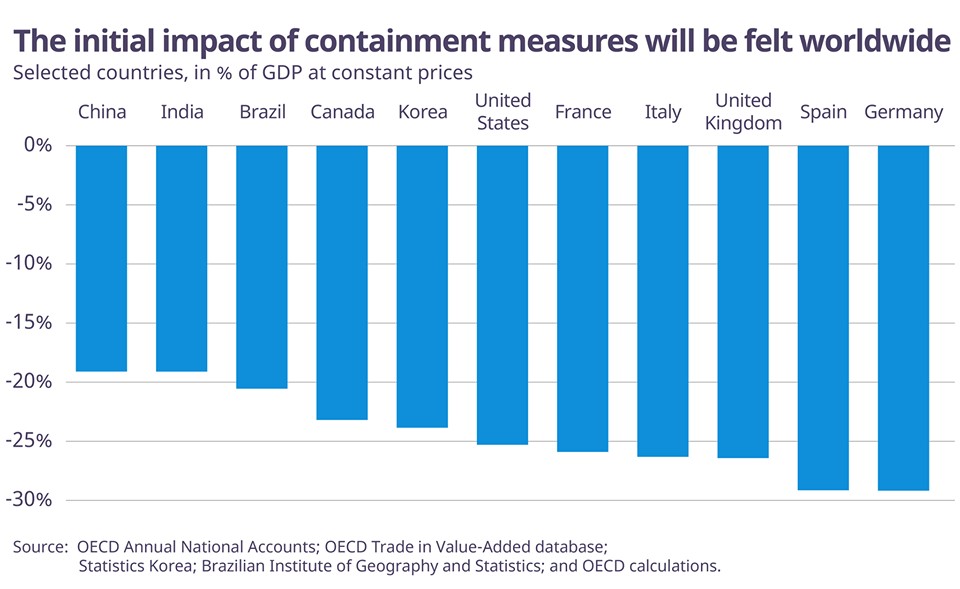
According to the OECD, output in most economies will fall by an average of 25% (OECD) while the lockdowns last and the lockdowns will directly affect sectors amounting to up to one third of GDP in the major economies. For each month of containment, there will be a loss of 2 percentage points in annual GDP growth.

This is a monstrous way of proving Marx’s labour theory of value, namely that “Every child knows a nation which ceased to work, I will not say for a year, but even for a few weeks, would perish.”  (Marx to Kugelmann, London, July 11, 1868).
The lockdowns in several major economies are having a drastic effect on production, investment and, above all, employment. The latest jobs figures for March out of the US were truly staggering, with a monthly loss of 700,000 and a jump in unemployment to 4.4%.

In just two weeks, nearly 10m Americans have filed for unemployment benefit.

All these figures surpass anything seen in the Great Recession of 2008-9 and even in the Great Depression of the 1930s.
Of course, the hope is that this disaster will be short-lived because the lockdowns will be removed within a month or so in Italy, Spain, the UK, the US and Germany.  After all, the Wuhan lockdown is ending this week after 50 days and China is gradually returning to work – if only gradually.  In other countries (Spain and Italy), there are signs that the pandemic has peaked and the lockdowns are working. In others (UK and US), the peak is still to come.

So once the lockdowns are over, then economies can quickly get back to business as usual. That’s the claim of US treasury secretary Mnuchin: “This is a short-term issue. It may be a couple of months, but we’re going to get through this, and the economy will be stronger than everKeynesian guru Larry Summers echoed this view: “I have the optimistic guess—but it’s only an optimistic guess—that the recovery can be faster than many people expect because it has the character of the recovery from the total depression that hits a Cape Cod economy every winter or the recovery in American GDP that takes place every Monday morning.”
During the lockdowns, various governments have announced cash handouts and boosted unemployment benefits for those laid off or ‘furloughed’ until business is restored.  And small businesses are supposedly getting relief in rates and cheap loans to tide them over.  That should save people’s livelihoods during the lockdowns.
One problem with this view is that, such have been the cuts in public services over the last decade or so, there is just not enough staff to process claims and shift the cash.  In the US, it is reckoned that many will not get any checks until June, by which time the lockdowns might be over!  Moreover, it is clear that many people and small businesses are not qualifying for the handouts for various reasons and will fall through this safety net.
For example, 58% of American workers say they won’t be able to pay rent, buy groceries or take care of bills if quarantined for 30 days or less, according to a new survey from the Society for Human Research Management (SHRM).  One in five workers said they’d be unable to meet those basic financial needs in less than one week under quarantine. Half of small businesses in the U.S. can’t afford to pay employees for a full month under quarantine conditions. More than half of small businesses expect to see a loss in revenue somewhere between 10-30%.
Indeed, many people are being forced to work, putting their health at risk because they cannot work at home like better paid, office-based workers.

Many small businesses in travel, retail and services will never come back after the lockdowns end. Even large companies in retail, travel and energy could well go bust, causing a cascade effect through sectors of economies. For example, the US Federal Reserve requires banks to run stress tests that assume certain bad scenarios to make sure the banks can weather a market downturn. The worst-case scenario had GDP falling by 9.9% in Q2 2020 with unemployment jumping to 10% by Q3 2021. Based upon recent estimates from Goldman Sachs, GDP will likely fall over 30% and unemployment could end up at a similar level… within weeks.
Also there are huge amounts of corporate debt issued by fairly risky companies which were not making much revenue and profit anyway before the pandemic.  And as I have said in previous posts, even before the virus hit the world economy, many countries were heading into recession.  Mexico, South Africa and Argentina among the G20 nations and Japan in the G7 were already in recession.  The Eurozone and the UK were close and even the best performer, the US, was slowing fast.  Now all that corporate debt that built up in the years since the end of the Great Recession could come tumbling down in defaults.
That is especially the case in the impoverished ‘Global South’ economies, which have experience an unprecedented $90bn outflow of capital as foreign investors leave the sinking ship.  And there is little or no safety net being offered by the likes of the IMF or the World Bank. Things are only going to get worse in the coming quarter and recovery may not be anywhere near the optimists’ view in H2 2020.
Clearly these lockdowns cannot go on forever, otherwise billions of people are going to be destitute and governments will be spending more and more, funded by more and more debt and/or the printing of money to make cash handouts and buy yet more debt.  You cannot go on doing that if there is no production or investment.  Jobs will disappear forever and inflation will eventually rocket.  We shall enter a world of permanent depression alongside hyper-inflation.
It seems that several European countries, encouraged by the peaking of cases are preparing to end their lockdowns by the end of this month.  But even if they do, a return to ‘normal’ will take months as it will depend on mass testing to gauge whether the virus will come back as it surely will and whether it could then be contained while gradually restoring production.  So any global recovery is not going to quick at all.  A German Ifo study predicted the German economy could shrink by up to 20% this year if the shutdown lasted three months and was followed by only a gradual recovery.
And the latest US forecasts from Goldman Sachs show the trough of the US recession being reached in the second quarter of 2020, with GDP likely to be 11-12 per cent below the pre-virus reading. This would involve a dramatic decline at an annualised rate of 34 per cent in that quarter.  GDP is then projected to rise very gradually, not reaching its pre-virus path before the end of 2021. This pattern, implying almost two “wasted” years in the US, has been common in recent economic forecasts. A similar picture is expected in the eurozone, which is experiencing a collapse in manufacturing output more precipitous than in the 2012 euro crisis.
But the gradual plan is the only óptimal’ option, says one bunch of economists: “importantly, the level of the lockdown, its duration, and the underlying economic and health costs depend critically on the measures that improve the capacity of the health system to cope with the epidemic (testing, isolating the vulnerable, etc.) and the capacity of the economic system to navigate through a period of suspended economic activities without compromising its structure.”
Could the lockdowns have been avoided?  The evidence is increasingly clear that they could have been.  When COVID-19 appeared on the scene, governments and health systems should have been ready.  It is not as if they had not been warned by epidemiologists for years.  As I have said before, COVID-19 was not an ‘unknown unknown’.  In early 2018, during a meeting at the World Health Organization in Geneva, a group of experts (the R&D Blueprint) coined the term “Disease X”: They predicted that the next pandemic would be caused by an unknown, novel pathogen that hadn’t yet entered the human population. Disease X would likely result from a virus originating in animals and would emerge somewhere on the planet where economic development drives people and wildlife together.
More recently, last September the UN published a report warning that there is a “very real threat” of a pandemic sweeping the planet, killing up to 80 million people. A deadly pathogen, spread airborne around the world, the report said, could wipe out almost 5 percent of the global economy.  “Preparedness is hampered by the lack of continued political will at all levels,” read the report. “Although national leaders respond to health crises when fear and panic grow strong enough, most countries do not devote the consistent energy and resources needed to keep outbreaks from escalating into disasters.”  The report outlined a history of deliberate ignoring of warnings by scientists over the last 30 years.
Governments ignored the warnings because they took the calculated view that the risk was not great and therefore spending on pandemics prevention and containment was not worth it.  Indeed, they cut back spending in pandemic research and containment.  It reminds me the decision of Heathrow airport in the UK to buy only two snow ploughs because it hardly ever snowed or froze in London, so the expense was not justifiable.  The airport was badly caught out one winter day and everything stopped.
How could the lockdowns have been avoided? If government had been able to test everybody for the virus, to provide protective equipment and huge armies of health workers to test and contract trace and then quarantine and isolate those infected.  The old and sick should have been shielded at home and supported by social care.  Then it would have been possible for everybody else to go to work, just as essential workers must do so now.  Small countries like Iceland (and Taiwan, South Korea) with high quality health systems have been able to do this.  Most countries with privatised or decimated health systems have not.  So lockdowns have been the only option if lives are to be saved.

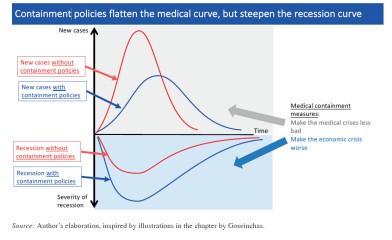
The policy of the lockdowns is only partly to save lives; it is also to try and avoid health systems in countries being overwhelmed with cases, leaving medics with the Hobson choice of choosing who will die or will get help. The aim is to ‘flatten the curve’ in the rise in virus cases and deaths so that health system can cope.  The problem is that flattening the curve in the pandemic by lockdowns increases downward curve in jobs and incomes for hundreds of millions.

And yet if the pandemic were allowed to run riot, historical studies show that it also would eventually destroy an economy.  A recent Federal Reserve paper, looking at the impact of the Spanish flu epidemic in the US, found that the then uncontrolled pandemic reduced manufacturing output by 18%. So lockdowns may be less damaging in the end.  It seems you cannot win either way.
Lives or livelihoods?  Some right-wing ‘neoliberal’ experts reckon that the capitalist economy is more important than lives.  After all, the people dying are mostly the old and the sick.  They do not contribute much value to capitalist production; indeed they are a burden on productivity and taxes.  In true Malthusian spirit, in the executive suites of the financial institutions, the view is prevalent that governments should let the virus rip and once all the young and healthy get immune, the problem would be solved.
This view also connects with some health expert studies that point out that every day, hospital doctors must make decisions on what is the most ‘cost effective’ from the point of view of health outcomes.  Should they save a very old person with COVID-19 if it means that some younger person’s cancer treatment is delayed because beds and staff have been transferred to the pandemic?
Here is that view: “if funds are not limitless – then we should focus on doing things whereby we can do the most good (save the most lives) for the least possible amount of money. Or use the money we have, to save the most lives.” Health economics measures the cost per QALY.  A QALY is a Quality Adjusted Life Year. One added year of the highest quality life would be one QALY.  “How much are we willing to pay for one QALY? The current answer, in the UK, is that the NHS will recommend funding medical interventions if they cost less than £30,000/QALY. Anything more than this is considered too expensive and yet the UK’s virus package is £350bn, almost three times the current yearly budget for the entire NHS. Is this a price worth paying?”  This expert reckoned that “the cost of saving a COVID victim was more than eleven times the maximum cost that the NHS will approve.” At the same time cancer patients are not being treated, hip replacements are being postponed, heart and diabetes sufferers are not being dealt with.
Tim Harford in the FT took a different view.  He points out that the US Environmental Protection Agency values a statistical life at $10m in today’s money, or $10 per micromort (one in a million risk of death) averted.  “If we presume that 1 per cent of infections are fatal, then it is a 10,000 micromort condition. On that measure, being infected is 100 times more dangerous than giving birth, or as perilous as travelling two and a half times around the world on a motorbike. For an elderly or vulnerable person, it is much more risky than that. At the EPA’s $10 per micromort, it would be worth spending $100,000 to prevent a single infection with Covid-19.  You don’t need a complex epidemiological model to predict that if we take no serious steps to halt the spread of the virus, more than half the world is likely to contract it. That suggests 2m US deaths and 500,000 in Britain — assuming, again, a 1 per cent fatality rate.  If an economic lockdown in the US saves most of these lives, and costs less than $20tn, then it would seem to be value for money.”  The key point for me here is that this dilemma of ‘costing’ a life would be reduced if there had been proper funding of health systems, sufficient to provide ‘spare capacity’ in case of crises.
There is the argument that the lockdowns and all this health spending are based on an unnecessary panic that will make the cure worse than the disease.  You see, the argument goes, COVID-19 is no worse than bad flu in its mortality rate and will have way less impact than lots of other diseases like malaria, HIV or cancer, which will kill more each year.  So stop the crazy lockdowns, just protect the old, wash your hands and we shall soon see that COVID is no Armageddon.
The problem with this argument is that evidence is against the view that COVID is no worse than annual flu.  It’s true that, so far, deaths have only reached 70,000 by April, some 40,000 less than flu this year and only quarter of the deaths from malaria.

But the virus ain’t over yet.  So far, all the evidence suggests that the mortality rate is at least 1%, ten times more deadly than annual flu; and is way more infectious. So if COVID-19 were not contained it would eventually affect up to 70% of the population before ‘herd immunity’ would be sufficient to allow the virus to wane.  That’s 50 million deaths at least!  Annual mortality rates would be doubled in most countries (see graph).

Moreover, this is a virus that is novel and different from flu viruses and there is no vaccine yet.  It is very likely to come back and mutate and so require yet more containment.
Some governments are risking people’s lives by trying to avoid total or even partial lockdowns to preserve jobs and the economy.  Some governments have put in place sufficient testing and contact tracing along with self-isolation, to claim that they can keep their economies going during the crisis .Unfortunately for them, even if that works, the lockdowns elsewhere have so destroyed trade and investment globally, even these countries cannot avoid a slump with global supply chains paralysed.
There is another argument against the lockdowns and saving lives.  A study by some Bristol University ‘safety experts’ reckoned that a “business as usual” policy would lead to the epidemic being over by September 2020, although such an approach would lead to a loss of life in the UK nearly as much as it suffered in the Second World War. But conversely, lockdowns could decrease GDP per head so much that the national population loses more lives as a result of the countermeasures than it saves.
But the Bristol study is just a risk assessment.  Proper health studies show that recessions do not increase mortality at all. A recession – a short-term, temporary fall in GDP – need not, and indeed normally does not, reduce life expectancy. Indeed, counterintuitively, the weight of the evidence is that recessions actually lead to people living longer. Suicides do indeed go up, but other causes of death, such as road accidents and alcohol-related disease, fall.
Marxist health economist Dr Jose Tapia (also an author of one of the chapters in our book World in Crisis) has done several studies on the impact of recessions on health.  He found that mortality rates in industrial countries tend to rise in economic expansions and fall in economic recessions. Deaths attributed to heart disease, pneumonia, accidents, liver disease, and senility—making up about 41% of total mortality—tend to fluctuate procyclically, increasing in expansions. Suicides, as well as deaths attributable to diabetes and hypertensive disease, make up about 4% of total mortality and fluctuate countercyclically, increasing in recessions. Deaths attributed to other causes, making up about half of total deaths, don’t show a clearly defined relationship with the fluctuations of the economy.  “All these effects of economic expansions or recessions on mortality that can be seen, e.g., during the Great Depression or the Great Recession, are tiny if compared with the mortality effects of a pandemic,” said Tapia in an interview.
In sum, the lockdowns could have been avoided if governments had taken notice of the rising risk of new pathogen pandemics.  But they ignored those warnings to ‘save money’. The lockdowns could have been avoided if health systems had been properly funded, equipped and staffed, instead of being run down and privatised over decades to reduce costs and raise profitability for capital.  But they weren’t.
And there is the even bigger picture.  If you have enough firemen and equipment, you can put out a bush fire after much damage, but if climate change is continually raising temperatures, another round of fires will inevitably come along.   These deadly new pathogens are coming into human bodies because the insatiable drive for profit in agriculture and industry has led to the commodification of nature, destroying species and bringing nature’s dangers closer to humanity.  Even if after this pandemic is finally contained (at least this year) and even if governments spend more on prevention and containment in the future, only ending the capitalist drive for profit will bring nature back into harmony with humanity.
For now, we are left with saving lives or livelihoods and governments won’t manage either.


March 31, 2020

Prof. Mario Caligiuri: “The coronavirus represents the death of capitalism and an opportunity to reinvent society »

Publié le
Mario Caligiuri3
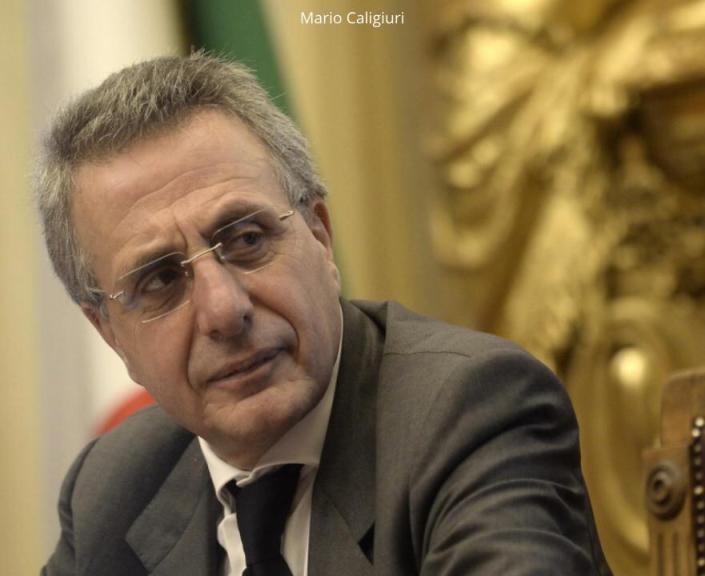
Prof. Mario Caligiuri. DR.
Mohsen Abdelmoumen: What is the situation in your country Italy in the context of the Covid19 virus epidemic?
Prof. Mario Caligiuri: At the moment, the Italian situation is the most serious in the world, in terms of the number of people infected and dead, even more than in China. The conditions are extremely difficult and in Lombardy they are even tragic. But the truth about the numbers is not told. For example, in China, from February to December 2019, 21 million mobile phones are turned off. I don’t know if that means anything. In Italy, according to the High Institute of Health, the percentage of deaths due to coronavirus alone is about 2%. In Russia, the number of infected persons is very low and no deaths have been reported so far. In Japan, the country was quarantined immediately after the official news of the postponement of the Tokyo Olympics to next year. It is only in recent weeks that strict measures have been taken against the pandemic by European countries with the exception of Sweden, and the United States, where the number of infections detected has made it the number one country in the world. While the figures are indicative, they must be interpreted and put into context. And the conclusions will be made at the end, several months from now.
You mention three very disturbing elements, such as the fact that 21 million mobile phones have been switched off in China, that only 2% of Italians have died from the coronavirus and that Russia has very few infected people and no deaths. That’s a lot of things to constitute a coincidence. In your opinion, what is the truth behind this mysterious Covid 19 virus?
In all great tragedies, there are those who suffer them and those who profit from them. The most important form of confrontation we will soon have to deal with is information warfare, which is boundless. Behind the mysterious Covid 19 virus, in my opinion, there is no conspiracy but a manifestation of nature that found us unprepared, especially in a historical phase in which man, through genetic engineering and artificial intelligence, has taken on the appearance of a God who grants life and death. What’s going on brings everyone back down to earth.
Don’t you think that there has been a huge lack of anticipation on the part of European governments with regard to the pandemic we are currently experiencing?
The first meeting of the European Commission to address the issue took place on 6 March 2020. The epidemic has been known with certainty since at least December 2019 and, as early as the end of January 2020, the World Health Organization underlined the very serious risk that this epidemic represented. Nothing more is needed to understand the neglect and unpreparedness of a large part of the European ruling class. 


Why has Europe abandoned Italy when China is trying to help it?
This confirms that every nation, beyond purely gratuitous assertions of principle, thinks first of itself. Rather than a Europe of the people, the European Union is based on the economy. China does its policy legitimately, as it does in Africa: propaganda and long-term investment.
Has Europe not shown its limits with the coronavirus crisis?
Irreversibly, if it is not in a position to confront the terrible economic crisis, which predicts a 4.5% reduction in GDP by 2020. But it could be even worse.
We have seen scenes of collective hysteria in supermarkets and superstores. Hasn’t this coronavirus crisis put individualistic consumption patterns to the test?
According to the philosopher Slavoj Žižek, global capitalism could undergo a profound transformation. For him, a radical change is needed and the coronavirus represents « the death of capitalism and an opportunity to reinvent society ». The whole social system, from media education to media literacy, is based on the promotion of consumption. Algorithms are the most powerful agent of political change in this century and are programmed in the capitalist logic of favoring the consumption of goods.
The health sector has been abandoned in the face of shortages of necessary equipment such as masks, respirators and hydro-alcoholic gel, which are sorely lacking, and the depletion and even suffering of health care workers. Don’t you think that the neo-liberal model that places profit above all else is to be questioned? Can we manage health as we manage any economic sector?
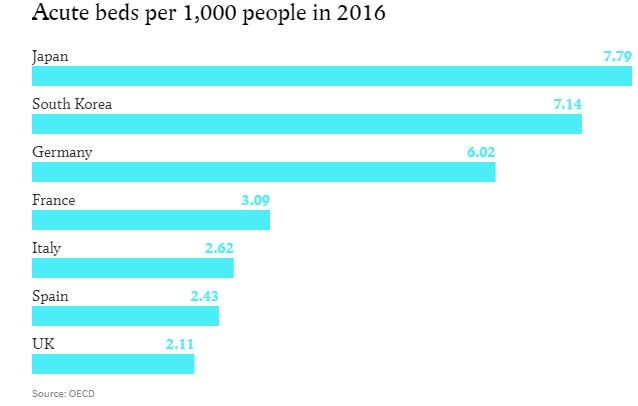
There is no doubt that health cannot be managed as an economic sector. In Italy, it is assigned to the regions, 70 % of whose budgets concern health care. In our country, in 1997, there were 575 acute care beds per 100,000 inhabitants. Today there are 275: less than half. Health in southern regions is often problematic, while at the national level, the private sector is very strong. All this confirms a banal truth: for many people, health is just a way to make money. The many exceptions, which we gratefully admire in Italy these days, only confirm the rule.
Are not peoples of Europe paying the price of austerity, deindustrialization and relocation?
After the Second World War, the idea of Europe ensured 75 years of peace, the longest period in history without conflict on our continent. During this period, however, economic and bureaucratic logics prevailed, especially after the fall of the Berlin Wall. The most aggressive logics of profit prevailed even more, which also explains the planetary spread of mafias. To cope with the pandemic crisis, the United States should see its budget deficit double, in Germany more than a thousand billion is injected, in France 300 billion and in Italy around 50 billion. When they will start to draw conclusions, there will be people in Europe who will suffer more and people who will suffer less. And the results will be unpredictable.
What do you think of the lack of competence of certain politicians who are managing this crisis on a do-it-yourself basis? Hasn’t the coronavirus exposed entire governments?
Politics is unforgivable for weakening public health. The ruling classes of the Western democracies underestimated what was happening. China used the iron fist, South Korea used technology. The ruling classes in these countries have proven to be more effective. Three years ago, Daniel Bell published the book « The Chinese Model », in which he theorizes that democracies are inadequate for creating effective public elites. We are living it. It is to be hoped that there will be an awakening soon, otherwise times will be really difficult because each private and public organization works mainly according to who leads and represents it.
Don’t you think that after this crisis nothing should ever be the same again?
It doesn’t seem obvious to me. We need to see how the political system will be re-articulated. In Italy, there is no alternative to this homogeneous political class. The new actors are no better than the old ones and have not reduced the inefficiency, social injustices and indefensible privileges of politicians. As an example, I would like to remind the position of the Five Stars movement on vaccines that they felt were doing more harm than good. If we don’t change all the musicians, the music will always be the same. But we don’t see any new musicians on the horizon.
It has been noted that in countries such as France, Belgium, etc. the population does not respect containment. Don’t you think that the issue of individual rights, the lack of discipline, complicates the solutions to eradicate the coronavirus?    

Certainly, but we must consider that this is a new situation and that social networks, rather than helping to understand, contribute to anxiety and confusion. Misinformation is the most significant fact of this era. Several years ago, I theorized on the society of disinformation, which is achieved by the excess of information on the one hand and the low level of education on the other. Today, many people understand this: why flood people with information, which is often useless and erroneous, when those who receive it do not have the critical and cultural tools to interpret it? This could be considered a very effective form of censorship. That is, the deprivation of the information necessary to understand reality.
How do you explain the lack of international cooperation, with the exception of China, Cuba, Venezuela and Russia, which send doctors and/or equipment and medicines, in the fight against this virus?
International cooperation usually works when there is something to take rather than something to give. Cuba is praiseworthy because, thanks to Fidel Castro, it has created a quality public health system at the service of the people. In the West, private health services are excellent, but they are certainly not for everyone.
Both the political system and the economic system, which some told us were infallible, have shown their vulnerability to a virus. What can we learn from this?
In particular, democratic political systems are in great crisis due to the insufficient selection of elites. Democracy is only a process in the hands of narrow oligarchies supported by the media, which give credibility to a system that fails even to guarantee the essential rights of citizens, from safety to health, from work to education. The economic system itself has confirmed the limits of a development model based on capitalism that has now imposed itself on the entire planet, including former communist states such as Russia and China.
On a completely different note, Operation Rubicon is a global scandal. How do you explain the CIA aided by the German BND spying on Allied states? Aren’t intelligence assets being misused?
Aldo Moro, the Italian statesman killed by the Red Brigades in 1978 while he was prisoner, had already stated that the German federal secret service was conducting activities in Europe on behalf of the United States. Nothing new or shocking. Years ago, the revelations of Edward Snowden, as well as those of Julian Assange, had already anticipated these events. Our President of the Republic, Francesco Cossiga, who was a great connoisseur of intelligence, maintained that it was normal to spy among allied and friendly countries. There is nothing shocking about that, because these are normal, unconventional foreign policy activities.
 You are a great intelligence specialist. How do you read the connivance between drug traffickers as well as serious crime and jihadists? How do you assess the intelligence cooperation between the northern and southern Mediterranean countries?
The convergence of interests between drug traffickers, criminals and jihadists is a very dangerous scenario, especially at this time. Few believe that states rightly focus on the fight against the coronavirus and therefore crime and terrorism are more far-reaching, especially at the IT level. In addition, one of the consequences of the economic crisis in the coming months will be an increase in social distress. With democratic ruling classes designated by election or competition, we will certainly be in even greater difficulty with mafias and terrorism, which choose their leaders on the basis of merit and individual ability. Intelligence is the deep state, the continuity of the state, independently of political majorities. Intelligence has never before had the task of stabilizing democracy and giving continuity to public institutions. It is precisely for this reason that cooperation between the intelligence services of European and African countries is a strategic step forward to transform the Mediterranean from a sea of conflict and social unrest into a sea of meetings and changes, to give new horizons to humanity in the 21st century.
Interview realized by Mohsen Abdelmoumen

Who is Prof. Mario Caligiuri?
Mario Caligiuri is a full professor at the University of Calabria, where he founded the first master’s degree in intelligence, the first course in intelligence and the first centre for intelligence studies at Italian universities. He is considered one of the leading international scientific experts in intelligence. His writings include intelligence and the humanities: Una disciplina accademica per il XXI secolo (2016), Cyber intelligence; Tra libertà e sicurezza (2016)Intelligence e magistratura; Dalla diffidenza reciproca alla collaborazione necessaria (2017) and, with Giangiuseppe Pili, Intelligence studies; Un’analisi comparata tra l’Italia e il mondo angloamericano” (2019). For the Italian intelligence magazine « Gnosis« , he recently wrote two very important essays: The unsustainable lightness of the democratic elites (2017), On artificial intelligence and the new world order and A priority commitment to intelligence (2018).

March 29, 2020

We Won’t Go Back to Normal, Because Normal Was the Problem, VIJAY PRASHAD 26, 2020


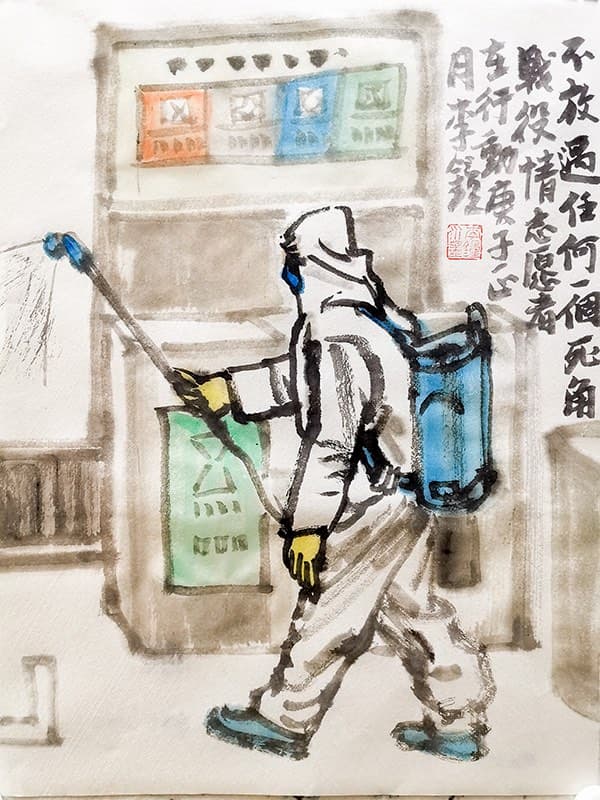
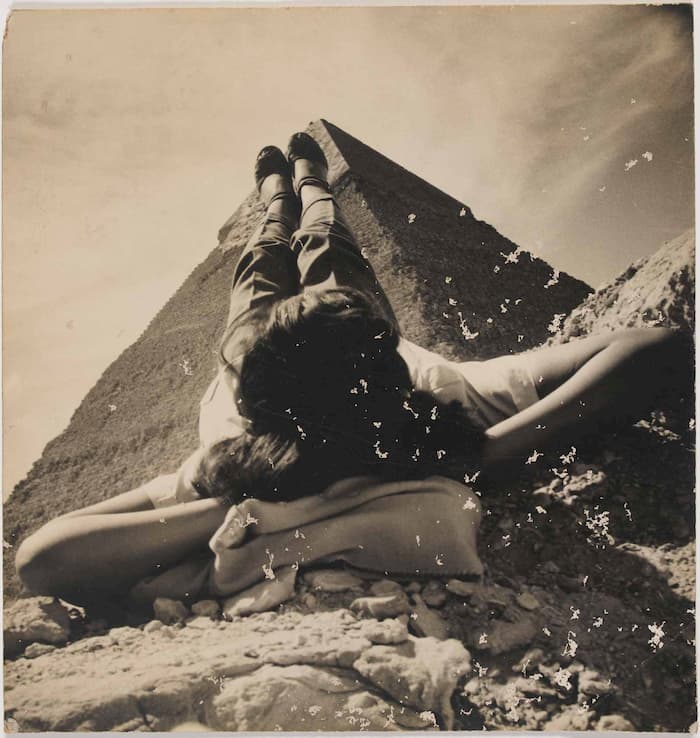
Li Zhong (China), Paintings for Wuhan, 2020.

Dear F­riends,
Greetings from the desk of the Tricontinental: Institute for Social Research.
It is hard to remember that just a few weeks ago, the planet was in motion. There were protests in Delhi (India) and Quito (Ecuador), eruptions against the old order that ranged from anger at the economic policies of austerity and neoliberalism to frustration with the cultural policies of misogyny and racism. Ingeniously, in Santiago (Chile), during its wave after wave of protests, someone projected a powerful slogan onto the side of a building: ‘we won’t go back to normal, because normal was the problem’. Now, in the midst of the novel coronavirus, it seems impossible to imagine a return to the old world, the world that left us so helpless before the arrival of these deadly microscopic particles. Waves of anxiety prevail; death continues to stalk us. If there is a future, we say to each other, it cannot mimic the past.
Certainly, the coronavirus is a serious matter and certainly its spread is a consequence of its own danger to the human body; but there are social issues here that bear serious thought. Key to any discussion has to be the sheer collapse of State institutions in most of the capitalist world, where these institutions have been privatised, and where private institutions have operated to minimise costs and maximise profit.

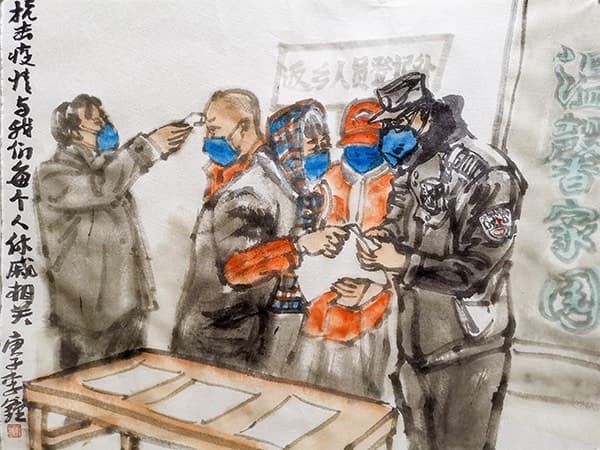
Li Zhong (China), Paintings for Wuhan, 2020.

This is most clear in the health sector, where public health institutions have been underfunded, where medical care has been transferred to private corporations, and where private hospitals and clinics operate without any surge capacity. This means that there are simply not enough hospital beds or medical equipment (masks, ventilators, etc.) and that the nurses, doctors, paramedics, janitors, and others on the front line are forced to operate in conditions of acute scarcity, in many cases without basic protection. It is often the people who make the least who are putting the most at stake to save lives in the face of the rapidly spreading pandemic. When a global pandemic strikes, the private-sector austerity model simply falls apart.

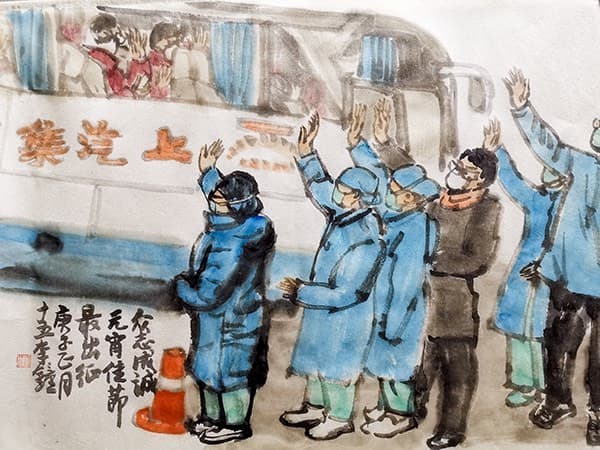
Li Zhong (China), Paintings for Wuhan, 2020.

Furthermore, our economic system has been so completely tilted to favour the financial sector and the plutocracy that it has – for a long time – simply ignored the growth of large-scale and permanent precarious employment, underemployment, and unemployment. This is not a problem created by the coronavirus or by the collapse of oil prices; this is a structural problem for which a term – precariat, or precarious proletariat – was invented at least a decade ago. With lockdowns and social isolation, small businesses have shuttered, and precarious workers find that their precarity defines them entirely. Even the most hardened bourgeois politicians are now forced to confront the reality of two points:
  1. That workers exist. The State-imposed general strike to prevent the spread of the virus and its consequences­ have proved that it is workers who produce value in our society and not ‘entrepreneurs’ who generate ideas, which they claim fancifully produces wealth. A world without workers is a world that halts.
  2. That the share of global wealth and income that workers control is now so low that they have limited reserves when their hard-earned incomes collapse. In the United States, one of the wealthiest countries in the world, a 2018 Federal Reserve study found that 40% of US households do not have the means to deal with unexpected expenses of around $400. The situation is not much better in the European Union, where the Eurostat data shows that 32% of households cannot bear unexpected expenses. That is why in the capitalist States there is now openly talk of widespread income support – even a Universal Basic Income – to manage the collapse of livelihoods and to stimulate consumer demand.
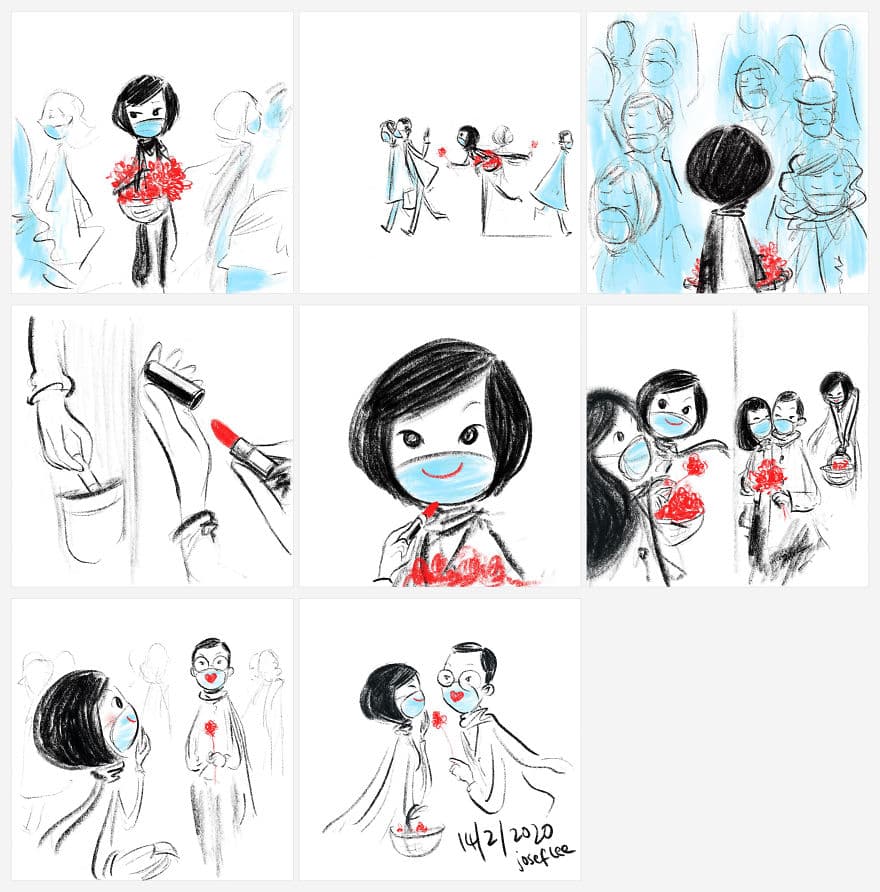
Josef Lee (Singapore), Comics in Response to the Coronavirus, 2020.
Last week, the International Peoples Assembly and Tricontinental: Institute for Social Research released a 16-point programme for this complex moment. A concatenation of crises has struck us: there are the long-term structural crises of capitalism (decline in the rate of profit, low rates of investment in the productive sector, underemployment and precarious employment), and there are the short-term conjunctural crises (collapse of the price of oil, the coronavirus).
It is now widely recognised, even by the investment houses, that the strategy for recovery from the 2008-09 financial crisis is not going to work; pumping large amounts of cash into the banking sector will not help. Directed investments are necessary in areas that had previously faced serious austerity cuts – areas such as health care, including public health, and income support. Manuel Bertoldi of Frente Patria Grande (Argentina) and I make the case for a serious debate around these issues. More than a debate about each separate policy, we need a debate about the very nature of how to understand the State and its institutions.
A key achievement of austerity capitalism has been to delegitimise the idea of State institutions (notably those that improve the well-being of the population). In the West, the typical attitude has been to attack the government as an enemy of progress; to shrink government institutions – except the military – has been the goal. Any country with a robust government and State structure has been characterised as ‘authoritarian’.
But this crisis has shaken that certainty. Countries with intact State institutions that have been able to handle the pandemic – such as China – cannot be easily dismissed as authoritarian; a general understanding has come that these governments and their State institutions are instead efficient. Meanwhile, the States of the West that have been eaten into by austerity policies are now fumbling to deal with the crisis. The failure of the austerity health care system is now clearly visible. It is impossible to make the case any longer that privatisation and austerity are more efficient than a system of State institutions that are made efficient over time by the process of trial and error.

Abduh Khalil (Egypt), Untitled, 1949.

The coronavirus has now crept into Palestine; most alarmingly, there is at least one case in Gaza, which is one of the world’s largest open-air prisons. The Palestinian Communist poet Samih al-Qasim (1939-2014) used to call his homeland the ‘great prison’, from whose isolation he gifted his luminous poetry. One of his poems, ‘Confession at Midday’, offers a brief journey into the emotional damage done to the world by austerity and neoliberalism:
I planted a tree
I scorned the fruit
I used its trunk as firewood
I made a lute
And played a tune
I smashed the lute
Lost the fruit
Lost the tune
I wept over the tree

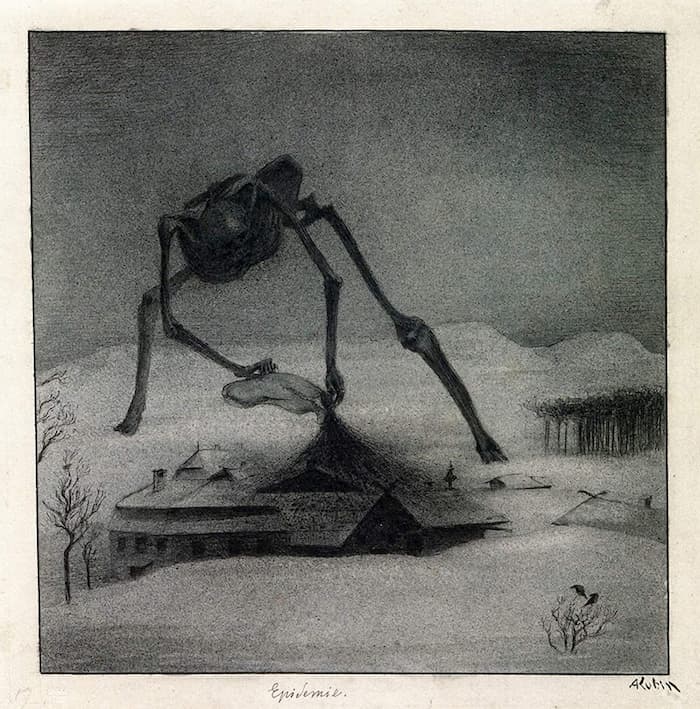
Alfred Kubin (Austria), Epidemic, 1900-1901 (Stadtische Galerie im Lenbachhaus Munich).

The coronavirus has only just begun to make its impact on India, whose public health system has been deeply eroded by a generation of neoliberal economic policies. Within India, the state of Kerala (population 35 million) – governed by the Left Democratic Front – is in the midst of a deeply campaign to tackle the coronavirus – as Subin Dennis, a researcher at the Tricontinental: Institute for Social Research, and I make clear in this report. Our findings suggest that Kerala has certain in-built advantages and that it has put in place measures that are worthy of study.

How is Kerala tackling the Coronavirus pandemic?
  1. Kerala’s Left governments over the past several decades have fought to maintain and even extend the public health system.
  2. Kerala’s Left parties and organisations have helped develop a culture of organisation, solidarity, and public action.
  3. Kerala’s Left government was swift in enacting measures to trace those infected by the virus through ‘contact tracing’ and testing at transportation hubs.
  4. The Chief Minister and Health Minister held daily press conferences that calmly provided the public with credible information and an analysis of the crisis and unfolding events.
  5. The slogan ‘Break the Chain’ captures the attempt by the government and by society to enforce forms of physical isolation, quarantine, and treatment to prevent the spread of the virus.
  6. The slogan ‘Physical Distance, Social Unity’ underlines the importance of raising resources to assist those in economic and psychological distress.
  7. Public action – led by trade unions, youth groups, women’s organisations, and cooperatives – of cleaning and preparing supplies has lifted the spirit of the people, encouraging them to trust in social unity and not to fragment into trauma.
  8. Finally, the government announced a relief package worth Rs. 20,000 crores, which includes loans to families through the women’s cooperative Kudumbashree, higher allocations for a rural employment guarantee scheme, two months of pension payments to the elderly, free food grains, and restaurants to provide food at subsidised rates. Utility payments for water and electricity as well as interest on debt payments will be suspended.
This is a rational and decent programme; it, along with the 16-point plan, should be studied and adopted elsewhere. To dither is to play with the lives of people.

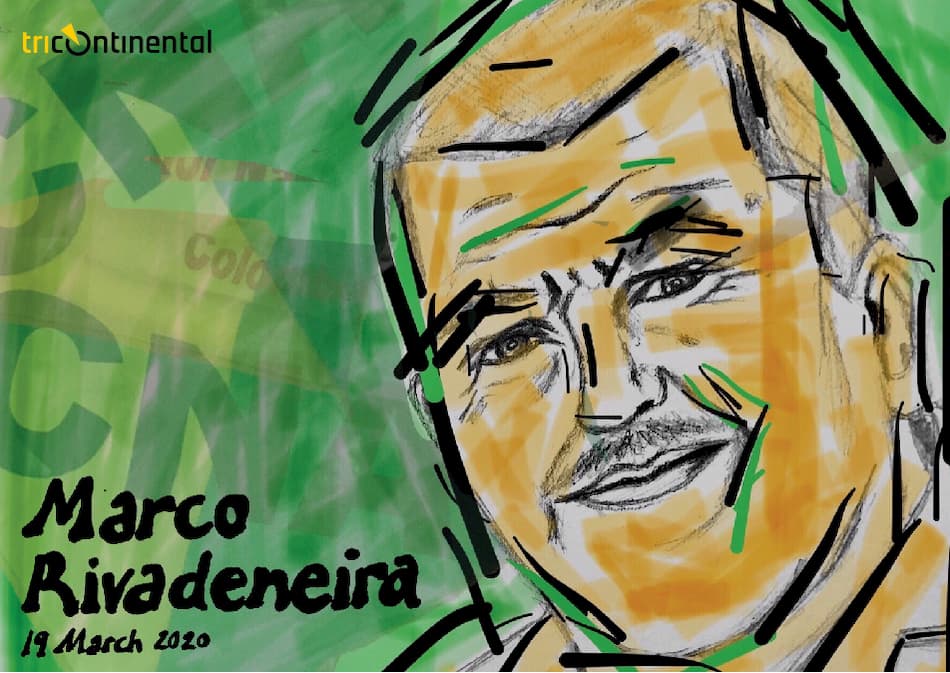
Kate Janse van Rensburg (South Africa), Marco Rivadeneira, 2020.

Colombia has implemented a national nineteen-day quarantine. Meanwhile, in prisons in Colombia, inmates held a protest against overcrowding and bad health facilities, fearing the death count if coronavirus breaches the walls; the crackdown by the State led to the death of twenty-three people. This is a fear in prisons around the world.
Meanwhile on 19 March, Marco Rivadeneira, an important leader of the agricultural worker and peasant movement in Colombia, was in a meeting with peasants in the municipality of Puerto Asís. Three armed men burst into the meeting, seized Marco, and assassinated him. He is one of more than a hundred leaders of popular movements who has been assassinated this year in Colombia, and one of eight hundred murdered since 2016 when the civil war was suspended. As Tricontinental: Institute for Social Research dossier no. 23 (December 2019) shows, this violence is a direct consequence of the unwillingness of the oligarchy to allow history to advance. They want to return to a ‘normal’ situation that benefits them. But Marco wanted to create a new world. He was killed for the hope that motivated him.

Warmly,
Vijay.

Featured Story

Dejemos que la izquierda de Estados Unidos tenga cuidado! por Andrew Taylor 23.06.2021

La Administración Biden ha habilitado una nueva "Iniciativa contra el terrorismo doméstico" para defender "The Homeland"...