May 30, 2016

NATO AND THE ULTRA-RIGHT: TURKISH HISTORY Maxim Lebsky

NATO AND THE ULTRA-RIGHT: TURKISH HISTORY
Maxim Lebsky  http://liva.com.ua/nato-nazi.html
NATO and the ultra-right: Turkish history
Secret military groups, Islamists and ultras were intended to fight against the left-wing movement and the Kurdish resistance


May 24, 2016
"From 1952 to the present day Turkey actually ran a secret NATO army" Gladio "with the center in Germany.For all processes, which are called the tutelage of the army and coups, has always been "Gladio" 1 .
Abdullah Ocalan
Rear units , which were formed with the support of NATO right-wing militants, at one time played a major role in the destruction of the left movement in Europe and Turkey. Working in conjunction with the secret police, the paramilitary groups followed a policy of "creating tension" by organizing attacks against the civilian population in order to discredit the left movement.
Network "Gladio" was created in the late forties. The main purpose of the groups formed within it was the organization of subversive and clandestine activities in case of Soviet invasion of Western Europe. The Personnel  for "Gladio" were the representatives of the fascist and anti-communist movement, including many former collaborators.
The level of secrecy that surrounded the activities of the secret NATO army, is evidenced by the fact that the first politician to recognize the cooperation with the far-right, was the Italian Prime Minister Giulio Andreotti, who was forced to do so in 1990. This was preceded by a six-year investigation into the Italian judge Felice Casson, who was involved in the killings Peteano where the May 31, 1972, three carabinieri were killed. Initially, investigators have attributed the attack "Red Brigades", but Felice Casson began reconsideration of the sensational case and was surprised to discover discovered that on the site of the explosion military explosive C-4, which does not look like a ultra samodelschinu was used. For this fact pulled the strings that led to the consequence of a far-right militant Vincenzo Vinchegerra - a member of a neo-fascist organization "New order» (Ordine Nuovo). Once in the Italian justice, Vincenzo did not remain silent and told about the links of his organization with the Italian secret services.
As it turned out, the Italian neo-Nazis were one of the branches of the underground network, which operated in the majority of NATO member countries. On behalf of the Italian structure of the whole network is called "Gladio", symbolizing the Roman short sword. It is difficult to say exactly what is the meaning invested in is the code name of its creators, but later it received a symbolic meaning: Roman Gladius was a double-edged sword, which can be both stabbing and slashing, and "rear group" had a dual task - to fight against the external enemy in the face of the Soviet Union and destroy the internal enemies - the local left-wing movement.
Among the fundamental works dedicated to cooperation with the far right, the book is to provide the Swiss historian Daniele Ganser: "NATO's Secret Army: Operation" Gladio "and terrorism in Western Europe." It presents a meticulous analysis of the secret armies in the 14 NATO countries. As acknowledged by Ganser, this activity was the most bloody in nature in three countries: Greece, Italy and Turkey. In this article, we will focus on Turkey, since the recent terrorist attacks in the country can have a direct link with the far-right Turkish project.
One of the determining factor in the development of post-war Turkey has a strategic role that was assigned to the country by US forces in the disposition of the Cold War. At the end of the 40s laid the paradigm of the American-Turkish relations, Turkey was assigned the role of "Southern Blade" NATO "underbelly" of the USSR. In March 1947 the US Congress approved the aid to Greece and Turkey in the amount of 400 mln. Dollars. In July of the same year between Turkey and the United States signed an agreement on the supply of arms and training by US instructors, officers and soldiers of the Turkish army. In addition, in 1948, Turkey is included in the Marshall Plan, and in the same year became a member of the IMF. Further more. According to official figures, for the period of the Truman Doctrine, Turkey was to re-Turkish army 175 million dollars, and from 1948 to 1953. Marshall gave her 656 million lire plan, and 58% of the amount of this tranche amounted to military expenditures. Total military spending in Turkey for the period totaled US $ 1.1 billion 2 , and US assistance to Turkey in the 1948-1959 biennium. It was $ 2.9 billion 3 .
The Turkish branch of "Gladio" was created in the early 1950s with the active participation of Colonel Alparslan Türkeş. Başbuğ (leader -. Tour) Turkish right-wing militant who was born in Cyprus in 1917. In 1938 he received the rank of lieutenant Tyurkesh and begins to serve in the army. During the Second World War, he actively nationalist and anti-communist propaganda, openly sympathizing with Nazi Germany. After the war Tyurkesh becomes a member of the commission of the Turkish General Staff in the United States and operates in various NATO structures 4 .
Headquarters of the Turkish "Gladio" was located in Ankara, CIA department building. Special Operations Executive (SOE) included five sections:  "Group training, including interrogation methods and psychological effects; a special unit, which specialized in anti-Kurdish operations; special department conducted special operation in Cyprus; Coordination Group, also known as the "Third Bureau"; and the administrative department of " .
As in other NATO countries, the Turkish "Gladio", first of all, was based on the ultra-right militants, managed by Colonel Tyurkesh. In 1965, he led the Republican Villagers Nation Party, which four years later was transformed into the Nationalist Movement Party (MHP). Its military wing becomes a youth organization "Grey Wolves» (Bozkurtlar). The official symbols of the party was the flag with three crescents and wolf image. Since the early Middle Ages was considered a wolf totem animal of the Turkic tribes. According to legend, they left Central Asia because of hunger, and followed a pack of gray wolves, which led them to the fertile Anatolia. Colonel Tyurkesh had a reputation as "the Turkish Mussolini," because he was the first in the history of Turkey created amorphous traditionalist movement the ultra-modern organization with mass support and combat troops Turkish Blackshirts.The ideology of Pan-Turkism MHP became combative, which has experienced a significant influence of the Italian Fascist corporatism and Nazism. Ideal for Turkish ultra-right was the creation of a large Turkic states - Great Turan and views Tyurkesh received expression in the so-called doctrine of "Nine rays": nationalism, idealism, moral, scientific, solidarism, policy towards the village, the development of freedom and personality, progress and nation, industrialization 
Tyurkesh wrote: "Recently, we have seen that Turkey has begun an ideological war between capitalists and communists. Both these philosophies are of foreign origin, they are both materialistic and are alien to the Turkish nation ... We also put forward the doctrine, based on spiritual values. "  And further:  " Against the communist ideology, which is the possibility of rapid expansion due to the negligence of the authorities, we have applied the ideology in recent years Turkic nationalism. We have created a modern national doctrine, which is directed against communism, and which will contribute to the development and the rise of Turkey. We called this doctrine "Nine rays." We - not for capitalism and for communism, we chose a third way, that is, advanced socio-economic doctrine, which is based on the spiritual foundations of Islam and Turkic nationalism and simultaneously represents the progress of modern scientific thought " .       
After the war, Turkey is experiencing rapid population rise: in 1940 the country's population of 17 million people, and in 1980 its population increased to 46 million this process was accompanied by an increase in the number of urban residents:. 1960 - 26% of the population lived in urban areas, in 1970 this figure amounted to 46% 8 . The social base of the "gray wolves" was the Anatolian rural youth, pouring into the city in the 1960s. Tyurkesh he organized a network of summer camps in which the neo-fascist militants received military training 9 .
As Ganser writes: "It was the National Fascist Movement, which develops and maintains the CIA while working with the Turkish secret army" 10 .  In his book he also says that the Turkish "Gladio" included not only the party Tyurkesh, but at least two other organizations: the National intelligence organization and counterinsurgency secret army 11 . These structures of the Turkish military and the far right were intended to fight against left-wing movement and the Kurdish resistance. After his arrest in 1977, vice-director of the NRA Sabahattin Savasman publicly stated: "Our secret service is working with the CIA since 1950 ... all the technical equipment that we used was provided by the CIA. Most of our staff is trained with the help of the CIA abroad. The headquarters of the NRA was built by the CIA ... all camera equipment for interrogation, from the simplest to the most complex devices came from the CIA. This I know, because I have worked directly with him " 12 
In 1975, the Turkish General Talat Turhan published a Turkish translation of the American combat statute FM30-31, which was developed by specialists of the secret service of the Pentagon and the US intelligence department of the Ministry of Defense. The Charter states: "The American military intelligence should be able to convince of the need to conduct special operations which will convince host governments and public opinion of the reality of the danger of rebellion. To achieve this, the US military intelligence should seek to introduce on roving agents, with the task of forming special groups are among the most radical elements of the insurgency. " "If it was not possible to successfully implement such agents in command of the insurgents could be useful to use the extreme left organizations for their own purposes, to achieve the goals described above" 13 . Ray Cline, the deputy CIA director for exploration in 1960, confirmed the authenticity of FM30-31 statute.
Army counterinsurgency training center is located in different regions of the country: Ankara, Istanbul, Izmir, Kayseri, Buka, Çanakkale, and after 1974 - Cyprus  14 . NRA Agents were directly related to the massacre in Kyzyldyre that killed  one of the leaders of the Turkish revolutionary generation of 1968 Mahir aspirations and his nine comrades. 
In their struggle against the leftist movement in Turkey NATO strategy was guided "by destabilization to stabilize." It can be represented as follows: there is a fierce political confrontation between the right and left-wing parties, the Left are gaining popularity and are close to seizing power at this point the secret services organized major terrorist attack or armed attack, in which killed a lot of civilians. Panic-stricken society demands to punish those responsible - and in its wake come to power military to "stop" a civil war and impose "order". It is worth mentioning that the second half of the XX century in Turkey, there were four military coups: in 1960, 1971 1980 and 1997. And every time they have played a prominent role far-right, which already in 1980 possessed the support of 200 thousand. Their active supporters 15 .
Turkish "Gladio" took part in the coup September 12, 1980 It was preceded by "Bloody Sunday" on Taksim Square - May 1, 1977. On that day, on the area it was about half a million demonstrators, and after sunset, snipers opened fire on them from the roof of the hotel "Marmara": 38 people were killed and hundreds injured. The perpetrators have not been found, but a number of evidence proving the involvement of the Turkish far-right militants. This was pointed out, even the Prime Minister Bulent Ecevit, a representative of the social democratic wing of the Republican People's Party.
As a result of these events, September 12, 1980 there was the third in the history of republican Turkey coup. He was due to the severe economic crisis, which was caused by a jump in oil prices in 1973 (Turkey imported 80% of its oil country) and the ongoing political instability in the country 16 . Political life in Turkey '70s - is alternately rule the two major parties in power - the Republican People's Party, led by Bulent Ecevit, and the Conservative Party of Justice, led by Suleyman Demirel. None of them could not form a single-party government, blocking the right Nationalist Movement Party and the Islamist National Salvation Party. From 1974 to 1980. It was formed seven coalition government offices 17 .
The leader of the coup on September 12, General Kenan Evren (he was subsequently sentenced to life imprisonment and died in prison) led counterinsurgency secret army and was actively involved in the military and police operations against leftist groups, involving them in the right-wing militants. In June 1978, General Evren is a visit to the USA, where, at a meeting with him, Zbigniew Brzezinski publicly sanctioned the military coup: "We need a stable Turkey. But events did not develop in this direction "18 .  In the next 1980, at a meeting of the NATO Military Committee in Brussels, NATO's commander in chief, General Rogers advised the Turkish military forces" to expand the scope of their powers " 19 .Thus, not only we are known in the US and Europe about the impending coup, but most actively pushed to it the Turkish military. 
After the coup, military dictatorship launched a large-scale repression against the left. According to the General Staff of the Turkish army, for the period from September 12 coup February 11, 1982 43 140 people were arrested. 57% of those arrested were aged 16-25 years  20 . According to estimates of the Turkish human rights activists, after the coup of 650 thousand. People were detained, 1,683,000 thousand. Man caught in a police filing cabinet, and 230 thousand. Man brought to trial. It has been handed down 517 death sentences and 50 convicts were hanged.
Tyurkesh was not a puppet of Turkish generals and wanted to lead his party to power. Kenan Evren took the "gray wolves" as a convenient tool for the suppression of the left, but after the defeat of the left movement necessity of an alliance with the far right has disappeared. 578 IPA members, headed by its leader appeared in court. They were accused of the murder of 594 people, including a prominent trade union leader Kemal Turkler 21 . At the same time, the number of committed "gray wolves" killers was clearly underestimated, because, according to independent experts on their account for about 4 thousands of lives 22 .
However, a few years later the authorities again took service "gray wolves". At this time, the ultra-right was used to combat the effect of gaining the Kurdistan Workers' Party. Since the beginning of 80s guerrillas Tyurkesh included in an active struggle against the Kurdish national liberation movement.The methods of struggle of the Turkish "Gladio" against the Kurds were very diverse, starting with operations under a foreign flag in order to discredit the PKK and ending with the publication of numerous propaganda literature, which developed a special Turkish intelligence department 23 . In the 80s it created the intelligence department of the Turkish Gendarmerie JİTEM (Jandarma İstihbarat ve Terörle Mücadele) , kotorіy responsible for the murder and disappearance of thousands of Kurds in the southeast of the country. One of the key leaders of the Major JİTEM The Ersever wrote in the early nineties of the book, which described in detail the activities of the Turkish death squads. Disguised as policemen attacked PKK Kurdish villages, raped and killed any innocent people. After a major book publishing Ersevera his dead body was found with his hands tied 24 , and JİTEM and continues to be actively involved in the punitive operations against the Kurds, which began in autumn 2015 25 . The gendarmes are directly related to the murder of three Kurdish women (Pakize Nair, Seve Demir, Fatma Uyar), which took place in the city of Sinop, in January 2016. This murder had a symbolic meaning, as happened three years after the massacre in Paris January 9, 2013, when the agent of Turkish special services committed the brutal murder of three Kurdish activists: Sakineh Jansiz, Fidan Doğan and Leyla Soylemez  26 .
Abdullah Ocalan writes: "As a result of the attacks of the two organizations to work together, with the powers that be above the law, even the constitution, there were more than ten thousand unsolved crimes. Murder Ozan Sefkana (Celal Ercan) and his team (1985), the murder of Comrade Makhsum Korkmaz (1986), attempts to surrender, committed by Selahattin Celik, as well as the crisis that took place at the Third Congress of the PKK in 1986 - all these are serious facts, which directly or indirectly are connected with the actions of JİTEM » 27 .
Activities of the far right to re-energize the start of a new round of military confrontation in the early 90s. During this period, the PKK leader was quite a lot of attacks, which they had had a direct bearing. November 3, 1996 near the village of Susurluk road accident occurred. The crashed car is right-wing militias and drug dealer Abdullah Çatlı, his girlfriend, the model associated with the Mafia Goncha Us, Deputy Chief of Istanbul Police Hussein Kodzhada and Member of Parliament was held in the government coalition of the Party of the True Path Sedat Bucak - the head of the militia detachment of pro-Turkish Kurdish militia. All passengers, except Budzhaka died. The fact that a wanted criminal, an active member of the punitive anti-Kurdish operations, was in the company of government officials, was the occasion for a major political scandal. Tens of thousands of people took to the streets to protest against the actions of the authorities, using neo-fascists and the secret army counterinsurgency.  
The culminating moment in the activities of the Turkish "Gladio" was the capture of Ocalan in 1999.Initially, the ruling circles of the United States denied the direct involvement of its secret services in the capture of PKK leader, but in the future in the US media published information about US involvement in the persecution of Abdullah Ocalan. This participation took the form of political pressure on the country in which at different times prezzhal in search of political asylum to Ocalan (Syria, Russia, Italy and Greece), as well as through the wiretapping of telephone conversations and monitoring of the movements of the Kurdish leader. All received information is transmitted to the United States Ankara, and that US agents were informed Turkey about the arrival of Ocalan in Kenya.After that the capture of PKK leader was only a technical problem 28 .
What is the current activities of the Turkish "Gladio"?
In March 2013 the leader of the PKK, Abdullah Ocalan appealed to the Turkish government to find a political solution to the Kurdish question. The next two years, Erdogan avoided carrying out large punitive actions in the south-east of the country - although the government has not made any serious moves in the issue of the release of Kurdish prisoners. PKK unilaterally started to withdraw their forces from the territory of Turkey, but Erdogan made it clear that will make concessions only after the complete capitulation of the Kurdish guerrillas. After that negotiations have stalled.
An important political background of these events was the civil war in Syria and the creation of the Kurdish autonomy in the north. The emergence of Kurdish cantons did not fit into the plans of the Turkish elite, but the ruling elite could not without good reason to go for a violation of a fragile truce.That reason was the terrorist attack July 20, 2015 in Suruç when errorist bomber killed 32 people and more than a hundred people were injured. The purpose of the attack was not chosen by chance - in Suruç border attended by activists of the socialist Federation of Youth Associations (Sosyalist Gençlik Derneği Federasyonu - SGDF) , to participate in a volunteer campaign to restore the destroyed Islamist Kurdish city of Cobán. (CHP) Deputy Chairman of the Kemalist Republican People's Party Veli Agbaba said that this tragedy - "the result of government policy in the Syrian issue and the activities of the security services" 29 .
In response, shares Kurdish guerrillas killed in the nearby town Sheylanpinar two police officers related to the jihadists. And this action became the formal reason for the resumption of the Turkish air force air strikes on PKK bases in the Qandil Mountains. It is difficult to believe that the murder of two police officers was the real cause of the armistice breaking. Quite the contrary - it was an expected reaction of the authorities on the terrorist attack in Suruç.
It is important to remember that in June of the same year in the Turkish parliamentary elections were held, the results of which, Erdogan's party lost the parliamentary majority (258 seats out of 550). A month later, an explosion occurred in Suruç and the war with the PKK. In this situation brings to mind the words of Engels: "... Where on the surface is a game of chance, there is this very randomness is always subordinated to the inner, hidden laws. The thing is just to discover these laws "  30 .  After the termination of the two-year truce with the Kurds Turkish capital sweeping series of terrorist attacks.October 10 a suicide bomber drives a bomb near the central railway station. During the attack killed 102 and injured 246 people. And in early November, held early elections in the Turkish parliament, in which the Justice and Development Party wins a majority - 317 seats (57.64%), thereby acquiring the ability to form a single-party government. These events are very well fit into the strategy of "creating tension" - the escalation of violence is almost always pushed disoriented society in the direction of the ruling party, turning it into a bastion of stability and order.   
During the two-thousand years in Turkey held a series of high-profile lawsuits against the Turkish military, the most famous of which was the conspirological business organization "Ergenekon", which ended in the arrest of retired military, were skeptical of a NATO cooperation . With it, Erdogan intimidated command of the Turkish army, which has positioned itself as the guarantor of the head of the Ataturk legacy. All military coups in Turkey took place under the same slogan: "Back to Ataturk", which means - to the secular and republican Turkey. As stated by Deputy Head of the General Staff of the Turkish Army, General Cevik Bir, "In Turkey, between Islam and democracy, concluded the marriage. The child of this union - secularism. Sometimes a child gets sick, and the Turkish army - just the doctor who saves him. Depending on the severity of the disease, we introduce the right medicine to the child recovered " 31 .
Erdogan learned the error of his ideological predecessors of the Democratic Party of Adnan Menderes, who was overthrown and executed by the military, and struck the Turkish generals preemptive strike aimed at dismantling the Kemalist heritage. This is evidenced by the important processes that take place at the National Intelligence Service. Leading position in this structure traditionally occupied military personnel - in such a way generals have a direct impact on the Turkish intelligence. In the early 90s the share of military unit in the NRA was about 35%, but now, according to some, it does not exceed 5%  32 . Thus, the structure of which was used for their own purposes cooperation with the far right, is now under the control of the Turkish President.
At present, the main enemy of the Turkish ruling elite is the Kurdish national liberation movement, which enjoys the support of the Turkish left. To suppress it, Erdogan is necessary to decide on a sweep of the Kurdish south-east Turkey and destroy the Kurdish autonomy in northern Syria. To this end, Turkey has supported the militants LIH and other Islamist groups, based on the jihadists as a force possessing enormous mobilization potential. However, the ultra-nationalist organizations - including the "Grey Wolves" - still used by the Turkish authorities.
The ancient Romans were pragmatic people and in the search for the perpetrator of crime has always asked the question «Cui prodest?» - «Who benefits?". With regard to acts of terrorism sweeping response to Turkey is clear - they are beneficial to the ruling Justice and Development Party, on the basis of an old strategy against the left-wing movement, which for many years was carried out in the country with the support of NATO and has always been based on collaboration with the forces of the extreme right reaction. Maxim Lebsko

Read on:
Carl Lebt .  Turkey: the struggle for cultural hegemony
Andrew Manchuk .  Kurdistan, which is not
Alexander Rybin .  Rozhava - "People's House"
Immanuel Wallerstein .  Taksim. Kurdish dilemma
Andrew Manchuk .  Istanbul. Echo "Nicky"
Alexander Ivanov .  Park Gezi. theatrical performance
Andrew Manchuk.  Hasankeyf. Doomed City

1. A. Ocalan Manifesto democratic society. Book Five: The Kurdish problem and the solution of the model of a democratic nation: protection of the Kurds who are in the grip of cultural genocide. M.2016.S.697
2. Kadyrov RR Turkey as a strategic ally of the US in the 50s of XX century // scientists. Kazan note.Univ. Ser. Humanity. science. T. 2010. 152 Kn. 3, ch. 1, pp 234.
3. Kadyrov RR Turkey as a strategic ally of the US in the 50s of XX century // scientists. Kazan note.Univ. Ser. Humanity. science. T. 2010. 152 Kn. 3, ch. 1, pp 237.
4. RF Muhammetdinov Origin and evolution of Turkism. - Kazan: Publishing house "Zaman", 1996.S.175
5. Ganser D. NATO Secret Army: Operation "Gladio" and terrorism in Western Europe / ed. from English. MA Krasikova Ed Chernoff AA. - M .: Kuchkovo Field, 2012. 269 pp
6. RF Muhammetdinov Origin and evolution of Turkism. - Kazan: Publishing house "Zaman", 1996.S.177
7. Quoted from Muhammetdinov RF Origin and evolution of Turkism. - Kazan: Publishing house "Zaman", 1996.S.177-178
8. RF Muhammetdinov Origin and evolution of Turkism. - Kazan: Publishing house "Zaman", 1996.S.194-195
9. Vachnadze G. Behind the scenes of one diversii.M.1985. S.11-12
10. Ganser D. NATO Secret Army: Operation "Gladio" and terrorism in the West Europeanization M .: Kuchkovo Field, 2012. 272 ​​pp
11. Ganser D. NATO Secret Army: Operation "Gladio" and terrorism in the West Europeanization M .: Kuchkovo field 2012. S.273-274
12. Ganser D. NATO Secret Army: Operation "Gladio" and terrorism in the West Europeanization M .: Kuchkovo field, 2012. S.275
13. Ganser D. NATO Secret Army: Operation "Gladio" and terrorism in the West Europeanization M .: Kuchkovo box, 2012. p.278
14. Serdar Celik Turkey's Killing Machine: The Contra-Guerrilla Force http://www.hartford-hwp.com/archives/51/017.html
15. Menshikov V. Gray Wolves // Around the World. 1983. number 8 (2515). [Electronic resource].URL: http://www.vokrugsveta.ru/vs/article/2039
16. Dr. İhsan, Dr. Sedat The rise of ideological-revolutionary terrorism: the Turkish experience, 1960-1980 // The Journal of Turkish Weekly (2014 14 March). Electronic Resource]. URL: http://www.turkishweekly.net/article/226/
17. VI Danilov, 80 Turkey: from a military regime to a "limited democracy". M., 1991. S. 18.
18. VI Danilov, 80 Turkey: from a military regime to a "limited democracy". M., 1991. S. 44.
19. VI Danilov, 80 Turkey: from a military regime to a "limited democracy". M., 1991. S. 51.
20. Keles R., UnsalA. Kentvesiyasalsiddet. Ankara. 1982. F. 58-59 // Op. by Daniel. Turkey 80 from a military regime to a "limited democracy". S. 28-29.
21. Menshikov V. Gray Wolves // Around the World. 1983. number 8 (2515). [Electronic resource].URL: http://www.vokrugsveta.ru/vs/article/2039/
22. Turkish Fascists: The MHP http://www.hartford-hwp.com/archives/51/019.html
23. Serdar Celik Turkey's Killing Machine: The Contra-Guerrilla Force http://www.hartford-hwp.com/archives/51/017.html
24. Ganser D. NATO Secret Army: Operation "Gladio" and terrorism in the West Europeanization M .: Kuchkovo field, 2012. S.286
25. https://undercoverinfo.wordpress.com/2016/01/11/jitem-secret-turkish-death-squad-responsible-for-recent-executions-of-kurds/
26. http://en.rfi.fr/europe/20150723-french-inquiry-implicates-turkish-secret-services-paris-kurds-murder
27. A. Ocalan Manifesto democratic society. Book Five: The Kurdish problem and the solution of the model of a democratic nation: protection of the Kurds who are in the grip of cultural genocide. M.2016.S.454
28. Gray B. Hunt for Ocalan: Washington disregards international law and democratic rights.[Electronic resource]. URL: http://www.wsws.org/ru/1999/feb1999/ocal-f24.shtml (access date: 01.12.2013)
29. http://nk.org.ua/geopolitika/terakt-v-suruche-v-kontekste-politicheskoy-borbyi-v-turtsii-16863
30. F. Engels. Ludwig Feuerbach and the End of Classical German Philosophy. Marx, Engels, Collected Works, vol. cit., Vol. 2, v. 21, p. 306.
31. https://lenta.ru/articles/2015/11/13/turkish_army/
32. http://arsiv.sabah.com.tr/2007/07/19/haber,4D36E8C34C434B5880E8E8BE1D3FF328.html

May 29, 2016

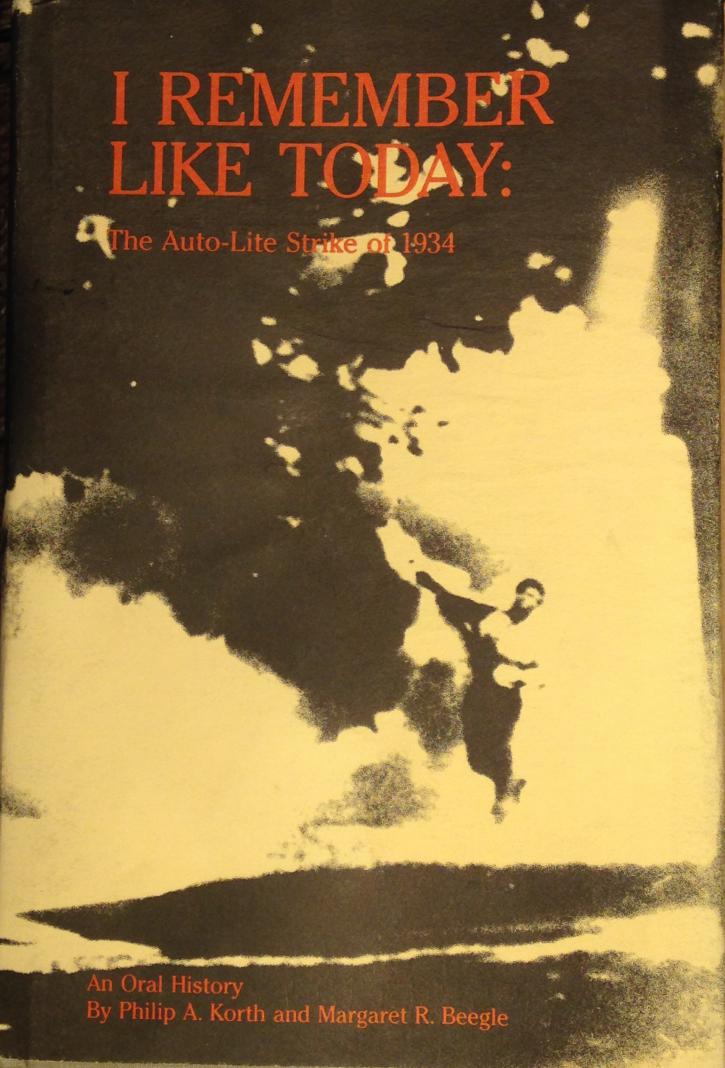
An overview of the 1934 Toledo Auto-Lite strike - Philip A. Korth & Margaret R. Beegle

An overview of the 1934 Toledo Auto-Lite strike - Philip A. Korth & Margaret R. Beegle
A summary by Philip A. Korth and Margaret R. Beegle of the 1934 Toledo Auto-Lite strike. Originally appeared as the second chapter of I remember like today: the Auto-Lite strike of 1934, an oral history.
The strikes at Auto-Lite in Toledo in the spring of 1934 secured a victory for the fledgling Automobile Workers Federal Union Local 18384 of the AFL and permanently altered the nature of worker-employer relationships in Toledo. This victory assured that working men and women in Toledo would have some power over their working lives and a voice in their community. Workers in Toledo today owe a debt of gratitude to the "unholy thirteen" who huddled over the fires burning in drums in front of Auto-Lite and who dreamed of freedom and dignity. And as today grows out of yesterday, so the workers in 1934 faced a set of conditions and attitudes shaped decades before by the industrial evolution of Toledo, the development of the automobile industry, and the historical struggles of their ancestors.
In the twenties, some workers at Auto-Lite had discussed the possibility of forming a union, but nothing had materialized. The nature of production work in a factory created in many minds—particularly in the minds of craft union advocates—an insuperable obstacle to forming a union. The factory operative enjoyed no inherent power, for he or she could be moved from job to job or speedily replaced because the machine performed the skilled functions while the operative tended it. The parts industry, like the automobile assembly industry itself, experienced the seasonal cycle of production and lay-offs, even in the best of times, so operatives at Auto-Lite faced constant uncertainty. They understood their vulnerability: employers could dismiss a worker at will or refuse to rehire a worker who got out of line. Forming a union in the twenties and thirties proved fully as out of line then as now Workers at Auto-Lite lived with fear and uncertainty, for with the exception of the model shop and related operations where a few workers made new products and cut dies, the Auto-Lite employed operatives almost exclusively. One need not look far to understand their reluctance to take the risks of forming a union.
In 1933, a few workers from Auto-Lite's Department Two, the punch press room, notably Charles Rigby, Lester Byrd, Chester Dombrowski and John [J. J.] Jankowski, began to act upon their belief that semi-skilled factory workers should and could form unions, and they approached the Toledo Central Labor Union for advice. Although sympathetic, no single craft union found them within its jurisdiction. Factory operatives simply did not fit the craft form of organization. Rigby and his friends were referred to a new Federal Labor Union, which had recently formed in Toledo.
Federal Labor Unions appeared in the AFL well before 1933. Produced by the debates between craft union advocates and industrial union advocates, the Federal Labor Union provided the structure to organize entire industrial plants or complexes. During the initial organizing period, all workers, regardless of skill or work assignment, would be recruited into a single Federal Labor Union chartered for a particular plant or factory system. Once organized, workers would be assigned to new or existing locals of the appropriate craft international. The organizers initially targeted Spicer Manufacturing Company, Bingham Stamping and Tool Company, Logan Gear Company, and City Auto Stamping Company. Through Rigby and his friends, the Auto-Lite, one of the largest employers in Toledo, joined the list, Membership from Auto-Lite, initially small, included strong and imaginative leaders.
Local 18384 had an unusual jurisdiction that included a number of distinct companies. Normally, a separate charter would have been issued for each, but Local 18384 covered five companies, each with its own shop committee to direct plant affairs. The officers reflect the atypical composition of Local 18384. When Lawrence D. Haynes, the first president of Local 18384, found a new job in Detroit in early March of 1934, the members declared the office vacant and elected Floyd L Bossier to fill it. Bossier did not work at any of the plants in Local 18384's jurisdiction. A city employee in the street department, he had built a reputation in Toledo by speaking on socialist themes and by campaigning actively for the new mayor and former Socialist, Solon Klotz. However, members of the Auto-Lite shop committee sat on the executive committee of the local—William Siefke, for example—and the local's financial secretary, George Addes, also came from Auto-Lite. Other officers and executive committee members came from the remaining four companies targeted for organizing. Thomas Ramsey, business agent for Local 18384, worked at City Auto Stamping. This reflected the nature of work in the auto parts business. The worker followed the work, sometimes from plant to plant around the city.
From August 1933 to February 1934, Local 18384's activities grew from a series of furtive, secret meetings in workers' basements to open meetings attracting a few hundred workers at the rented Moose Hall. There, in February, the membership decided to strike Spicer, Bingham, and Logan to enforce the union's demands for recognition, wage increases, and a seniority system. Members of the Auto-Lite shop committee insisted that Auto-Lite be included, although the union had little active support there. Charles Rigby, chairman of the Auto-Lite shop committee, argued persuasively that a strike there could be effective since union supporters dominated the punch press room, Department Two, which made the stampings for the entire assembly operation. This obvious tactical advantage convinced Local 18384's executive committee to include Auto-Lite in the strike; and it agreed to continue the strike at Spicer, Bingham, and Logan until Auto-Lite settled.
On February 23, Local 18384 struck Spicer, Bingham, Logan, and Auto-Lite. Production at Spicer, Bingham, and Logan slowed significantly as a result of the strike, but at Auto-Lite production continued unabated. On the morning of February 23, fifteen workers out of Auto-Lite's work force of fifteen hundred clustered with their picket signs and union badges around a fifty-five gallon drum salamander in front of the factory on Champlain Street, watching the mass of workers report for work. Support by strikers at Spicer, Bingham, and Logan, who refused to return to work unless Auto-Lite reinstated its strikers, sustained them.
The handful of strikers huddled around fires in late February surely felt the chill of winter; but just as surely, they felt chilled because they were so few in number. Fear thawed from their faces four days later, however, when they won an agreement and reinstatement. On February 28, the strike ended, The Auto-Lite strikers returned to work under a thirty-day agreement, knowing they had survived where others had not but fully aware of their precarious situation and of the immense organizing task before them. They had achieved an important moral victory, for they demonstrated to their fellow workers and to themselves that Auto-Lite was not invincible.
Assuming that they had won recognition, the Auto-Lite shop committee arranged meetings with management. The meetings quickly demonstrated that Auto-Lite had merely acknowledged the existence of Local 18384 but did not recognize it as the bargaining agent for Auto-Lite workers. The nucleus of workers in the punch press room, building upon their successful reinstatement, signed up workers in anticipation of the inevitable showdown. The company also prepared by adding new workers to the force and, more ominously, by secretly purchasing tear gas and arms from Federal Laboratories, a munitions manufacturer.
The April 1 deadline of the February agreement passed without a contract, but the union continued to try to negotiate. On April 12, six weeks after their modest victory, the membership voted to strike; and on Friday. April 13, approximately four hundred Auto-Lite workers set up picket lines. An equal or greater number of workers crossed the picket lines, entering the factory without serious incident. The strike appeared to divide the work force equally, but many new hires were among those entering. The company responded by increased hiring, replacing those workers who had struck. Minor incidents, such as pushing. shoving, and some fist fights, occurred on the picket lines and at homes around the community when union members tried to persuade those still working to join the strike. From the first day of the strike, the Toledo Police Department assigned officers to patrol the picket lines, but they made no attempt to disperse the picket.
The picket lines rallied strikers, kept their spirits high, preserved their solidarity. and generated fear and guilt in those who sought to cross them. Workers from other plants around Toledo and from other unions joined Auto-Lite strikers on the picket lines, as did members of the Lucas County Unemployed League, which had been organized in 1933 by members of the American Workers party. Thus, the picket lines became a major target of the Auto-Lite management, which went to court to attack them. On May 3. counsel for Auto-Lite appeared before Judge Roy R. Stuart in the Court of Common Pleas seeking injunctive relief from the pickets.
Bringing the case before the Court of Common Pleas invoked the county's jurisdiction. Judge Stuart granted the injunction and limited pickets to twenty-five. He assigned responsibility for enforcement to Lucas County Sheriff David Krieger, a Republican who had run for office with the support of C. O. Miniger, president of Auto-Lite. Krieger began to hire special deputies to enforce the injunction. He did not require previous police experience for the job. The deputies dressed in street clothes and wore only arm bands and badges to identify themselves. Auto-Lite paid their wages. Fifty Toledo police force members had recently been laid off because of the city's strained financial situation, but none joined Krieger's force of special deputies.
On May 5, leaders of the Lucas County Unemployed League announced in a public letter to Judge Stuart that they intended to violate the injunction against mass picketing. Two days later, as the leaders picketed Auto-Lite, Sheriff Krieger arrested them and charged them with contempt of court. Judge Stuart convicted them but then suspended their sentences and released them. They returned to the picket lines, where they were joined by dozens of union members who had also agreed to break the injunction. Additional arrests ensued; but in large measure the league and the union defeated the injunction, for the city and county, unable to handle mass arrests, had to release the pickets shortly after their arrests. The pickets quickly lost whatever respect they had had for the sheriff and the courts.
Ironically, the injunction proved crucial, for the strike seemed doomed until its issuance. Auto-Lite operated with non-strikers supplemented by the newly hired. Although less efficient, production of generators, meters, and gauges continued. In addition, some strikers filtered back into the plant. However, the hated injunction had aroused the strikers. Their ability to break the injunction in fact, if not in law, encouraged other workers in the community to join them, and the picket lines swelled. Auto-Lite remained intransigent. It intended to break the picket line. When crowds of up to six thousand rallied in front of Auto-Lite on May 21, 22, and 23 to hear speakers from the American Workers party and the union.
Auto-Lite hastily added to its cache of arms. The company encouraged Sheriff Krieger to enforce the injunction more energetically. Adding to his force of special deputies, which now included Auto-Lite workers who remained at work and scabs, Krieger set out on May 23 to disperse the pickets. He stationed deputies well supplied with tear gas on the roof while others were stationed in front of the plant. The subsequent melee began when someone threw a heavy steel bracket from the building and hit a female picket, Alma Hahn, in the ear and neck. Outraged, the pickets surged forward and attempted to storm into the building to attack the person who threw it. The special deputies fired tear gas down on the pickets, who then fell back across the street. News of the fighting quickly spread across Toledo and attracted larger crowds. Attendance at movie houses declined as the Auto-Lite strike became the most exciting show in town.
The Auto-Lite factory also became a symbol, a target for Toledo workers' pent-up exasperation, frustration, and anger. The strikers, determined to halt production at Auto-Lite, surrounded the factory on the afternoon of May 23 and refused to let the strikebreakers out when the shift ended. Strikers, sympathizers, and children from the area showered the factory building with bricks and stones until no window remained unbroken. Managers herded the strikebreakers into the adjoining building behind the main plant where they spent the entire night in darkness and terror. The special deputies soon exhausted Auto-Lite's stockpile of tear gas, so an emergency call went out to Cleveland for additional supplies. The crowd overturned cars and set them afire as they dodged tear gas canisters and projectiles.
Frantic calls for help from inside the factory persuaded the governor to intervene, and, at midnight, units of the Ohio National Guard were mobilized and sent into Toledo. They arrived at 4:30 in the morning, deployed on Michigan Avenue two blocks away, and marched to the plant, dispersing the crowd as they advanced. Within hours, the guardsmen had moved the crowd back and had taken up positions, setting up machine gun emplacements at key intersections near the plant. At 7:30 that morning, the guard released the strikebreakers and escorted a bus carrying some of them away from the building.
The guard ended the siege of the Auto-Lite factory, but it did not end the struggle. The crowd remained, restless and hostile. The young, frightened, and poorly-trained guardsmen failed to intimidate the crowd. Rocks and bricks soon accompanied the taunts and insults passing back and forth across the picket lines. On Thursday afternoon, May 24, a full battle between guardsmen and the crowd erupted in front of the Auto-Lite factory. Guardsmen hurled back rocks thrown from the crowd, also pausing to throw tear gas canisters and to fire tear gas shells. Members of the crowd donned gloves to hurl the tear gas back into the guardsmen's ranks. With fixed bayonets, guardsmen charged into the crowd repeatedly, only to retreat again as the Battle of Chestnut Hill raged back and forth in front of the factory. During one charge, guardsmen fired, wounding more than a dozen and killing Frank Hubay, a young unemployed worker who had once worked for Auto-Lite. But the gunfire did not disperse the crowd. Later that night, guardsmen fired again and wounded two more. The adjutant general of the guard, Frank D. Henderson, ordered the nine hundred guardsmen reinforced, bringing the total on duty at Auto-Lite to 1,350. Friday, May 25, saw no serious encounters; but on Saturday, amid union demands that the plant close completely and the guard with-draw, a crowd of five thousand clashed with the guard. Two hundred were injured and fifty arrested.
The following week the plant remained closed. No further violent confrontations occurred as federal mediators, the company, and the union attempted to work out an agreement. Auto-Lite suggested that the Automobile Labor Board, which President Roosevelt had appointed on March 25, be asked to intervene; but Local 18384, sensing victory, rejected the suggestion. On Friday, May 31, the guard with-drew, and an agreement negotiated directly between the union and Auto-Lite management emerged. On June 4, the union ratified this agreement in which Auto-Lite recognized Local 18384 as the legitimate bargaining agent for its members. On June 5, the Auto-Lite plant reopened.
However, Local 18384 did not win an unqualified victory. The order of rehiring placed strikers second in importance to old employees who had remained at work during the strike, and it secured bargaining rights only for its members. Shortly before the strike, some workers who aligned themselves with Auto-Lite management formed a competing organization called the Auto-Lite Council. Management recognized this company union's bargaining rights and gave them priority in rehiring. The order of rehiring created few difficulties in practice, however, since virtually all old workers were rehired at the same time, striker and non-striker alike. Newly hired strikebreakers found themselves ignored, and many were not rehired until months later when production began to accelerate.
The Auto-Lite Council hung on for two more years; but Local 18384 won the real victory, of course, for its recognition established the basis for collective bargaining. Auto-Lite workers understood this and rushed to join Local 18384. Within months, the Auto-Lite Council was a paper organization. Preferential treatment that Auto-Lite management promised council members never materialized, and its members realized that they could expect no more in their negotiations than the union already had won.
Local 18384's success in establishing a conventional collective bargaining relationship with Auto-Lite management failed to fulfill the hopes of the leaders of the American Workers party, the Communist party, and other radical supporters of the strikers who had seen in the Auto-Lite strike the potential for a more dramatic and revolutionary outcome. Likewise, the plan of the AFL leadership to distribute the membership of Local 18384 among existing craft unions never reached fruition because the CIO formed in 1935. Local 18384 then evolved into Local 12 of the United Automobile Workers, CIO. Members of Local 12 became leaders of the UAW and supported the organization of other strikes such as the Chevrolet transmission plant strike in 1935 and the great Flint sit-down strike of 1936-1937.
Ultimately, Auto-Lite closed because the expanding assembly companies began to produce their own parts and no longer needed Auto-Lite. In the fifties, Ford Motor Company bought the Auto-Lite name and some of its patents. In the early sixties, the Toledo plant and its remaining operations were absorbed by a conglomerate. The Auto-Lite factory on Champlain Street, scene of the tragedy and triumph of 1934, closed its doors in 1962. When the following interviews were conducted in 1973, the building stood virtually abandoned, a store-house for industrial implements.
When Auto-Lite closed, the workers, many of whom had struggled there in 1934, were given the option of retirement or transfer to other plants far from Toledo. Some, who had lived in Toledo their entire lives, did transfer to protect their small pensions. Others remained, unwilling to disrupt their lives. Some received pensions of thirty to fifty dollars per month after working for Auto-Lite for thirty or more years. Some received no pensions at all. Although Local 12 was able to find jobs for some Auto-Lite workers at other plants it had organized, it could not do so for all. Thus, it confronted the central assumption unions make and also discovered the limits of its power: unions assume that the employer wants to remain in production. When an employer does not wish to remain in production, a union cannot force him to do so. If an employer chooses to discard a factory and cease production, he can do so. Therefore, many Auto-Lite workers found themselves unemployed: too young to retire and too old to hire. Discarded much like old industrial machinery, these workers had to subsist on small pensions and on Social Security.
This brief summary of events tells us what happened when and where but not how and why. The rest of this book will answer those questions, but a review of issues may also aid in an understanding of the strike. The dynamics of organizing help us understand some of these events, because organizing requires a worker's personal commitment, a willingness to stand up and be counted. A committed worker knows in a most personal way who stands up with him and who "sticks." One worker must rely on the word of another for, in truth,
even today, the only real power workers have is the power of their solidarity. Therefore, loyalty to one's brothers and sisters in the move-ment becomes the essential virtue. The importance of this loyalty helps to explain the intensity of commitment and also the rancor that divisiveness created at Auto-Lite.
Loyalty arose on both sides at Auto-Lite. Union organizers appealed to a felt, common plight on the job and to class solidarity. They declared that mutual loyalty among workers would generate the unity necessary to improve working life and to secure their dignity and freedom. If they stuck together, they could win. Conversely, the company identified the organizers as a small group of malcontents not really part of the corporate family and who were even considered "outsiders." Managers appealed to the workers' sense of loyalty to the company as the supplier of jobs, of livelihoods. The company made clear the consequence of joining a union that peers had created. Unions represented disloyalty and thereby removed one from the family's protective embrace. For some workers, that appeal proved persuasive, notably for those who internalized the company's viewpoint and who believed that unions disrupted the harmony of industrial life. Some also carried with them a vague sense that unions were somehow illicit.
Section 7(a) of the National Industrial Recovery Act passed in 1933 appeared to resolve the legal question. It asserted:
(1) that employees shall have the right to organize and bargain collectively through representatives of their own choosing, and shall be free from interference, restraint, or coercion of employers of labor or their agents, in the designation of such representatives. .
(2) that no employee and no one seeking employment shall be required as a condition of employment to join any company union or to refrain from joining, organizing, or assisting a labor organization of his own choosing. . .
Although unenforceable and unclear (even allowing the formation of company unions dominated by management), the act suggested that government approved unions. The act, therefore, had a psychological impact far greater than its legal precedent. No organizer in Toledo declared, as organizers did elsewhere, that "President Roosevelt wants you to join a union"; but the act's implications encouraged key organizers to act, and thousands of workers responded. Without doubt, company assertions that unions were not respectable lacked credibility.
The act also discomfited workers who had hidden behind feelings of helplessness that rationalized doing nothing. The act compelled them to confront the reality of their conditions and to recognize that they could legitimately act to assert their dignity and freedom. The federal government certainly did not play an activist role in Toledo on behalf of organizing efforts; but Section 7(a) lowered one barrier to organization and encouraged workers to unite and to seek negotiating meetings with management. The inconclusiveness of such negotiations, however, convinced workers that the law would ultimately be enforced only through their own united efforts.
Additional stimulus for organizing came from leftist political parties, such as the American Communist party, the Socialist party, the Socialist Workers party and the American Workers party. Members of the Conference for Progressive Labor Action and graduates and staff from Brookwood Labor College founded by A. Muste also focused their attention on Toledo. Trained at Brookwood as organizers, they used their skills to help raise the consciousness of Auto-Lite workers. They not only counseled strike leaders but actively supported them through innovative organizations such as the Lucas County Unemployed League, which rallied potential strikebreakers in support of the strikers.
The crushing weight of the Great Depression on the industrial worker also created conditions that lead to the strike, Some Americans, assuredly, scarcely felt the depression and others eluded its debilitating effects; but industrial workers felt its full weight. Wholly reliant upon wages and a steady job, they quickly felt the disintegration of business activity. Possessing modest skills and easily replaced, they found themselves in constant competition for survival with other desperate men and women. If unemployed, they were forced to seek others' jobs. If employed, they could feel hungry eyes on themselves.
The resultant uncertainty and anxiety permeate the interviews in this book. If a strike failed, overt union sympathizers would surely lose their jobs and would likely be blacklisted. Relief—charity, in the view of many—was demeaning and clearly a final, desperate measure. Nevertheless, these deep anxieties did not defeat the movement toward unity and organization. Those who overcame their fears, who took the risk, live vividly in the memories of the men and women who will speak to us in this book.
The workplace itself, where these men and women mingled, where they earned their bread and discovered the ties of solidarity, compels our attention as it controlled their lives. The conditions they encountered— the character and posture of their supervisors, the pace of their work, the nature of the machines they operated—all helped create environment conducive to organizing. As long as resentment troubled only the individual, it could be isolated and rendered harmless. Consequently, the first organizing step required breaking down that isolation and generating awareness of a common plight. What was the common plight of the Auto-Lite workers? How did Auto-Lite deal with its employees? What was the workplace like? What did it feel like to be an employee of Auto-Lite? Workers and managers alike will answer questions such as these in the interviews.
Clearly, loyalty among workers at Auto-Lite proved more powerful than a sense of obligation to company managers. Personal bonds among a few men who worked in the same small department created the initial unity, but trust and faith had to spread broadly throughout the plant for organizing to succeed. A modest success—simple reinstatement after the February strike—provided the encouragement; personal bonds and peer sympathy then brought workers together.
This reconstruction of events and review of issues in the 1934 strike at the Auto-Lite factory provides a context for the personal recollections that follow. (See Appendix A: The Narrators for a descriptive listing of the individuals who contributed oral histories to this book) The complexity of such an event, coupled with differing individual experiences and points of view, emerges in the oral histories that complete this volume. These oral histories help create an understanding of the human drama of such a strike, of the hundreds of personal decisions and actions which made it live.
Many of the people interviewed for this book have passed away; but much to our good fortune, their stories survive. They are not illiterate; but many have not, generally, expressed in writing their fears and hopes, their attitudes and sentiments. Because our culture relies so heavily on written documents to define historical reality, the experiences of these people are often shared with only a few. Some are not shared at all, and we are the poorer for it. This book aspires to save some of those experiences and to enrich our understanding of the Auto-Lite strike of 1934.
Originally appeared in 'I remember like today: the Auto-Lite strike of 1934, an oral history' by Philip A. Korth and Margaret R. Beegle, Michigan State University Press, 1988
Typed up for libcom.org by Juan Conatz

May 28, 2016

Poll: Most Russians Prefer Return of Soviet Union and Socialism: Telesur


A recent poll revealed that most Russians would like to see the return of the Soviet Union and socialism.
The festival of youth and students on the Moscow streets, 1957

Telesur

The majority of Russians polled in a recent study would prefer living under the Soviet Union and would like to see the socialist system and Soviet state restored.

According to the latest poll conducted by the Levada Center, over 50 percent of Russian citizens believe the collapse of the Soviet Union was bad and could have been avoided. Only 28 percent of the population surveyed feels positive about its collapse, while 16 percent were unable to answer such a complex question.

A little more than half of respondents stated that the demise of the Soviet Union could have been prevented , while 33 percent said it was inevitable.

Fourteen percent of respondents see the restoration of the Soviet Union as quite realistic, while 44 percent consider it unfeasible. Thirty-one percent of people would not be happy with such a turn of events, however.

The center published that nostalgia for the USSR is at an all-time high since 2000.

This could be tied to the fact that for the first time since the recession era of 2008-2009, Russians are spending more than half of their monthly incomes on food, according to a study by the Institute of Social Analysis and Forecasting Institute. And state subsidies are minimal.


Back in 2005, Vladimir Putin was reported to have said that the collapse of the Soviet Union was “the major geopolitical disaster of the [last] century."


Classroom break USSR School 1963

How the Pentagon punished NSA whistleblowers Long before Edward Snowden went public: THE GUARDIAN, 23 May 2016


John Crane was a top Pentagon official fighting to protect NSA whistleblowers. Instead their lives were ruined – and so was his

www.theguardian.com

“We are now becoming a police state,” Diane Roark said in a 2014 television interview. Referring to herself and the other NSA whistleblowers, she added, “We are the canaries in the coal mine. We never did anything wrong. All we did was oppose this programme. And for that, they just ran over us.”

By now, almost everyone knows what Edward Snowden did. He leaked top-secret documents revealing that the National Security Agency was spying on hundreds of millions of people across the world, collecting the phone calls and emails of virtually everyone on Earth who used a mobile phone or the internet. When this newspaper began publishing the NSA documents in June 2013, it ignited a fierce political debate that continues to this day – about government surveillance, but also about the morality, legality and civic value of whistleblowing.
But if you want to know why Snowden did it, and the way he did it, you have to know the stories of two other men.
The first is Thomas Drake, who blew the whistle on the very same NSA activities 10 years before Snowden did. Drake was a much higher-ranking NSA official than Snowden, and he obeyed US whistleblower laws, raising his concerns through official channels. And he got crushed.
Drake was fired, arrested at dawn by gun-wielding FBI agents, stripped of his security clearance, charged with crimes that could have sent him to prison for the rest of his life, and all but ruined financially and professionally. The only job he could find afterwards was working in an Apple store in suburban Washington, where he remains today. Adding insult to injury, his warnings about the dangers of the NSA’s surveillance programme were largely ignored.


“The government spent many years trying to break me, and the more I resisted, the nastier they got,” Drake told me.
Drake’s story has since been told – and in fact, it had a profound impact on Snowden, who told an interviewer in 2015 that: “It’s fair to say that if there hadn’t been a Thomas Drake, there wouldn’t have been an Edward Snowden.”
But there is another man whose story has never been told before, who is speaking out publicly for the first time here. His name is John Crane, and he was a senior official in the Department of Defense who fought to provide fair treatment for whistleblowers such as Thomas Drake – until Crane himself was forced out of his job and became a whistleblower as well.
His testimony reveals a crucial new chapter in the Snowden story – and Crane’s failed battle to protect earlier whistleblowers should now make it very clear that Snowden had good reasons to go public with his revelations.
Advertisement

During dozens of hours of interviews, Crane told me how senior Defense Department officials repeatedly broke the law to persecute Drake. First, he alleged, they revealed Drake’s identity to the Justice Department; then they withheld (and perhaps destroyed) evidence after Drake was indicted; finally, they lied about all this to a federal judge.

The supreme irony? In their zeal to punish Drake, these Pentagon officials unwittingly taught Snowden how to evade their clutches when the 29-year-old NSA contract employee blew the whistle himself. Snowden was unaware of the hidden machinations inside the Pentagon that undid Drake, but the outcome of those machinations – Drake’s arrest, indictment and persecution – sent an unmistakable message: raising concerns within the system promised doom.
“Name one whistleblower from the intelligence community whose disclosures led to real change – overturning laws, ending policies – who didn’t face retaliation as a result. The protections just aren’t there,” Snowden told the Guardian this week. “The sad reality of today’s policies is that going to the inspector general with evidence of truly serious wrongdoing is often a mistake. Going to the press involves serious risks, but at least you’ve got a chance.”

Snowden saw what had happened to Drake and other whistleblowers like him. The key to Snowden’s effectiveness, according to Thomas Devine, the legal director of the Government Accountability Project (GAP), was that he practised “civil disobedience” rather than “lawful” whistleblowing. (GAP, a non-profit group in Washington, DC, that defends whistleblowers, has represented Snowden, Drake and Crane.)


“None of the lawful whistleblowers who tried to expose the government’s warrantless surveillance – and Drake was far from the only one who tried – had any success,” Devine told me. “They came forward and made their charges, but the government just said, ‘They’re lying, they’re paranoid, we’re not doing those things.’ And the whistleblowers couldn’t prove their case because the government had classified all the evidence. Whereas Snowden took the evidence with him, so when the government issued its usual denials, he could produce document after document showing that they were lying. That is civil disobedience whistleblowing.”

The sad reality is that going to the inspector general with evidence of truly serious wrongdoing is often a mistake
Edward Snowden
Crane, a solidly built Virginia resident with flecks of grey in a neatly trimmed chinstrap beard, understood Snowden’s decision to break the rules – but lamented it. “Someone like Snowden should not have felt the need to harm himself just to do the right thing,” he told me.
Crane’s testimony is not simply a clue to Snowden’s motivations and methods: if his allegations are confirmed in court, they could put current and former senior Pentagon officials in jail. (Official investigations are quietly under way.)
But Crane’s account has even larger ramifications: it repudiates the position on Snowden taken by Barack Obama and Hillary Clinton – who both maintain that Snowden should have raised his concerns through official channels because US whistleblower law would have protected him.


By the time Snowden went public in 2013, Crane had spent years fighting a losing battle inside the Pentagon to provide whistleblowers the legal protections to which they were entitled. He took his responsibilities so seriously, and clashed with his superiors so often, that he carried copies of the Whistleblower Protection Act of 1989 and the US constitution in his breast pocket and pulled them out during office conflicts.
Crane’s attorneys at GAP – who were used to working with all types of government and corporate whistleblowers – were baffled by him: in their experience, most senior government officials cared little for whistleblowers’ rights. So what motivated Crane to keep fighting for the rights of whistleblowers inside the Pentagon, even as his superiors grew increasingly hostile and eventually forced him to resign?
To hear Crane tell it, the courage to stand up and fight runs in his family. He never forgot the story he heard as a child, about his own grandfather, a German army officer who once faced down Adolf Hitler at gunpoint – on the night the future Fuhrer first tried to take over Germany.

A former press aide to Republican members of Congress, John Crane was hired by the Inspector General’s office of the Department of Defense in 1988. Within US government agencies, an inspector general serves as a kind of judge and police chief. The IG, as the inspector general is known, is charged with making sure a given agency is operating according to the law – obeying rules and regulations, spending money as authorised by Congress. “In the IG’s office, we were the guys with the white hats,” Crane said.
By 2004 Crane had been promoted to assistant inspector general. At the age of 48, his responsibilities included supervising the whistleblower unit at the Department of Defense, as well as handling all whistleblower allegations arising from the department’s two million employees (by far the largest workforce in the US government), in some cases including allegations originating in the NSA and other intelligence agencies.


 Thomas Drake, NSA whistleblower, in a still from the Robert Greenwald documentary War on Whistleblowers. Photograph: Robert Greenwald for the Guardian
By this time, Thomas Drake had proceeded well down the path that would eventually connect him with Crane. Drake’s first day as a fully fledged employee of the National Security Agency was 11 September 2001. Although the NSA would balloon in size and budget as the US responded to the September 11 attacks, the agency already ranked as the largest, most lavishly funded spy organisation on Earth. Created in 1952, the NSA was the government’s code-breaker and all-hearing global “ear”. The NSA intercepted the communications of foreign governments and individuals and translated this raw intelligence into information usable by the CIA, the FBI and kindred government agencies.

Drake, a father of five, had worked for the NSA for 12 years as a private-sector contractor. Now, as a staff member proper, he reported directly to the NSA’s third highest ranking official, Maureen Baginski; she headed the NSA’s largest division, the Signals Intelligence Directorate, which was responsible for the interception of phone calls and other communications.
Tall, sombre, intense, Drake was a championship chess player in high school whose gift for mathematics, computers and languages made him a natural for foreign eavesdropping and the cryptographic and linguistic skills it required. During the cold war, he worked for air force intelligence, monitoring the communications of East Germany’s infamous secret police, the Stasi.
Within weeks of the September 11 attacks, Drake was assigned to prepare the NSA’s postmortem on the disaster. Congress, the news media and the public were demanding answers: what had gone wrong at the NSA and other federal agencies to allow Osama bin Laden’s operatives to conduct such a devastating attack?
As Drake interviewed NSA colleagues and scoured the agency’s records, he came across information that horrified him. It appeared that the NSA – even before September 11 – had secretly revised its scope of operations to expand its powers.
Since its inception, the NSA had been strictly forbidden from eavesdropping on domestic communications. Drake’s investigation persuaded him that the NSA was now violating this restriction by collecting information on communications within as well as outside of the United States. And it was doing so without obtaining legally required court orders.
A straight arrow since high school – he once gave the police the names of classmates he suspected of selling pot – Drake told me he felt compelled to act. “I took an oath to uphold and defend the constitution against all enemies foreign and domestic,” he explained.
To Drake, the President’s Surveillance Program, as it was known inside the George W Bush administration, recalled the mindset of the Stasi. “You don’t spend year after year listening to a police state without being affected, you just don’t,” he told me. “I remember saying to myself, ‘Wow, I don’t want this to happen in our country!’ How could you live in a society where you always have to be looking over your shoulders, not knowing who you could trust, even in your own family?”

A straight arrow since high school – Drake once gave the police the names of classmates he suspected of selling pot
Drake’s descent into a nightmare of persecution at the hands of his own government began innocently. Having uncovered evidence of apparently illegal behaviour, he did what his military training and US whistleblower law instructed: he reported the information up the chain of command. Beginning in early 2002, he shared his concerns first with a small number of high-ranking NSA officials, then with the appropriate members of Congress and staff at the oversight committees of the US Senate and House of Representatives.
Drake spent countless hours in these sessions but eventually came to the conclusion that no one in a position of authority wanted to hear what he was saying. When he told his boss, Baginski, that the NSA’s expanded surveillance following 9/11 seemed legally dubious, she reportedly told him to drop the issue: the White House had ruled otherwise.

John Crane first heard about Thomas Drake when Crane and his colleagues at the Pentagon’s Office of the Inspector General received a whistleblower complaint in September 2002. The complaint alleged that the NSA was backing an approach to electronic surveillance that was both financially and constitutionally irresponsible. The complaint was signed by three former NSA officials, William Binney, Kirk Wiebe and Edward Loomis, and a former senior Congressional staffer, Diane Roark. Drake also endorsed the complaint – but because he, unlike the other four, had not yet retired from government service, he asked that his name be kept anonymous, even in a document that was supposed to be treated confidentially within the government.
Binney, Wiebe, Loomis and Roark shared Drake’s concerns about the constitutional implications of warrantless mass surveillance, but their complaint focused on two other issues.

Drake eventually came to the conclusion that no one in a position of authority wanted to hear what he was saying
The first was financial. The whistleblowers contended that the NSA’s surveillance programme, codenamed Trailblazer, was a shameful waste of $3.8 billion – it had been more effective at channelling taxpayer dollars to corporate contractors than at protecting the homeland.
Second, the whistleblowers warned that Trailblazer actually made the US less secure. They acknowledged that Trailblazer had vastly expanded the amount of electronic communications NSA collected. But this avalanche of raw data was too much – it left NSA’s analysts struggling to distinguish the vital from the trivial and thus liable to miss key clues.

Drake had discovered a shocking example while researching his postmortem report on the September 11 attacks. Months beforehand, the NSA had come into possession of a telephone number in San Diego that was used by two of the hijackers who later crashed planes into the World Trade Center. But the NSA did not act on this finding.
As Drake later told the NSA expert James Bamford, the NSA intercepted seven phone calls between this San Diego phone number and an al-Qaida “safe house” in Yemen. Drake found a record of the seven calls buried in an NSA database.

US officials had long known that the Yemen safe house was the operational hub through which Bin Laden, from a cave in Afghanistan, ordered attacks. Seven phone calls to such a hub from the same phone number was obviously suspicious. Yet the NSA took no action – the information had apparently been overlooked.

The NSA whistleblowers first sent their complaint to the inspector general of the NSA, who ruled against them. So they went up the bureaucratic ladder, filing the complaint with the Department of Defense inspector general. There, Crane and his staff “substantially affirmed” the complaint – in other words, their own investigation concluded that the NSA whistleblowers’ charges were probably on target.
In the course of their investigation, Crane and his colleagues in the inspector general’s office also affirmed the whistleblowers’ allegation that the Bush administration’s surveillance programme violated the fourth amendment of the US constitution by collecting Americans’ phone and internet communications without a warrant. “We were concerned about these constitutional issues even before we investigated their complaint,” Crane told me. “We had received other whistleblower filings that flagged the issue.”
In line with standard procedure, these investigative findings were relayed to the House and Senate committees overseeing the NSA – and this helped nudge Congress to end funding for the Trailblazer programme. But for the NSA whistleblowers, this apparent victory was the beginning of a dark saga that would change their lives for ever.


The Bush administration’s mass surveillance efforts were partly exposed in December 2005, when the New York Times published a front page article by reporters James Risen and Eric Lichtblau, which revealed that the NSA was monitoring international phone calls and emails of some people in the US without obtaining warrants.
Advertisement

Eight years later, that story would be dwarfed by Snowden’s revelations. But at the time, the Bush White House was furious – and they were determined to find and punish whoever had leaked the details to the New York Times.
According to Crane, his superiors inside the Pentagon’s Inspector General’s office were eager to help. Henry Shelley, the general counsel – the office’s top lawyer – urged that the IG office should tell the FBI agents investigating the Times leak about Drake and the other NSA whistleblowers.
After all, the NSA whistleblowers’ recent complaint had objected to the same surveillance practices described in the Times article – which made them logical suspects in the leak. Crane objected strenuously. Informing anyone – much less FBI investigators – of a whistleblower’s name was illegal.

After debating the matter at a formal meeting in the personal office of the inspector general, Shelley and Crane continued arguing in the hallway outside. “I reached into my breast pocket and pulled out my copy of the Whistleblower Protection Act,” Crane recalled. “I was concerned that Henry was violating the law. Our voices weren’t raised, but the conversation was, I would say, very intense and agitated. Henry [replied] that he was the general counsel, the general counsel was in charge of handling things with the Justice Department and he would do things his way.”

Henry Shelley declined my repeated requests for an interview. In an email, he told me, “I am confident when this matter is fully resolved no wrongdoing on my behalf will be identified.”
There the disagreement between Crane and Shelley stalled. Or so it seemed until 18 months later. On the morning of 26 July, 2007, FBI agents with guns drawn stormed the houses of Binney, Wiebe, Loomis and Roark. Binney was towelling off after a shower when agents accosted him; he and his wife suddenly found themselves with guns aimed directly between their eyes, the retired NSA man recalled.

Crane smelled a rat. The investigation that his staff had conducted into the whistleblowers’ complaint had been highly classified: very few people could have known their names, and they would have been inside the IG’s office. After the raids, Crane confronted Shelley and demanded to know whether the IG’s office had given the names to the FBI. Shelley refused to discuss the matter, Crane says.
The battle soon escalated. Four months later, FBI agents stormed Drake’s house in an early morning raid, as his family watched in shock.

After Drake was indicted in 2010, his lawyers filed a Freedom of Information Act request to obtain documents related to the investigation Crane’s office had conducted into the claims of the NSA whistleblowers. According to Crane, he was ordered by his superiors in the IG’s office to delay releasing any documents – which could have exonerated Drake – until after the trial, which was expected to take place later in 2010.

Crane alleges that he was ordered to do so by Shelley and Lynne Halbrooks – who had recently been named the principal deputy inspector general (in other words, the second-highest ranking official in the IG’s office). Crane protested but lost this skirmish as well. (Halbrooks did not respond to repeated requests for an interview.)
In December 2010, nearly five years after the Pentagon’s inspector general’s office had apparently given Drake’s name to FBI investigators, Drake’s lawyers filed a complaint with the inspector general, alleging that Drake had been punished in retaliation for his whistleblowing. According to their complaint, the crimes Drake had been charged with were “based in part, or entirely, on information that Mr Drake provided to the [Pentagon] IG” during its investigation of the NSA whistleblowers.

Crane was at once alarmed and revolted. The complaint from Drake’s lawyers seemed to confirm his suspicion that someone in the IG’s office had illegally fingered Drake to the FBI. Worse, the indictment filed against Drake had unmistakable similarities to the confidential testimony Drake had given to Crane’s staff – suggesting that someone in the IG’s office had not simply given Drake’s name to the FBI, but shared his entire testimony, an utter violation of law.
Advertisement

Drake’s complaint demanded investigation, Crane told Halbrooks. But Halbrooks, joined by Shelley, allegedly rejected Crane’s demand. She added that Crane wasn’t being a “good team player” and if he didn’t shape up, she would make life difficult for him.
But there was even worse to come. As Drake’s trial approached in the spring of 2011, Crane knew that the law required the IG’s office to answer the retaliation complaint filed by Drake’s lawyers. But, 

Crane says, Shelley now informed him it would be impossible to respond – because the relevant documents had been destroyed. Lower level staff “fucked up”, Crane said Shelley told him: they had shredded the documents in a supposedly routine purge of the IG’s vast stores of confidential material.
Crane could not believe his ears. “I told Henry that destruction of documents under such circumstances was, as he knew, a very serious matter and could lead to the inspector general being accused of obstructing a criminal investigation.” Shelley replied, according to Crane, that it didn’t have to be a problem if everyone was a good team player.

On 15 February, 2011, Shelley and Halbrooks sent the judge in the Drake case a letter that repeated the excuse given to Crane: the requested documents had been destroyed, by mistake, during a routine purge. This routine purge, the letter assured Judge Richard D Bennett, took place before Drake was indicted.
“Lynne and Henry had frozen me out by then, so I had no input into their letter to Judge Bennett,” Crane said. “So they ended up lying to a judge in a criminal case, which of course is a crime.”
With Drake adamantly resisting prosecutors’ pressure to make a plea deal – “I won’t bargain with the truth,” he declared – the government eventually withdrew most of its charges against him. Afterwards, the judge blasted the government’s conduct. It was “extraordinary”, he said, that the government barged into Drake’s home, indicted him, but then dropped the case on the eve of trial as if it wasn’t a big deal after all. “I find that unconscionable,” Bennett added. “Unconscionable. It is at the very root of what this country was founded on … It was one of the most fundamental things in the bill of rights, that this country was not to be exposed to people knocking on the door with government authority and coming into their homes.”

When John Crane put his career on the line by standing up for legal treatment of Pentagon whistleblowers, he was following a moral code laid down 80 years before by his German grandfather. Crane grew up in suburban Virginia, but he spent nearly every summer in Germany with his mother’s extended family. During these summer sojourns, Crane heard countless times about the moment when his grandfather confronted Hitler. His mother and his grandmother both told the story, and the moral never changed. “One must always try to do the right thing, even when there are risks,” Crane recalled being instructed. “And should someone do the right thing, there can of course be consequences.”
Crane’s grandfather was days shy of turning 40 on the night of Hitler’s “Beer Hall Putsch”, 8 November, 1923. Plotting to overthrow the Weimar Republic, Hitler and 600 armed members of his fledgling Nazi party surrounded a beer hall in Munich where the governor of Bavaria, Gustav von Kahr, was addressing a large crowd. The rebels burst into the hall, hoping to kidnap Von Kahr and march on Berlin. After his men unveiled a machine gun hidden in the upstairs gallery, Hitler fired his pistol into the air and shouted, “The national revolution has begun!”

During summer sojourns, Crane heard countless times about the moment when his grandfather confronted Hitler

Crane’s grandfather, Günther Rüdel, was in the hall as part of his military duties, Rüdel recalled in an eight-page, single-spaced, typewritten affidavit that provides a minute-by-minute eyewitness account of the putsch. (Rüdel was later a government witness in the trial that sentenced Hitler to five years in prison, though he was not called to testify.)
The son of a prominent German general, Rüdel had served with distinction in the first world war, earning two Iron Crosses. By 1923, he was serving as chief political aide to General Otto von Lossow, the German army’s highest official in Bavaria. As such, Rüdel was the chief liaison between Von Lossow and Von Kahr and privy to the two men’s many dealings with Hitler. Suspecting that

Hitler and his followers were planning a coup, Lossow and Rüdel had forced their way into the beer hall to monitor developments. The head of Bavaria’s state police, Hans Ritter von Seisser, was also there, accompanied by a bodyguard. Rüdel was standing with Lossow and Von Seisser when armed men burst into the hall, with Hitler in the lead.
“Hitler, with pistol held high, escorted on right and left by armed men, his tunic stained with beer, stormed through the hall towards the podium,” Rüdel wrote in his affidavit. “When he was directly in front of us, police chief Von Seisser’s adjutant gripped [but did not unsheath] his sword. Hitler immediately aimed his pistol at the man’s chest. I shouted, ‘Mr Hitler, in this way you will never liberate Germany.’ Hitler hesitated, lowered his pistol and pushed his way between us to the podium.”
In the surrounding chaos, Hitler’s men tried to force Von Kahr, Lossow and Von Seisser to join the coup, but their uprising soon fizzled. A few days later, Hitler was arrested and charged with treason. He served a year in jail, where he wrote his autobiography, Mein Kampf.

“We are now becoming a police state,” Diane Roark said in a 2014 television interview. Referring to herself and the other NSA whistleblowers, she added, “We are the canaries in the coal mine. We never did anything wrong. All we did was oppose this programme. And for that, they just ran over us.”

“They’re saying, ‘We’re doing this to protect you,’” Roark’s fellow whistleblower William Binney told me. “I will tell you that that’s exactly what the Nazis said in Special Order 48 in 1933 – we’re doing this to protect you. And that’s how they got rid of all of their political opponents.”
These are strong statements – comparing the actions of the US government to Nazi Germany, warning of an emerging “police state” – so it’s worth remembering who made them. The NSA whistleblowers were not leftwing peace nuts. They had spent their professional lives inside the US intelligence apparatus – devoted, they thought, to the protection of the homeland and defence of the constitution.
They were political conservatives, highly educated, respectful of evidence, careful with words. And they were saying, on the basis of personal experience, that the US government was being run by people who were willing to break the law and bend the state’s awesome powers to their own ends. They were saying that laws and technologies had secretly been put in place that threatened to overturn the democratic governance Americans took for granted and shrink their liberties to a vanishing point. And they were saying that something needed to be done about all this before it was too late.

In Washington, top government officials and politicians still insist that the true villain is Edward Snowden. Former CIA director James Woolsey has called for Snowden to be “hanged by the neck until he’s dead, rather than merely electrocuted”.
Democrats are less bloodthirsty, but no more forgiving. President Obama and Hillary Clinton argue that Snowden broke the law when he should have trusted it. “He could have gotten all of the protections of being a whistleblower,” Clinton said in the first Democratic presidential debate last October. “He could have raised all the issues that he has raised. And I think there would have been a positive response to that.”
Tell that to Thomas Drake. Tell it, for that matter, to John Crane.
Halbrooks forced Crane to resign his post in January 2013. After leaving the Pentagon, Crane made his way to the Government Accountability Project, where the erstwhile protector of whistleblowers became a whistleblower himself.
Crane filed a complaint against Shelley and Halbrooks, detailing many more alleged misdeeds than reported in this article. The Office of Special Counsel, the US agency charged with investigating such matters, concluded in March of 2016 that there was a “substantial likelihood” that Crane’s accusations were well-founded. The OSC’s choice of the term “substantial likelihood” was telling. It could have ruled there was merely a “reasonable belief” Crane’s charges were true, in which case no further action would have been required. By finding instead that there was a “substantial likelihood”, the OSC triggered a process that legally required secretary of defense Ashton Carter to organise a fresh investigation of Crane’s allegations. Because no federal agency is allowed to investigate itself, that inquiry is being conducted by the Justice Department.
Incredible as it may sound, Crane aims to get his old job back. His attorney, Devine, thinks that is a fantasy. In Devine’s view, the problems facing whistleblowers are systemic – and the system does not forgive, especially someone who has exposed the system’s corruption as devastatingly as Crane has done.
To Crane, however, it is a simple matter of right and wrong. It was not he who broke the law; it was his superiors. Therefore it is not he who should pay the price but they.
“I just want to see the system work properly,” he says. “I know the system can fail – world war two, Nazi Germany – but I also know that you need to do what is right. Because the government is so powerful, you need to have it run efficiently and honestly and according to the law.”
“What are the odds the system will work properly in your case?” I asked Crane.
“I’m not giving you odds,” he replies with a chuckle. “This is just something that I have to do.”


This article is adapted from Mark Hertsgaard’s new book, Bravehearts: Whistle Blowing in the Age of Snowden (Hot Books/Skyhorse)

Featured Story

Dejemos que la izquierda de Estados Unidos tenga cuidado! por Andrew Taylor 23.06.2021

La Administración Biden ha habilitado una nueva "Iniciativa contra el terrorismo doméstico" para defender "The Homeland"...